
Mirra is an intensely bitter, unfiltered coffee beverage from the Harran Plain and southeastern Anatolian region of Turkey.
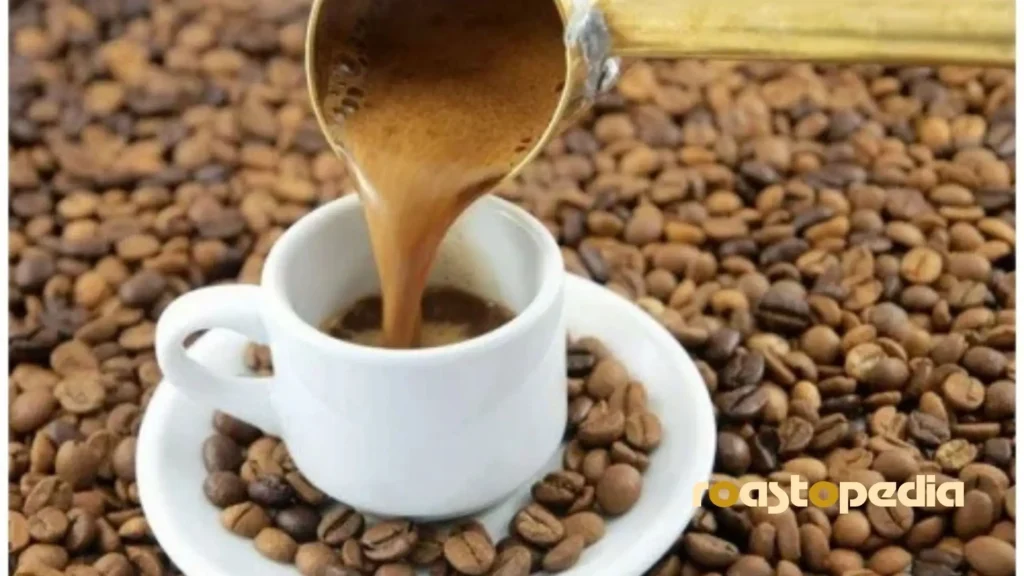
The coffee is particularly associated with Şanlıurfa, Mardin, and Gaziantep provinces — as well as with communities across the Syrian border and among Arab and Kurdish populations of the region.
It is considered one of the most concentrated and bitter coffee preparations in the world, brewed through an extended, multi-hour process that extracts maximum soluble solids from the grounds.
Mirra is deeply embedded in the hospitality culture of the region: to refuse a cup of Mirra is considered a social slight, and guests are expected to drink multiple small servings.
Etymology
Mirra derives from the Arabic word murr (مُرّ), meaning “bitter.” The name is entirely descriptive — Mirra coffee is defined by its extreme bitterness, which is not a flaw but a deliberate characteristic.
In Turkish usage, Mirra has been adapted as a loanword without modification, pronounced with the double-r as in the Arabic source. The beverage is occasionally called murra kahve in mixed Arabic-Turkish usage.
The term has no connection to myrrh (the resin), despite phonetic similarity; myrrh derives from a different Arabic root (murr also, but referring to the resin of Commiphora trees — an etymological coincidence).
The Science of the Brew
Mirra preparation is exceptional for its duration and extraction intensity. Ground dark-roasted coffee (often a coarser grind than that of the standard Türk Kahvesi) is simmered in a dedicated long-handled pot called a dallah or a specialized copper vessel, sometimes for 6–8 hours over low heat, with water added periodically as the liquid reduces.
The result is a hyper-concentrated brew with total dissolved solids (TDS) potentially exceeding 5–6%, compared to ~1.2–1.5% for espresso and ~0.8–1.2% for Türk Kahvesi.
Caffeine content per serving is paradoxically moderate due to the tiny cup size (typically 20–30 ml). The extended brewing drives Maillard and pyrolysis reactions far beyond normal parameters, producing high concentrations of bitter quinolactones, chlorogenic acid lactones, and melanoidins.
Taste & Sensory Profile
Mirra’s flavor profile is dominated by overwhelming, dry bitterness with undertones of dark chocolate, smoked wood, and earth. There is negligible sweetness — Mirra is traditionally consumed without any sugar whatsoever, which is culturally essential to its identity.
Long extraction and high temperature suppress Mirra’s acidity. The consistency is closer to a thick syrup or treacle than a conventional coffee; it coats the palate completely.
The aftertaste is prolonged and intensely bitter, lingering for several minutes. Cardamom is sometimes added in regional variants. The beverage is served in very small handleless cups (fincan or finjal), similar to those used for Arabic coffee.
Variations
Plain Mirra (no additions, most traditional), Mirra with Cardamom (adds aroma and slight sweetness to the bitterness), and lighter Mirra preparations (shorter brewing, less concentrated) are among households without access to the long-form traditional method.
In some Gulf Arab communities, a closely related beverage called Gahwa shares preparation principles but incorporates saffron and cardamom — a sweeter relative of the same long-brew tradition.
Notable Facts
Serving Mirra follows a strict ritual in Şanlıurfa and surrounding areas: the host pours for the most senior guest first, and the cup is refilled continuously until the guest signals they are done by gently shaking the empty cup (wiggling it laterally).
Failing to signal refusal means continued refilling — sometimes leading to consumption of five or more servings.
Mirra pots are often left on low heat throughout the entire day in traditional households, functioning as a perpetual brew that is continuously refreshed by adding water and occasional grounds. Some anthropologists classify
Mirra is a boundary marker between southeastern Turkish coffee culture and the broader Arabic coffee tradition, reflecting centuries of cultural exchange along the Fertile Crescent.
Related Drinks
Türk Kahvesi, Arabic Gahwa (Saudi/Gulf-style), Bedouin coffee, Yemeni Qishr (ginger-spiced coffee husk tea), Ethiopian Buna ceremony coffee.