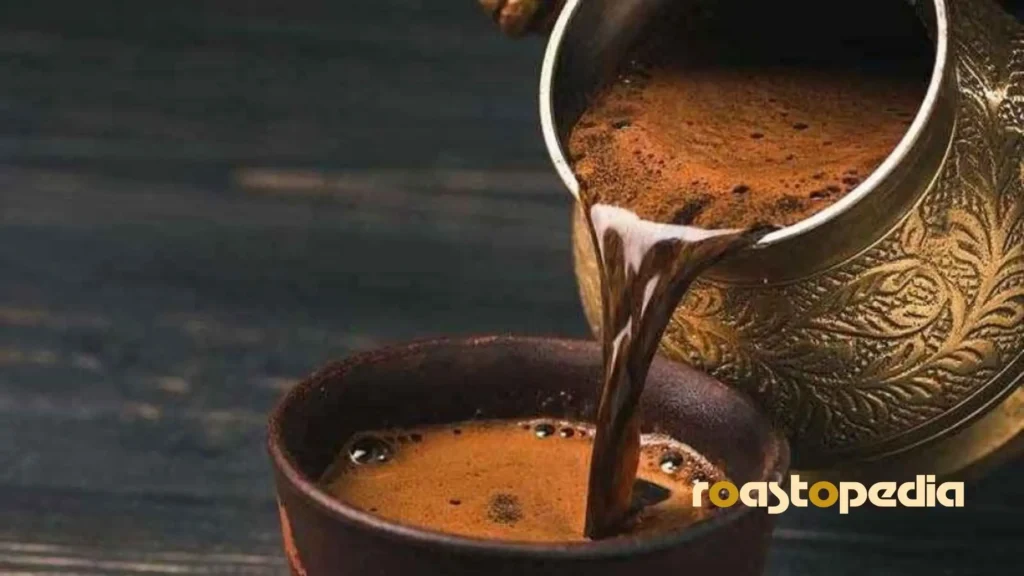
Mastic Turkish Coffee is a specialized preparation of Türk Kahvesi incorporating mastic resin (Pistacia lentiscus var. chia) — a product harvested almost exclusively on the Greek island of Chios, where it has been cultivated and traded since ancient times.
The use of mastic in coffee reflects a centuries-old culinary exchange between Ottoman Anatolia and the Aegean islands, particularly following the Ottoman conquest of Chios in 1566.
Mastic trade was one of the most valuable commercial monopolies in the eastern Mediterranean; the Genoese, and later the Ottomans, heavily regulated production.
Its incorporation into coffee formulas was recorded in 17th-century Ottoman palace records and persisted as a regional specialty through the Aegean littoral and Istanbul’s Greek-influenced neighborhoods (especially Beyoğlu and the Princes’ Islands).
Etymology
The English word mastic derives from the Medieval Latin mastiche, from Greek mastíkhē (μαστίχη), connected to the verb mastichān — “to gnash the teeth” or “to chew” — because mastic was chewed as a breath freshener and digestive aid in antiquity.
The Greek word is also the origin of the English verb “masticate.” In Turkish, the resin is called damla sakızı (“droplet resin”) or simply sakız.
Chios itself is called Sakız Adası (“Resin Island”) in Turkish — the only island in the Ottoman system named after a product rather than a geographic feature, underscoring the commercial importance of mastic.
The Science of the Brew
Chios mastic is composed primarily of alpha-pinene (a monoterpene), beta-myrcene, and the rare triterpene masticadienonic acid, which imparts its characteristic pine-citrus aroma.
These compounds are volatile and heat-sensitive: adding mastic to the cezve during brewing releases the aromatics into the coffee at temperatures between 75–90°C.
A small quantity (1–2 small resin drops per cup) is sufficient — the resin partially dissolves in the hot liquid, dispersing terpenes throughout. Mastic also has demonstrable antimicrobial properties (active against Helicobacter pylori) and anti-inflammatory effects, lending the drink a functional-food dimension beyond flavor.
The fat-soluble aromatics bind to coffee’s lipid fraction, producing a more integrated, lingering aroma than water-soluble spices.
| Compound | Role in Mastic Turkish Coffee |
| Alpha-pinene | Primary aroma: fresh pine, citrus peel |
| Beta-myrcene | Supporting note: earthy, balsamic warmth |
| Masticadienonic acid | Bitter-sweet backbone; anti-inflammatory |
| Polymer (insoluble) | Texturizing agent; mild emulsification |
| Linalool (trace) | Floral, lavender-adjacent softness |
Taste & Sensory Profile
Mastic Turkish Coffee presents the fundamental profile of Türk Kahvesi — earthy, bitter, full-bodied — layered with a distinctive cooling, pine-fresh, slightly citrusy top note. The resin adds a subtle sweetness and a very faint astringency on the finish.
The aroma is immediately recognizable to anyone familiar with Chios mastic products. Mouthfeel is slightly thicker than standard Türk Kahvesi due to partial resin dissolution.
The cooling sensation — similar to but less intense than menthol — makes the drink feel refreshing despite its concentration, an unusual sensory combination.
Variations
Plain Mastic Turkish Coffee (resin only, no other spices), Mastic-Cardamom blend (common in Aegean and Istanbul café versions), Mastic added to Osmanlı Kahvesi base (multiple-spice luxury version), and cold mastic coffee (a modern adaptation where the brewed drink is chilled and served over ice).
Commercial pre-ground Turkish coffees with mastic flavoring are widely sold, though authentic preparations use actual resin pieces.
Notable Facts
Chios mastic tears — the raw resin collected from scored tree bark — were among the most expensive commodities in medieval European trade, listed alongside pepper and saffron in merchant records.
The 21 villages in the southern part of Chios island where mastic is produced are collectively called the Mastichochoria (“mastic villages”) and have an unbroken cultivation history of over 2,500 years.
Mastic production requires scoring individual trees with small iron tools during summer — each tree yields only 60–180 grams of resin annually. The EU granted Chios mastic Protected Designation of Origin (PDO) status in 1997.
Ancient Egyptians used mastic resin in embalming preparations, predating its culinary applications.
Related Drinks
Türk Kahvesi, Osmanlı Kahvesi, Dibek Kahvesi with Mastic, Greek Mastiha liqueur (same resin, alcoholic base), Ayran with Mastic (traditional digestive drink).