
Red Eye Coffee is a high-caffeine American beverage that emerged as a utilitarian solution for long-distance travelers and shift workers in the late 20th century.
While its exact date of invention is difficult to pinpoint due to its grassroots origin, it became a staple of American “diner” and “airport” coffee culture in the 1980s and 1990s.
The drink was designed to solve a specific problem: the perceived “weakness” of standard drip coffee for those facing extreme fatigue.
By combining the volume of a standard drip coffee with the concentrated power of an espresso shot, the Red Eye provided a “supercharged” stimulant that fit into a standard 12-ounce cup.
The drink gained national recognition through the expansion of specialty coffee chains like Starbucks and Peet’s, where it moved from a “secret menu” item to a recognized standard.
It is particularly associated with “red-eye flights”—overnight flights that depart late at night and arrive early the next morning, leaving passengers with the eponymous red, tired eyes. In this context, the Red Eye was not just a drink but a functional tool for biological regulation.
As the “Third Wave” of coffee took hold in the 2000s, the Red Eye was often viewed with skepticism by purists who believed the espresso ruined the nuance of the drip coffee, yet it remains one of the most frequently ordered “off-menu” items in the United States.
Etymology
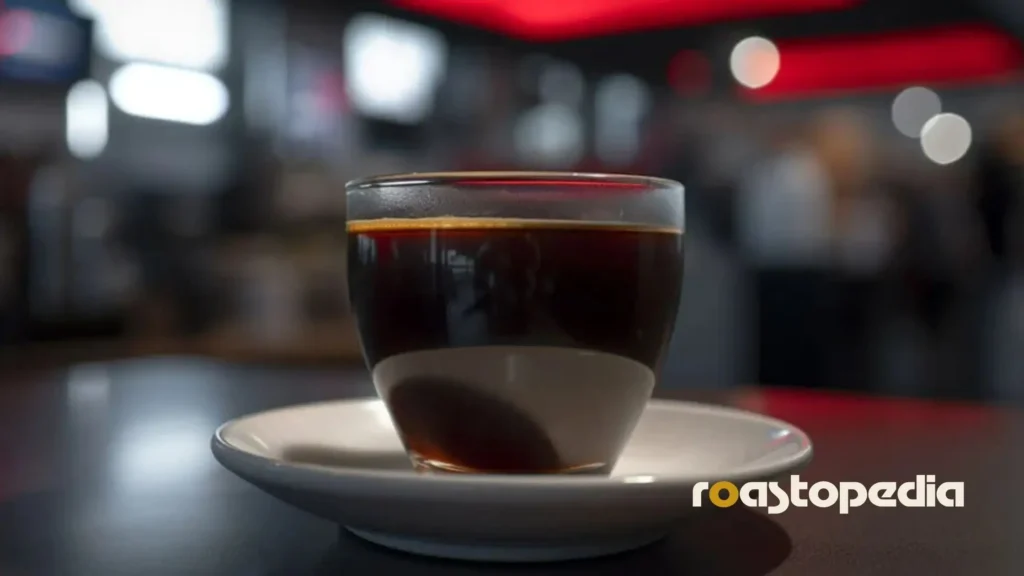
Red Eye’s etymology is directly linked to the commercial aviation industry. A “red-eye flight” is a journey where the passenger is unable to get a full night’s sleep, resulting in bloodshot eyes upon arrival.
The drink was named to signify its role as the cure—or the fuel—for such journeys. The name is part of a broader “eye” taxonomy in American coffee culture, where the intensity of the drink is measured by the number of espresso shots added: one for a “Red Eye,” two for a “Black Eye,” and three for a “Dead Eye.”
In certain regions, particularly in the Northeast, the drink is also known as a “Shot in the Dark,” emphasizing the addition of a dark espresso shot into a lighter pool of drip coffee.
The Science of the Brew
The science of Red Eye Coffee focuses on the “caffeine stacking” of two distinct extraction methods. Drip coffee is an immersion or percolation process that extracts a wide range of soluble solids over 4 to 6 minutes, resulting in a high volume of caffeine (typically 95-150mg).
Espresso is a high-pressure extraction (9 bars) that occurs in 25 to 30 seconds, pulling out a highly concentrated amount of caffeine (63mg per shot) along with intense oils and colloidal solids.
When combined, the Red Eye delivers a total caffeine load of approximately 160mg to 210mg, which is near the maximum recommended single-serving limit for many adults.
Technically, the addition of the espresso shot to the drip coffee also alters the TDS (Total Dissolved Solids) of the beverage. The drip coffee serves as a solvent-rich base, while the espresso adds a layer of emulsified oils and “fines” (micro-particles of coffee) that increase the body and perceived bitterness of the cup.
This “double extraction” creates a chemical profile that is richer in trigonelline and chlorogenic acids than a standard cup, contributing to its intense stimulating effect.
| Extraction Metric | Drip Coffee (Base) | Espresso (Add-on) | Resultant Red Eye |
| Volume | 300 ml | 30 ml | 330 ml |
| Caffeine Content | 120 mg | 64 mg | 184 mg |
| TDS Percentage | 1.25% | 9.0% | ~1.95% |
| Temperature | 85°C | 65°C | ~82°C |
| pH Level | 5.1 | 4.8 | ~5.0 |
| Lipids | Low | High (Crema) | Moderate |
Taste & Sensory Profile
On the sensory profile, Red Eye’s is characterized by “amplified bitterness” and a significant increase in body compared to a standard black coffee. The drip coffee provides a broad, acidic, and often fruity or nutty base, while the espresso shot adds a sharp, intense “punch” of roasted flavors and a syrupy mouthfeel.
The crema from the espresso shot typically dissipates quickly into the larger volume of drip coffee, but it contributes to a lingering, oily finish on the palate. It is a drink of “intensity over nuance,” designed for those who value the tactile and physiological impact of coffee over the delicate aromatics of a single-origin pour-over.
Variations
The primary variations are defined by the number of shots added. The “Red Eye” uses a single shot. The “Black Eye” uses a double shot, providing a significantly darker color and more intense flavor. The “Dead Eye” (or “Green Eye” in Starbucks nomenclature) uses three shots, resulting in a beverage that is nearly 30% espresso by volume.
Another variation is the “Canadiano,” where the espresso is added first, and the drip coffee is poured over it, theoretically preserving more of the crema’s aromatics, though this is rare in American service.
Notable Facts
A little-known fact about the Red Eye is its regional naming variations across the United States. In Alaska, the drink is often called a “Sludge Cup,” referring to the thick, dark nature of the combined brew.
In the Pacific Northwest, it was briefly known as a “Mondo,” a term popularized in the early 90s grunge scene.
From a health perspective, the Red Eye is a subject of interest in “chronobiology” studies; the specific combination of high-volume and high-concentration caffeine makes it more effective at resetting the circadian rhythm than either drink alone, as it provides both an immediate and a sustained caffeine “spike.”
Related Drinks
The Red Eye is the American counterpart to the Australian “Long Black” (espresso over hot water) and the “Americano” (water over espresso).
However, because it uses coffee as the diluent instead of water, it is significantly more potent. It is also structurally related to the “Dirty Chai,” where espresso is added to a tea-based latte.