
Frappuccino is perhaps the most significant commercial innovation in the history of blended coffee, representing the successful fusion of the milkshake and the espresso bar. The drink’s origin is not actually within Starbucks, but rather in a Boston-based coffee chain called The Coffee Connection, founded by George Howell.
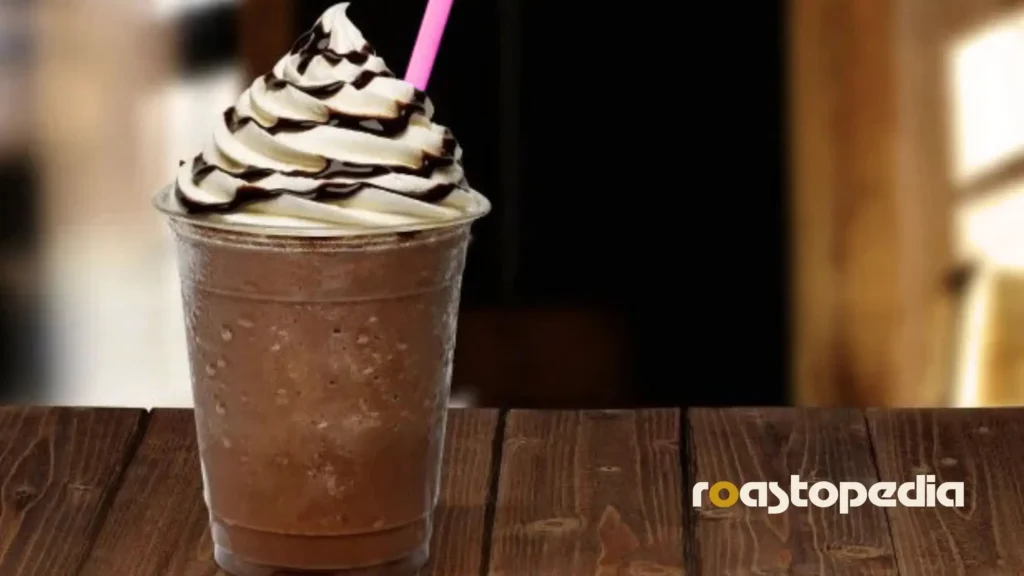
In the early 1990s, Howell’s employee, Andrew Frank, developed a recipe for a “frozen cappuccino” using a soft-serve ice cream machine to achieve a smooth, consistent texture.
Howell, a “Third Wave” pioneer, was initially skeptical of the sugary concoction but trademarked the name “Frappuccino”—a portmanteau of “frappé” (the French-inspired New England term for a thick milkshake) and “cappuccino.”
In 1994, Starbucks purchased The Coffee Connection for $23 million, primarily to acquire Howell’s locations in the Boston area, but the Frappuccino trademark was the unexpected “diamond in the rough.”
Starbucks CEO Howard Schultz recognized the drink’s potential as a “gateway beverage” for younger consumers and those who found traditional coffee too bitter.
The Starbucks R&D team, led by Dan Moore, spent months reformulating the recipe to be reproducible in thousands of stores without the need for bulky soft-serve machines.
They developed a “base syrup” containing emulsifiers that allowed the ice, milk, and coffee to blend into a stable slurry. The national rollout in 1995 was a transformative success, increasing Starbucks’ summer sales by over 20% and spawning an entire category of “blended coffee” that now dominates the global fast-casual market.
Etymology
The etymology of “Frappuccino” is a linguistic hybrid that reflects its dual heritage. The prefix “Frappé” comes from the French frapper, meaning “to hit” or “to chill,” but in the context of New England (where the drink was born), a “frappé” specifically refers to a thick milkshake made with ice cream, as opposed to a “milkshake,” which in Boston parlance is just shaken milk and syrup.
The suffix “-uccino” is taken from “cappuccino,” the traditional Italian beverage of espresso and foamed milk. The name was intended to give a sense of European sophistication to what was essentially a cold, blended dessert.
Today, “Frappuccino” is a legally protected trademark of Starbucks, though it has become a “genericized” term in common parlance for any blended coffee drink.
The Science of the Brew
The science of the Frappuccino is a study in “emulsion stability” and “viscosity management.” The primary technical challenge of a blended coffee drink is preventing the “separation” of the ice from the liquid. Without a stabilizing agent, a blended coffee would quickly turn into a layer of watery ice floating atop a pool of syrup.
Frappuccino solves this through the use of a “base syrup” containing xanthan gum or pectin. These hydrocolloids act as thickeners and emulsifiers, trapping the air and tiny ice crystals in a viscous matrix that mimics the mouthfeel of heavy cream.
The coffee component of a Frappuccino is not standard drip coffee or fresh espresso, but a “Frap Roast”—a concentrated, dehydrated coffee powder reconstituted with cold water. This is a technical necessity; hot espresso would melt the ice too quickly, leading to a thin, watery texture.
The high sugar content (often exceeding 50 grams per serving) is chemically necessary to depress the freezing point of the mixture, ensuring it remains “slushy” rather than freezing into a solid block.
| Ingredient / Property | Technical Role | Primary Component |
| Emulsifier | Suspension Stability | Xanthan Gum |
| Coffee Base | Concentrated Flavor | “Frap Roast” (Spray-dried) |
| Sweetener | Freezing Point Depression | Sucrose / Fructose |
| Dairy Component | Lipid Richness | Whole Milk (Standard) |
| Overrun | Aeration Percentage | 15% – 25% |
| Temperature | Phase Maintenance | -2°C to -4°C |
Taste & Sensory Profile
One of the things people appreciate about Frappuccino is its sensory profile, which is dominated by “sweetness” and “coldness,” with the coffee acting as a background aromatic rather than the primary flavor.
The initial sensation is one of extreme smoothness and “creaminess,” a result of the xanthan gum emulsion. The “Frap Roast” provides a dark, slightly toasted, and caramelized flavor that cuts through the sugar.
Because the beverage is served at sub-zero temperatures, the “perceived bitterness” of the coffee is significantly reduced, allowing for a much higher consumption rate. The finish is cloying and sweet, often enhanced by the addition of whipped cream and flavored drizzles, which add layers of “textural contrast.”
Variations
The Frappuccino has expanded into two distinct branches: Coffee-based and Cream-based (coffee-free). Coffee-based variations include the “Caramel Frappuccino,” “Mocha Frappuccino,” and the “Java Chip,” which adds semi-sweet chocolate chips for textural “crunch.”
Cream-based versions, such as the “Vanilla Bean” or “Strawberries and Crème,” cater to non-coffee drinkers. In international markets, the Frappuccino is used as a vehicle for regional flavors, such as the “Red Bean Frappuccino” in China or the “Matcha Frappuccino” in Japan.
Modern variations also include “Light” versions (using erythritol and non-fat milk) and plant-based versions using oat or coconut milk.
Notable Facts
A little-known fact about the Frappuccino is its “thermodynamic efficiency.” Because of the high sugar and fat content, a Frappuccino retains its “slush” state for nearly 30 minutes in a standard plastic cup, whereas a simple blended iced coffee would separate in less than five.
Additionally, George Howell, the original creator of the name, famously hates the modern version of the drink; he has called it a “milkshake for people who don’t like coffee,” even though the sale of the name funded his later specialty coffee ventures.
From a nutritional science perspective, a “Grande” Frappuccino can contain more calories than a double cheeseburger, a fact that led to the “Frappuccino tax” discussions in various health-conscious municipalities.
Related Drinks
The Frappuccino is the direct descendant of the Greek “Frappé” (shaken instant coffee) and the Italian “Granita di Caffè.” It is functionally related to the “Smoothie” and the “Slushie,” but distinguished by its coffee-based emulsion.
It serves as the “Americanized” version of the “Affogato,” replacing the elegant scoop of gelato with a blended, stabilized slurry.