
Coffee pulp, also known by its Spanish name cascara (meaning “husk” or “peel”), is the outer skin and fleshy mesocarp of the coffee cherry that is separated from the coffee bean (seed) during processing. Historically treated as an agricultural by-product and disposal problem, cascara has increasingly been valorized as a raw material for beverages, food ingredients, animal feed, biofuel, and other industrial applications, driven by growing interest in the circular economy and food-waste reduction. Dried and steeped as an infusion, cascara is also marketed directly to consumers as “coffee cherry tea” or “coffee fruit tea.”
Terminology
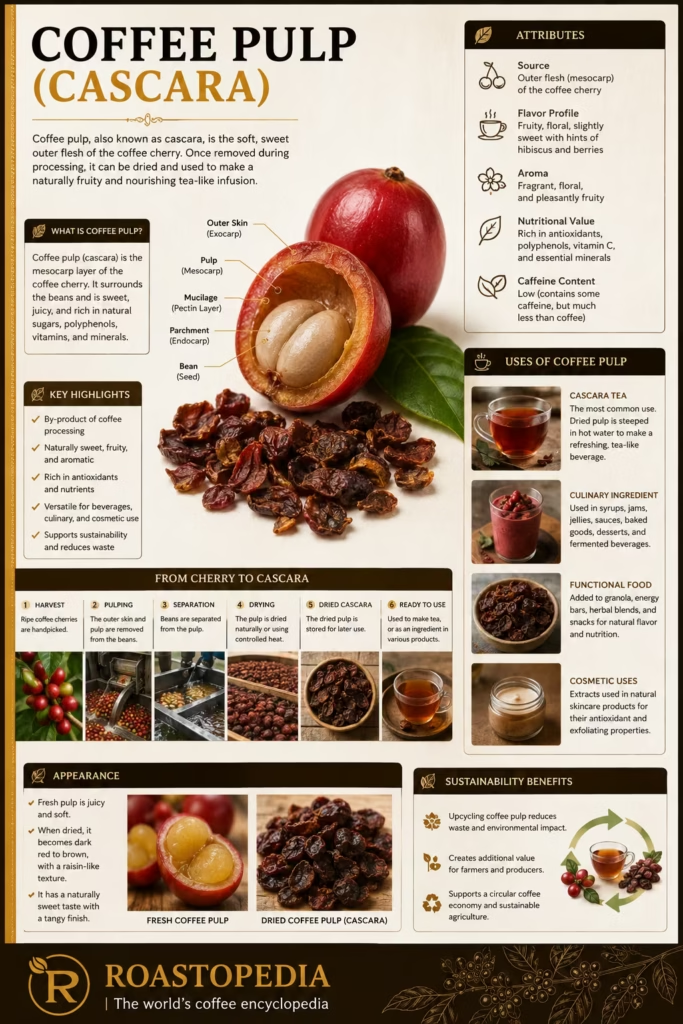
The coffee cherry (see the Anatomy of the Coffee Cherry) consists of several layers: an outer skin (exocarp), a fleshy pulp (mesocarp), a mucilaginous layer, a parchment husk (endocarp), a silverskin, and finally the bean itself. Terminology varies by region, processing method, and end use:
- Coffee pulp or cascara most often refers to the skin and mesocarp removed during wet (washed) processing.
- Coffee husk typically refers to the dried outer covering removed during dry (natural) processing, when the whole cherry is sun-dried before hulling.
- Cascara is also used more broadly in the specialty coffee trade to describe the dried cherry skins used to brew an infused beverage, regardless of the processing method that produced them.
Together, the pulp, mucilage, and husk account for roughly 40–50% of the fresh cherry’s weight, meaning that for every kilogram of green coffee produced, close to a kilogram of pulp or husk residue is generated.
History
Cascara has a long history of informal, traditional use in coffee-growing communities, predating its recent popularity in specialty coffee markets. In Yemen, it is known as qishr and has traditionally been brewed as a spiced beverage, sometimes combined with ginger and other spices.
Similar traditional uses have been documented in Ethiopia, the birthplace of coffee cultivation, and in parts of Bolivia and other Latin American coffee-growing regions. Its adoption by specialty coffee roasters and cafés in North America, Europe, and elsewhere in the 2010s and 2020s reflects a broader trend toward reducing food waste and finding new markets for agricultural by-products.
Production and Processing
Coffee cherries are processed by one of two principal methods, and the by-product generated differs accordingly.
Wet (washed) Processing
In wet processing, ripe cherries are mechanically pulped shortly after harvest, separating the skin and pulp from the bean while it is still enclosed in mucilage and parchment. This method is used primarily for Coffea arabica and produces higher-quality “mild” coffees, but it is water- and energy-intensive and generates large volumes of pulp along with highly polluting wastewater (sometimes called “honey water,” or aguas mieles) with high biochemical and chemical oxygen demand.
Dry (natural) Processing
In dry processing (natural), used mainly for Coffea canephora (robusta), whole cherries are sun-dried before the outer husk and parchment are removed in a single hulling step. This method is simpler, less water-intensive, and generally less polluting than wet processing, but it yields a different by-product, coffee husk, and takes longer.
Drying and Stabilization of Cascara
Fresh coffee pulp has high moisture and sugar content and spoils quickly, so for use in beverages and food products it must be dried promptly, typically by sun-drying or mechanical drying to a stable moisture level. Drying method and duration significantly affect the final composition, color, and antioxidant content of the dried cascara, as does the ripeness of the cherries at harvest and the coffee variety.
Composition
Cascara is a nutrient- and phytochemical-dense material. Reported composition figures vary with geography, variety, ripeness, and processing, but cascara typically contains approximately 50% carbohydrates, 20% dietary fiber, 10% protein, 2.5% fat, and around 1.3% caffeine by dry weight, along with minerals and a range of bioactive polyphenols.
Key bioactive compounds identified in cascara include:
- Chlorogenic acid, generally the predominant phenolic compound, along with other hydroxycinnamic acid derivatives.
- Flavonoids, including catechins, proanthocyanidins, and flavonol glycosides such as dihydromyricetin derivatives.
- Alkaloids, notably caffeine, trigonelline, and theobromine.
- Phenolic acids, such as gallic and protocatechuic acid.
- Pectic polysaccharides, which have been extracted and characterized from cascara and are of interest for use as gelling or thickening agents.
Because composition is influenced by so many variables, researchers have noted that this variability complicates efforts to standardize cascara-based products for functional-food or nutraceutical markets.
Coffee Pulp Uses
These are the common uses of coffee pulp:
Cascara Beverage
The best-known consumer application of coffee pulp is cascara as a brewed infusion, sometimes described as “coffee cherry tea.” Dried cascara husks are steeped in hot or cold water, similar to loose-leaf tea, producing a lightly caffeinated, fruity, tea-like beverage. Cascara has long been consumed traditionally in coffee-growing regions of Ethiopia, Yemen, and Bolivia, and it has more recently gained popularity in specialty coffee markets in Europe and North America, where it is sold as loose dried cherry, syrups, and ready-to-drink beverages.
Food Ingredient
Dried and milled cascara can be incorporated into food products as a flour substitute or functional ingredient. Studies have shown that coffee cherry flour can replace a portion of wheat flour, commonly cited at up to around 15%, in baked goods such as bread and biscuits without substantially compromising baking performance or sensory qualities. Cascara has also been used experimentally to produce juice, jam, jelly, purée, and fermented products such as kombucha and water kefir.
Animal Feed
Coffee pulp and husk have long been explored as ingredients in animal feed, particularly for ruminants, owing to their fiber and carbohydrate content. However, their caffeine and tannin content can limit palatability and digestibility, so pulp is often composted, fermented, or otherwise treated before use as feed.
Soil Amendment and Composting
Because raw pulp is high in organic matter, it is widely used as compost or mulch on coffee farms. Composting or vermicomposting reduces caffeine and tannin content, making the resulting material more suitable as a soil amendment and reducing the risk of phytotoxicity associated with fresh pulp application.
Bioenergy and Industrial Applications
Coffee pulp and husk have been investigated as feedstocks for biogas production via anaerobic digestion, for solid biofuel (briquettes and pellets), and for biochar and hydrochar production. Coffee-pulp-derived biochars have shown promise as low-cost biosorbents for removing polyphenols, dyes, and pesticides from wastewater. Other studied applications include use in bioethanol production, as a substrate for mushroom cultivation, and as a source of pectin and other extractable polysaccharides for industrial use.
Regulatory Status
In the European Union, dried coffee cherry pulp was granted novel food approval, permitting its use specifically in non-alcoholic beverages. Broader commercial use of other cascara-derived products in the EU has been constrained by the absence of novel food approvals covering those additional applications, along with a lack of comprehensive risk-assessment data on some bioactive constituents.
Because caffeine content is considered the primary limiting factor for consumer safety, researchers have derived recommended safe-intake levels for different age groups, concluding that even adolescents could consume modest quantities of cascara-based products without expected adverse effects.
Environmental Impact and Waste Management
Coffee is cultivated in roughly 80 countries and is one of the most widely traded agricultural commodities, and coffee processing generates an enormous volume of by-product biomass. Only about 5–10% of the coffee cherry’s mass ends up in the final brewed beverage, meaning that pulp and husk together can represent the majority of harvested cherry weight.
Estimates suggest that global coffee production and consumption generate on the order of billions of tons of solid coffee waste over time, with coffee husk alone estimated at around ten million tons annually.
Improper disposal of coffee pulp, husk, and wet-processing wastewater poses meaningful environmental risks. Because pulp contains caffeine and tannins, its direct dumping into waterways or onto land can be toxic to aquatic organisms and can degrade water and soil quality; wet-processing wastewater is characterized by high biochemical and chemical oxygen demand and low pH.
These concerns have driven interest in valorization strategies, such as those described above, that convert cascara from an environmental liability into a marketable resource, consistent with circular-economy principles applied to agricultural by-products.
Potential Health Effects
Preliminary in vitro research has attributed several potentially beneficial biological activities to cascara extracts, including antioxidant, anti-inflammatory, antibacterial, and lipid-metabolism-related effects, generally linked to its phenolic and flavonoid content. Cascara extracts have also shown antimicrobial activity against some drug-resistant bacterial pathogens in laboratory studies.
As with many functional-food ingredients derived from by-products, most evidence to date comes from in vitro or preclinical studies, and cascara’s caffeine content remains the main safety consideration for human consumption, particularly for children, pregnant individuals, and people sensitive to caffeine.
See Also
References
- Phenolic Acid Composition of Coffee Cascara in Connection with Antioxidant Capacity: A Geographic Assessment. PMC. https://www.ncbi.nlm.nih.gov/pmc/articles/PMC12108463/
- Heeger, A., et al. Risk Assessment of Coffee Cherry (Cascara) Fruit Products for Flour Replacement and Other Alternative Food Uses. Molecules, 27(23), 8435 (2022). https://www.mdpi.com/1420-3049/27/23/8435
- Bioactives of coffee cherry pulp and its utilisation for production of Cascara beverage. Food Chemistry (2016), via ScienceDirect. https://www.sciencedirect.com/science/article/abs/pii/S0308814616319161
- Bioactives of coffee cherry pulp and its utilisation for production of Cascara beverage. PubMed. https://pubmed.ncbi.nlm.nih.gov/27979301/
- Coffee Cascara as a Source of Natural Antimicrobials: Chemical Characterization and Activity Against ESKAPE Pathogens. PMC. https://www.ncbi.nlm.nih.gov/pmc/articles/PMC12898695/
- Chemical Characteristics of Cascara, Coffee Cherry Tea, Made of Various Coffee Pulp Treatments. IOP Conference Series: Earth and Environmental Science (2021). https://iopscience.iop.org/article/10.1088/1755-1315/709/1/012030
- Waste Water Management in Wet Coffee Processing Mills and their Impact on the Water Quality Status of Gidabo River and its Tributaries, Southern Ethiopia. PMC. https://pmc.ncbi.nlm.nih.gov/articles/PMC11181887/
- Utilization of Coffee Husk and Pulp Waste as Soil Amendment: A Review. Semantic Scholar / ResearchGate. https://www.researchgate.net/publication/377382701_Utilization_of_Coffee_Husk_and_Pulp_Waste_as_Soil_Amendment_A_Review
- Bioactive compounds in coffee husk: extraction, functional properties, applications, and sustainable approach in circular economy. RSC Sustainability (2025). https://pubs.rsc.org/en/content/articlehtml/2025/su/d5su00531k
- Optimizing the functional quality of coffee (Coffea arabica cv. ‘Catidiaf 21′) Pulp: Impact of cultivation system, ripening stage, and drying method on valorization for food industry applications. ScienceDirect (2026). https://www.sciencedirect.com/science/article/pii/S2772502226000466
- An Overview of the Potential Uses for Coffee Husks. In Coffee in Health and Disease Prevention, Chapter 31. https://pages.uoregon.edu/chendon/coffee_literature/old_literature/2015%20Coffee%20in%20Health%20and%20Disease%20Prevention,%20Chapter%2031,%20Uses%20for%20coffee%20husks.pdf
- Coffee pulp and husk-derived hydrochars and biochars adsorb polyphenols and pesticides from wastewater. ScienceDirect (2026). https://www.sciencedirect.com/science/article/pii/S2352186425007254
- Coffee processing waste: Unlocking opportunities for sustainable development. ScienceDirect (2024). https://www.sciencedirect.com/science/article/pii/S1364032124009894