
When used in coffee roasting, caramelization refers to a thermal breakdown of sugars — mainly sucrose, which constitutes roughly 6–8% of a green coffee bean’s dry weight. The chemical reaction transforms green coffee into roasted beans. As beans heat during roasting, this sugar melts, breaks apart, and recombines into hundreds of new aromatic compounds.
When Does Caramelization Begin?
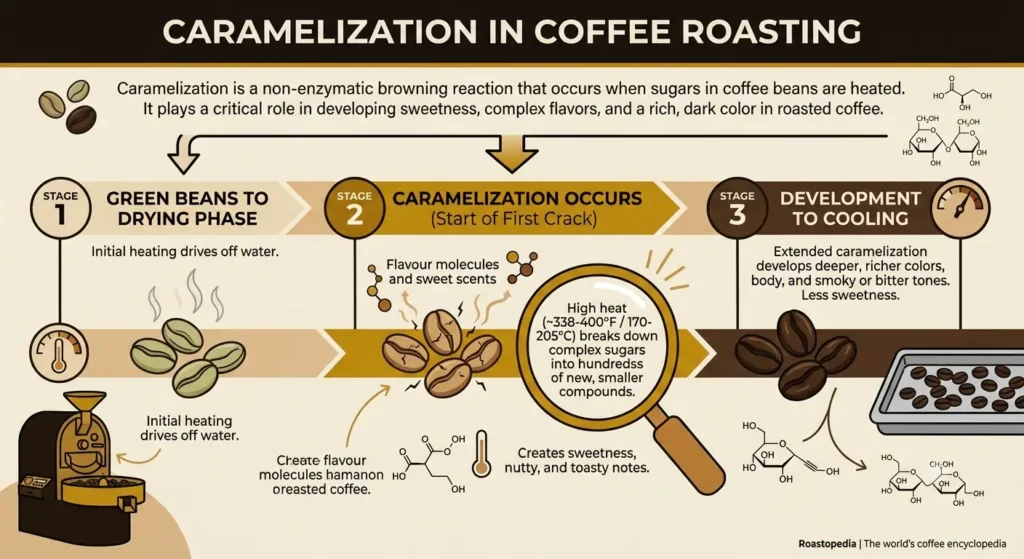
Caramelization typically begins once beans reach approximately 170°C (338°F), though the exact onset varies depending on the rate of temperature increase. A slower heating rate can trigger caramelization slightly earlier, while a faster, more aggressive roast can push the threshold higher. Once initiated, the reaction is progressive: it continues to intensify for as long as heat is applied, until the roast is terminated or the sugars are fully degraded into carbon.
Notably, caramelization does not increase perceived sweetness; it reduces it. As sugar molecules degrade, they lose their original sweet character and are replaced by new, more complex compounds associated with caramel, toffee, toasted marshmallow, and brown-sugar flavors, and, if the reaction progresses further, bitter and smoky notes. For this reason, caramelization functions as a balance point in roasting: a limited degree of caramelization contributes sweetness and depth, while excessive caramelization eliminates sweetness altogether.
Caramelization vs. Maillard Reaction
Caramelization and the Maillard reaction occur during overlapping stages of the roast, and both contribute to browning and flavor development, but they are chemically distinct processes.
- Reactants involved: The Maillard reaction requires reducing sugars and amino acids (proteins) reacting together under heat. Caramelization involves sugars alone; no protein is required.
- Onset temperature: The Maillard reaction generally begins earlier, at approximately 140–165°C (284–330°F). Caramelization begins later, once beans exceed roughly 170°C (338°F).
- Sequence in the roast: Maillard browning dominates the early and middle stages of roasting — the browning phase preceding first crack — while caramelization becomes more prominent as the roast progresses toward and through first crack.
- Flavor contribution: The Maillard reaction is largely responsible for the nutty, toasted, bready, and savory-roasted notes in coffee, along with the formation of melanoidins — large brown pigment compounds that add body and color. Caramelization contributes sweet, caramel, toffee, and brown-sugar notes, along with additional fruit-like aromatic byproducts, though it can also generate bitterness as it progresses.
- Overlap: Because both reactions occur concurrently for much of the roast, coffee’s final flavor profile reflects a combination of the two rather than either reaction in isolation.
In summary: the Maillard reaction involves sugar and protein and produces predominantly savory, roasted notes, while caramelization involves sugar alone and produces predominantly sweet, caramel-type notes that can shift toward bitterness as the reaction progresses.
Caramelization and Coffee Roast Levels
How far caramelization is allowed to progress is one of the biggest levers a roaster has for shaping flavor — and it lines up closely with the light, medium, and dark roast spectrum.
- Light roast (ending around first crack, ~196–204°C / 385–400°F): Caramelization has only just begun. Much of the coffee bean’s original sucrose remains intact, which is why light roasts tend to taste brighter, more acidic, and closer to the coffee’s origin character — florals, fruit, citrus — with only a hint of sweetness from early caramelization.
- Medium roast (past first crack, before second crack, ~210–221°C / 410–430°F): Caramelization is well underway. This is where the classic “caramel,” brown sugar, and light chocolate notes most people associate with coffee really emerge, alongside a fuller body and softened acidity. It’s considered the roast level with the best balance between origin character and roast-developed sweetness.
- Dark roast (through and beyond second crack, ~221–249°C / 430–480°F): Caramelization is extensive — most of the bean’s sucrose has been converted or broken down entirely. Rather than tasting sweeter, dark roasts often taste less sweet and more bitter, smoky, and bold, since the sugars have essentially been “spent” and pyrolysis (charring) starts to take over. Acidity drops sharply and origin character fades behind roast-driven flavor.
Roasters sometimes use tools like the Agtron scale — an infrared reflectance measurement that specifically targets sucrose caramelization — to quantify roast degree more precisely than color alone allows, since caramelization level correlates directly with flavor development.
See Also
References
- Sweet Maria’s Coffee Library — library.sweetmarias.com
- Perfect Daily Grind — perfectdailygrind.com
- Coffee Bros. — coffeebros.com
- MTPak Coffee — mtpak.coffee
- Specialty Coffee Association (SCA) — sca.coffee
- National Coffee Association (NCA) — ncausa.org
- Verena Street Coffee Roasters — verenastreet.com
- Seelaz Coffee Academy — seelaz.com
- Cafe Serre — cafeserre.com
- Coffee Gear Hub — coffeegearhub.com
- Ally Open Coffee Blog — allyopen.com
- Coffee Sapiens — coffeesapiens.org
- Journal of Agricultural and Food Chemistry (American Chemical Society) — pubs.acs.org