
Catuai (also spelled Catuaí) is a cultivar of Coffea arabica, the species responsible for the majority of the world’s specialty and commercial Coffee Bean supply. It is not a wild or naturally occurring botanical variety; it was deliberately bred, meaning it qualifies as a cultivar rather than a variety in the strict botanical sense, though the coffee trade frequently uses the two terms interchangeably. Catuai belongs entirely to the Arabica lineage and has no genetic relationship to Robusta (Coffea canephora), a separate species within the genus Coffea. Catuai coffee is one of the most widely planted cultivars in Latin America and is commercially significant across Brazil, Central America, and Colombia.
Origin and Development
Catuai was developed by Brazil’s Instituto Agronômico de Campinas (IAC) beginning in 1949, through a controlled cross between Bourbon-derived Mundo Novo and yellow Caturra, itself a compact natural mutation of Bourbon. The cross was initially designated H-2077 and underwent more than two decades of pedigree selection before its official release for commercial cultivation in Brazil in 1972. The name derives from the Tupi-Guarani expression catu’a, meaning “very good.”
Because both of its parent lines trace back to Typica and Bourbon, the two founding groups from which nearly all catalogued Arabica cultivars descend, Catuai is considered a direct descendant of the two most genetically significant lineages in Coffee Plant breeding history.
Botanical and Agronomic Characteristics
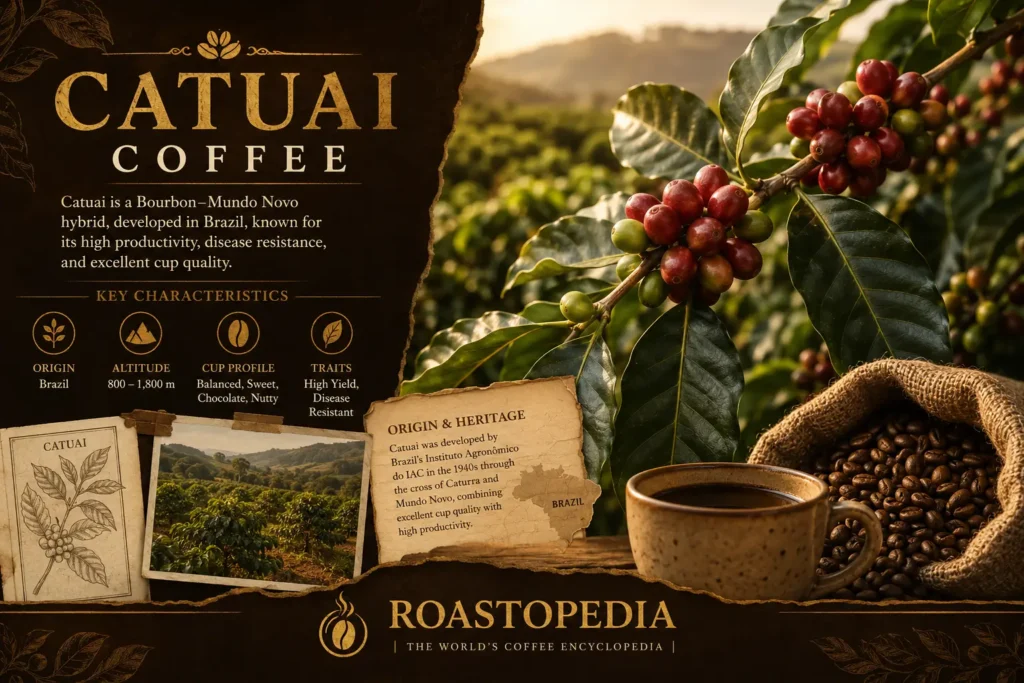
A Catuai coffee plant is generally a semi-dwarf, compact plant, a trait inherited from its Caturra parent, combined with the vigor and productivity of Mundo Novo. Its short stature and dense lateral branching allow it to be planted at high density, which contributed to the intensification of full-sun coffee farming across Central America during the 1970s and 1980s.
The plant typically begins bearing fruit around its third year and performs best at elevations between roughly 800 and 1,800 meters above sea level, with Altitude and Terroir together shaping much of its eventual cup character. Catuai tolerates strong wind and heavy rainfall well, but it shows high susceptibility to coffee leaf rust and coffee berry disease, requiring active disease management, particularly in humid growing regions.
Yellow and Red Catuai
Catuai exists in two principal color selections, distinguished by the ripening color of the Coffee Cherry: Red Catuai and Yellow Catuai. Yellow Catuai coffee ripens to a bright yellow rather than the deep red typical of most Arabica cultivars, a trait shared with its yellow Caturra parent.
Numerous sub-lines exist within each color group, including IAC-44, IAC-74, IAC-86, Catuai SH3, and Catuai 99, developed through continued selection in Brazil and beyond. Blind cupping evaluations have generally found no consistent, discernible flavor distinction attributable to cherry color alone; differences in cup quality are more strongly linked to growing altitude, Terroir, and post-harvest handling than to whether a lot is classified as red or yellow Catuai.
Cultivation and Global Distribution
Brazil remains the primary home of Catuai, where it accounts for a substantial share of national Arabica production and is cultivated widely as Estate Coffee across Minas Gerais, São Paulo, and Bahia. Catuai spread beyond Brazil starting in 1970, when it was introduced to Guatemala, where it now represents roughly one-fifth of national output. It was later established in Honduras and, in 1985, in Costa Rica, where it remains economically important alongside Caturra.
Catuai coffee also appears, to a lesser extent, in Colombia, Nicaragua, and parts of Indonesia. Where sustainable farming practices are followed, Catuai is also grown under certified Organic Coffee programs, particularly on smaller family-run farms.
Processing and Flavor Profile
Catuai adapts well to washed, natural, and honey processing, and each method produces a distinct expression of the cultivar. Washed yellow Catuai, produced by removing the cherry skin and pulp before drying, tends to emphasize clarity, brighter acidity, and a cleaner cup, a style favored in much of Central America. Natural, or dry-processed, Catuai, more common in Brazil, is dried with the fruit intact and typically produces greater sweetness, body, and fruit-forward character.
In the cup, Catuai is generally described as balanced and reliable rather than exceptional, with moderate Coffee Acidity, medium body, and a Coffee Aroma frequently associated with chocolate, caramel, nuts, and light spice. Yellow Catuai coffee is often noted for a slightly softer body and gentler acidity compared with Red Catuai, though these distinctions narrow considerably once altitude and processing are accounted for. A light-to-medium Coffee Roast Level is generally recommended to preserve these characteristics.
Significance in the Coffee Industry
For decades, Catuai was valued chiefly for productivity, disease tolerance relative to its parents, and suitability for mechanized or high-density farming rather than for exceptional cup quality. That reputation has shifted somewhat in recent years, as well-managed Estate Coffee lots of Catuai, particularly from Brazil, have placed in Cup of Excellence competitions and other quality-focused evaluations, prompting renewed interest from specialty roasters.
Catuai also functions as a foundational parent in ongoing breeding programs, where it is crossed with disease-resistant lines such as Timor Hybrid in efforts to combine its yield and compact growth with stronger rust resistance.
See Also
- Caturra
- Bourbon
- Geisha Coffee
- Cultivar
- Coffea arabica (Arabica)
- Terroir
- Washed Process (Wet Process)
- Natural Process (Dry Process)
- Coffee Acidity
References
- World Coffee Research. “Catuai.” Arabica Coffee Varieties Catalog, varieties.worldcoffeeresearch.org.
- World Coffee Research. “Caturra.” Arabica Coffee Varieties Catalog, varieties.worldcoffeeresearch.org.
- Specialty Coffee Association (SCA). “Coffee Varieties and Cultivars: Terminology Standards,” sca.coffee.
- International Coffee Organization (ICO). “Botany of the Coffee Plant,” icocoffee.org.
- Instituto Agronômico de Campinas (IAC). “Programa de Melhoramento Genético do Café,” iac.sp.gov.br.
- Davis, A.P., Govaerts, R., Bridson, D.M., & Stoffelen, P. (2006). “An Annotated Taxonomic Conspectus of the Genus Coffea (Rubiaceae).” Botanical Journal of the Linnean Society.
- Wintgens, J.N., ed. (2004). Coffee: Growing, Processing, Sustainable Production. Wiley-VCH.
- Perfect Daily Grind. “Exploring the Catuai Coffee Variety,” perfectdailygrind.com.
- Daily Coffee News. “The Coffee Roaster’s Complete Guide to Coffee Varieties and Cultivars,” dailycoffeenews.com.
- Instituto Hondureño del Café (IHCAFÉ). “Variedades de Café Cultivadas en Honduras,” ihcafe.hn.
- Instituto del Café de Costa Rica (ICAFE). “Variedades de Café en Costa Rica,” icafe.cr.
- Anacafé (Asociación Nacional del Café, Guatemala). “Variedades de Café,” anacafe.org.
- Food and Agriculture Organization of the United Nations (FAO). “Coffee Crop Information,” fao.org.
- Royal Botanic Gardens, Kew. “Coffea arabica.” Plants of the World Online, powo.science.kew.org.