
Among espresso-based coffee drinks, the cortado is considered to occupy a distinctive position for preserving the character of espresso while tempering it with only a modest amount of steamed milk.
What is a Cortado?
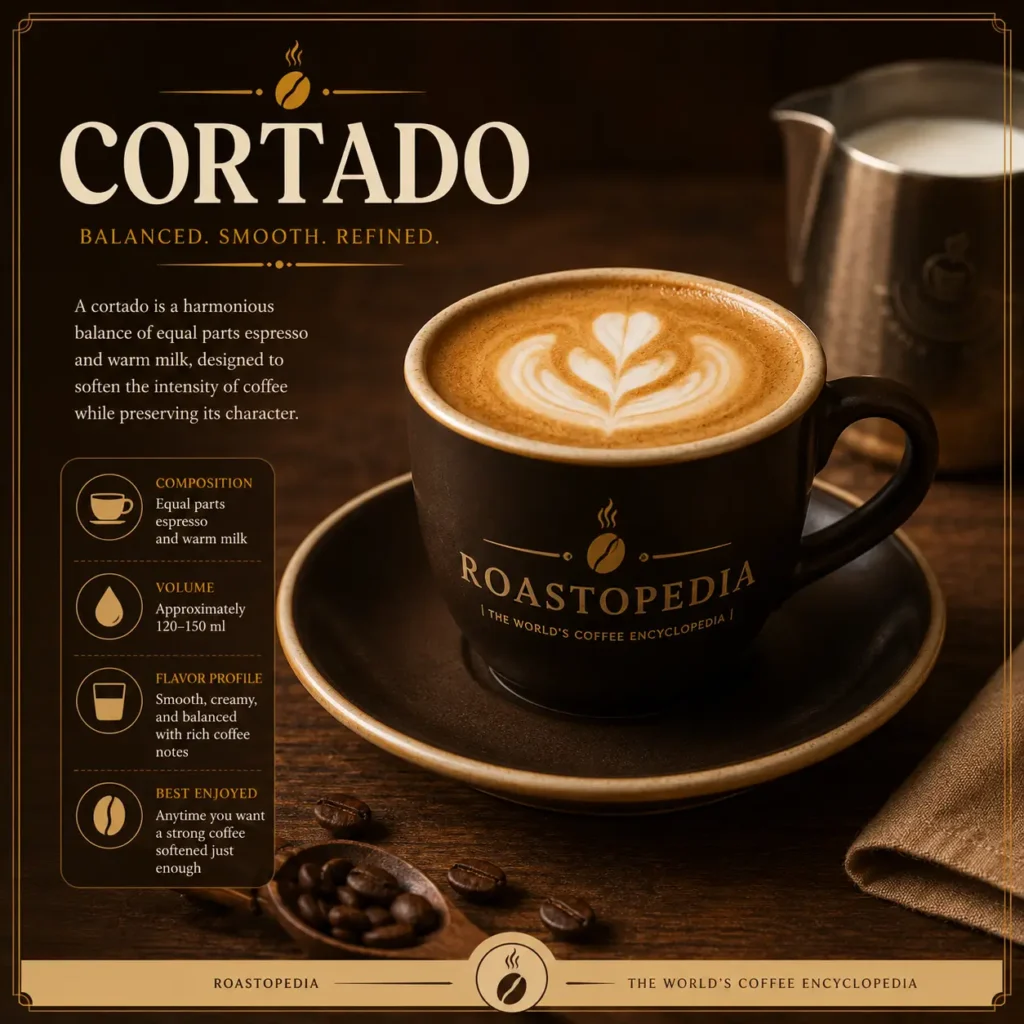
A cortado is a small, balanced espresso drink made by “cutting” a shot of espresso with a roughly equal amount of warm, lightly steamed milk. The result sits in the space between a straight café solo and a milkier caffè latte: strong enough to showcase the espresso’s flavor, yet softened just enough that the acidity and bitterness fade into the background. Born in Spain and carried across the Atlantic by colonization and migration, the cortado has become one of the most requested drinks on modern specialty-coffee menus, prized for its compact size and its refusal to let milk dominate the cup.
Infobox (At a Glance)
| Attribute | Detail |
| Origin | Spain (Basque Country) |
| Type | Espresso-based, milk-forward |
| Primary Ingredients | Espresso, steamed milk |
| Standard Ratio | 1:1 espresso to milk |
| Typical Volume | 4–4.5 oz (120–135 ml) |
| Serving Vessel | Small glass, often with a metal ring base |
| Foam Level | Minimal to none |
| Serving Temperature | Warm, not scalding |
| Related Drinks | Macchiato, Piccolo Latte, Flat White |
Etymology
The name cortado comes from the Spanish verb cortar, meaning “to cut.” In this context, the milk is understood to “cut” the intensity of the espresso, tempering its sharpness without erasing its character. Regional cousins of the word appear throughout the Spanish- and Portuguese-speaking world: Catalan speakers say tallat, the closest Basque term is ebaki, and in Portugal the drink is called pingado or garoto, all carrying a similar “cut” or “spotted” meaning.
History
Coffee historians generally trace the cortado’s roots to Spain’s Basque Country in the early-to-mid 20th century, where it grew out of a broader Spanish coffee culture already offering both the milk-heavy café con leche and the unadulterated café solo. The cortado settled neatly in between the two. From the Basque Country, it spread across the Iberian Peninsula, reaching Portugal easily thanks to shared culinary traditions on the peninsula.
Spanish and Portuguese colonization then carried the drink across the Atlantic. In Cuba, where fresh milk was historically harder to come by than preserved sugarcane products, the recipe evolved into the sweetened cortadito, made with condensed milk rather than fresh steamed milk. When Cuban communities settled in cities such as Miami in the mid-20th century, they brought the cortadito with them, cementing it as a fixture of Cuban-American coffee culture.
The drink’s modern American identity owes a great deal to San Francisco’s early-2000s specialty coffee scene. A barista at Blue Bottle Coffee began serving a cortado-style drink in a small 4.5-ounce Libbey glass originally intended for cupping, naming the beverage “Gibraltar” after the glass itself. The style spread to other West Coast roasters and eventually to New York cafés, and by the drink’s third decade on menus, “cortado” and “Gibraltar” had become closely associated, if not perfectly interchangeable, terms in American third-wave coffee shops.
Traditional Preparation
A traditional cortado starts with a single or double shot of espresso pulled directly into its serving glass. While the shot extracts, milk is steamed only enough to warm it through, with barely any microfoam introduced, distinguishing the technique from the more vigorous steaming used for a cappuccino or flat white. The steamed milk is then poured gently over the espresso until the two reach a near-equal ratio, and the drink is served immediately, while the temperature and texture are at their best.
Ingredients
- Espresso: One or two shots, depending on regional and café preference
- Steamed milk: Whole milk is traditional, though skim, oat, and other alternatives are common substitutes today
- No sugar, syrup, or flavoring is added in the traditional recipe, though sweetened versions like Cuba’s cortadito exist as regional variations
Characteristics
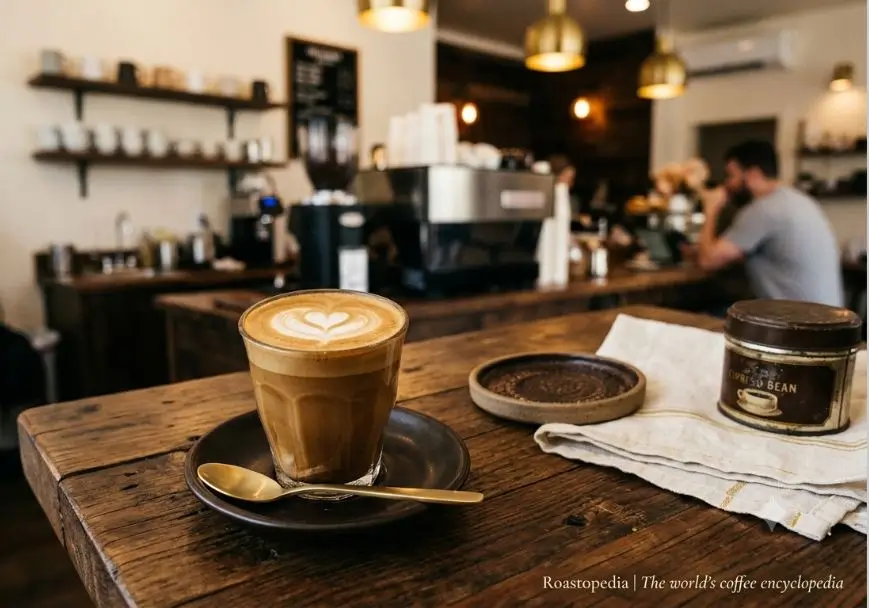
A cortado has a compact, dense body with a smooth, almost velvety mouthfeel, since the light steaming leaves little foam to separate from the liquid. The espresso’s flavor notes remain clearly detectable, whether that means the chocolate and caramel tones typical of South American beans or the brighter citrus and berry notes found in some African origins, while the milk simply rounds off harsh edges.
Compared to a cappuccino, a cortado is markedly less airy and foamy; compared with a latte, it is far less diluted and far more coffee-forward.
Regional Variations
- Spain: The classic 1:1 ratio, served in a small glass without foam, often as a mid-morning or afternoon pick-me-up.
- Portugal: Known locally as a garoto or, in a larger format, a galão, which uses a lighter 1:3 ratio.
- Cuba: The sweetened cortadito, made with condensed milk, a legacy of the island’s sugarcane economy.
- United States: Often called a “Gibraltar” on the West Coast, referencing the glass it’s traditionally served in, and typically made with a double shot for a stronger profile.
- Czech Republic: Sold commercially under localized names such as “corto classic” by some chains.
Cultural Significance
In Spain, ordering “un cortado” at a neighborhood bar is a small daily ritual rather than a novelty order, reflecting a slower, seated approach to coffee that contrasts with the grab-and-go habits associated with Italian espresso doppio culture.
In Cuba and Cuban-American communities, the cortadito carries deeper social weight, often shared among family and friends as a gesture of hospitality. Its adoption by third-wave roasters in the United States and beyond turned the cortado into a symbol of coffee craftsmanship, valued for letting the barista’s espresso work shine through rather than hiding it under milk.
Comparison with Similar Drinks
The cortado is frequently confused with several close relatives. A macchiato uses only a small dollop of milk or foam rather than an equal volume of milk, making it more concentrated. A flat white uses a similar espresso-to-milk ratio but relies on more heavily textured microfoam, giving it a silkier, hotter finish closer to a small latte.
Australia’s piccolo latte is built on a single ristretto shot topped with steamed milk in a latte style, resulting in a slightly different balance. Italy’s marocchino adds cocoa powder and is served in an even smaller glass. Compared with all of these, the cortado’s defining trait remains its near-total absence of foam paired with an even espresso-to-milk ratio.
Typical Specifications
- Espresso: 1–2 fl oz (30–60 ml)
- Steamed milk: 1–2 fl oz (30–60 ml), matching the espresso volume
- Total volume: Approximately 4 fl oz (120 ml)
- Glass size: 4.5 fl oz (135 ml) Gibraltar-style glass is standard in the U.S.
- Milk temperature: Around 130–150°F (55–65°C)
- Caffeine content: Roughly 60–130 mg, depending on whether a single or double shot is used
See Also
- Macchiato
- Caffè Latte
- Cappuccino
- Café con Leche
- Café Solo
- Piccolo Latte
- Ristretto
- Marocchino
- Espresso Doppio
References
- Wikipedia. “Cortado.” https://en.wikipedia.org/wiki/Cortado
- Boothroyd, Gemma. “Tiny Drink, Big Influence: The History of the Cortado.” Barista Magazine. https://www.baristamagazine.com/tiny-drink-big-influence-the-history-of-the-cortado/
- Gomez, Eddie P. “Misunderstood Coffee Drinks: The Cortado.” Barista Magazine. https://www.baristamagazine.com/misunderstood-coffee-drinks-the-cortado/
- Kanniah, Janice Chinna. “What Is a Cortado?” Perfect Daily Grind. https://perfectdailygrind.com/2020/03/what-is-a-cortado/
- Garçon Coffee. “What Is a Cortado? The Complete Guide to Spain’s Favorite Coffee.” https://garconcoffee.com/what-is-a-cortado/
- 94 Celcius. “Cortado: Origin, Preparation and Secrets for a Balanced Coffee.” https://94celcius.com/en/blogs/blog-personnelle/the-cortado-everything-you-need-to-know-about-this-cafeinated-drink
- 787 Coffee. “What Is A Cortado? History, How-To.” https://www.787coffee.com/drinks-explained-787-coffee/what-is-a-cortado
- Colipse Coffee. “What Is a Cortado? Types, Calories, and How to Make It.” https://colipsecoffee.com/blogs/coffee/cortado
- Tank Coffee. “What Is A Cortado Coffee?” https://www.tankcoffee.com/what-is-cortado-coffee/
- GoSpecialtyCoffee. “Cortado.” https://gospecialtycoffee.com/ckb/types-of-coffee-drinks/cortado/
- Nomad Coffee Club. “What Is a Cortado & How Can You Make the Perfect Cortado at Home?” https://www.nomadcoffeeclub.com/blogs/news/what-is-a-cortado
- 1Zpresso. “What Is a Cortado? How It Compares to Latte?” https://1zpresso.coffee/what-is-a-cortado/
- Methodical Coffee. “What is a Cortado? And How Do You Make One?” https://methodicalcoffee.com/blogs/coffee-culture/what-is-a-cortado-and-how-do-you-make-one
- Copenhagen Coffee Lab. “What is a cortado?” https://copenhagencoffeelab.com/inside-the-lab/what-is-a-cortado/
- Bones Coffee Company. “What is a Cortado.” https://www.bonescoffee.com/a/blog/what-is-a-cortado