
Coffee is a brewed beverage prepared from roasted coffee beans, the seeds of berries from the Coffea genus of flowering shrubs. Coffee is one of the most widely consumed beverages in the world, valued for its stimulating effects, its distinctive aroma, and the enormous diversity of flavors that emerge depending on where it is grown, how it is processed, and how it is prepared.
While the word “coffee” most often refers to the drink itself, it also describes the coffee plant that produces it, the fruit — known as the coffee cherry — that the beans are extracted from, and the broader agricultural and cultural industry built around cultivating, roasting, and brewing it.
Coffee occupies a unique place among global commodities: it is simultaneously a crop, a manufactured product, a ritual, and a culture. From the terraced hillsides of the Coffee Belt to the espresso bar on a city corner, coffee connects farmers, roasters, and drinkers across continents.
Etymology
The English word “coffee” entered the language in the mid-16th century via the Dutch koffie, itself borrowed from the Ottoman Turkish kahve, which came from the Arabic qahwah. The precise origin of qahwah is debated; some scholars trace it to a term originally used for wine, later applied to the coffee drink as it spread through the Arab world.
Botanical Origins
Coffee comes from the Coffea genus, a group of flowering evergreen shrubs and small trees native to tropical and subtropical Africa and parts of Asia. A mature coffee plant produces fragrant white blossoms — the coffee flower — which develop into small stone fruits called coffee cherries. Each cherry typically contains two seeds, positioned flat side to flat side, which are processed and roasted to become the coffee beans used to brew the beverage. The plant’s broad, glossy coffee leaves are themselves sometimes dried and brewed into a tisane in a handful of producing regions, though this remains a minor use compared to the bean.
Of the more than 120 known Coffea species, only a few are cultivated at commercial scale:
- Coffea arabica (Arabica) — accounts for roughly 60% of world production. Arabica is prized for its comparatively delicate, aromatic, and acidic flavor profile and grows best at higher altitudes.
- Coffea canephora (Robusta) — hardier, higher in caffeine, and generally more bitter and full-bodied than Arabica. Robusta thrives at lower elevations and is more resistant to pests and disease.
- Coffea excelsa (Excelsa) — a tall, distinctive species valued for complex, tart, fruity notes; it makes up a small fraction of global output.
- Coffea liberica (Liberica) — known for its large beans and bold, woody, sometimes smoky flavor; cultivated mainly in West Africa and parts of Southeast Asia.
Within these species, growers also work with numerous varieties and cultivars, selectively bred or naturally occurring strains — such as Bourbon, Typica, Caturra, Geisha (considered the most expensive coffee as of July 2026), and SL28 — each contributing its own character to the cup. One well-documented Kenyan cultivar, SL34, is prized for its bright acidity and is widely planted across East Africa.
Origin and History
Coffee originated in the highlands of northeastern Africa before spreading across the Arabian Peninsula and eventually becoming one of the world’s most widely traded agricultural commodities. Its history encompasses the discovery of the coffee plant, the development of coffee cultivation and trade, and the global expansion of coffee culture over several centuries. The following sections examine the major stages in coffee’s historical development.
Legendary Beginnings
The most widely told origin story credits an Ethiopian goat herder named Kaldi, who is said to have noticed his goats becoming unusually energetic after eating berries from a certain shrub. Whether or not the tale is literally true, it reflects the plant’s genuine botanical homeland: the highlands of present-day Ethiopia, where wild Coffea arabica still grows.
Early Cultivation and Spread
Coffee’s transformation from a wild plant into a cultivated crop and prepared beverage is generally traced to Yemen and the wider Arabian Peninsula around the 15th century, where it was brewed in monasteries and traded through the port of Mocha — a name that would later become synonymous with the drink itself. From Arabia, coffee spread to Persia, Egypt, Turkey, and North Africa, and by the 16th and 17th centuries it had reached Europe through Venetian trade routes.
Coffeehouses, sometimes called “penny universities” in England for the price of admission and the caliber of conversation found within, became centers of social, intellectual, and political life in cities such as Constantinople, London, Paris, and Vienna. Colonial powers later established coffee plantations in their tropical territories — the Dutch in Indonesia, the French in the Caribbean, and the Portuguese in Brazil — spreading cultivation of the coffee plant around the globe and laying the foundation for the modern industry.
The Modern Era
Brazil became the world’s dominant coffee producer by the 19th century and remains the largest today, followed by Vietnam, Colombia, Indonesia, and Ethiopia. The 20th century saw the rise of instant coffee, mass-market roasting, and eventually the specialty coffee movement, which reframed coffee not merely as a commodity but as an agricultural product worthy of the same attention to origin, variety, and craft given to wine. This evolution is often described in terms of successive coffee waves — from the first wave of mass consumption, through the second wave that popularized espresso-based drinks, to the third wave emphasis on traceability and craft, and the more recent fourth and fifth waves exploring technology, sustainability, and hyper-precision brewing.
Where Coffee Grows
Commercial coffee cultivation is confined almost entirely to a band of tropical and subtropical latitudes known as the Coffee Belt, stretching roughly between 25° North and 30° South of the Equator. This zone provides the consistent warmth, rainfall, and — at higher elevations — cooler nights that coffee plants need to thrive. Major growing regions include:
- Latin America — Brazil, Colombia, Guatemala, Honduras, Costa Rica
- Africa — Ethiopia, Kenya, Rwanda, Burundi, Uganda
- Asia-Pacific — Vietnam, Indonesia, India, Papua New Guinea
Altitude, soil composition, rainfall, and shade cover all shape a coffee’s final flavor, a concept often described using the French term terroir, borrowed from winemaking.
Harvesting
Coffee cherries ripen unevenly on the branch, which shapes how a farm chooses to harvest. The main coffee harvesting techniques are:
- Selective picking — hand-picking only ripe cherries, often over multiple passes through the same trees. This is labor-intensive but yields more consistent quality, and is the standard for specialty-grade Arabica.
- Strip picking — stripping all cherries from a branch at once, ripe or not, by hand. Faster but less selective.
- Machine harvesting — mechanized stripping used on flatter terrain and larger farms, particularly common in Brazil.
Processing
Once picked, cherries must be processed to extract the green coffee beans within — the raw, unroasted seed that is later shipped to roasters around the world. The three principal processing methods are washed (wet) processing, natural (dry) processing, and honey processing, each of which imparts distinct characteristics to the finished cup by controlling how much of the cherry’s fruit and mucilage remains in contact with the bean during drying.
Roasting
Green coffee is essentially flavorless and must be roasted before it can be brewed. Roasting applies heat to the green bean, triggering chemical reactions — most notably the Maillard reaction and caramelization — that develop the aromatic oils, acids, and sugars responsible for coffee’s flavor. Roast levels generally range from light to dark, with lighter roasts preserving more of the bean’s origin character and darker roasts producing bolder, more bittersweet, smokier notes.
Brewing and Preparation
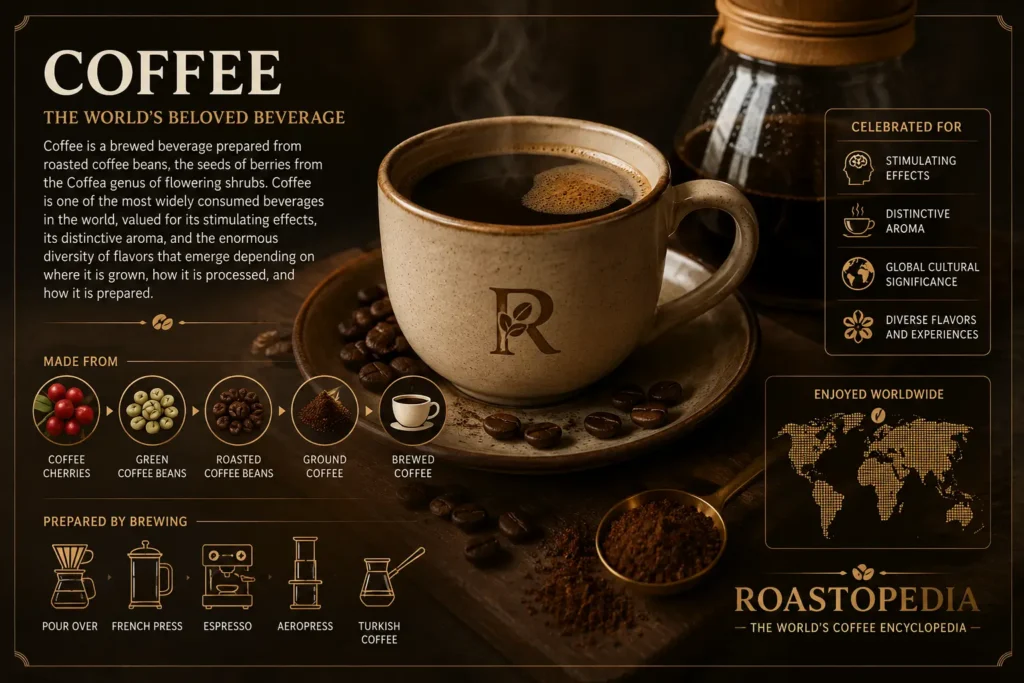
Roasted beans are ground and brewed using one of many coffee brew methods, each of which extracts flavor differently depending on grind size, water temperature, brew time, and pressure. Popular methods include drip filtration, French press, pour-over, espresso, cold brew, and the moka pot, among many others cataloged across specialty and traditional brewing traditions worldwide.
From these base preparations comes an enormous range of coffee drinks — espresso, cappuccino, latte, americano, macchiato, cortado, and countless regional and modern variations — along with a wider catalog of other coffee drinks unique to specific cultures and eras. Coffee’s flavor is typically evaluated across attributes such as body, acidity, sweetness, bitterness, and aftertaste, a vocabulary explored in depth under coffee flavors.
Decaffeinated and Organic Coffee
Not all coffee is consumed for its caffeine content. Decaf coffee undergoes a process — using water, solvents, or carbon dioxide — that removes the majority of caffeine from the green bean before roasting, while retaining much of the flavor. Separately, organic coffee refers to coffee grown without synthetic pesticides or fertilizers, certified according to organic agricultural standards that vary by country.
Coffee Culture and Competition
Coffee has generated its own competitive and educational ecosystem. Organizations run structured training through institutions such as the Specialty Coffee Association (SCA), while professional baristas and roasters compete in sanctioned events under broader coffee rules and formats, including the World Barista Championship, World Brewers Cup, World Latte Art Championship, World Cup Tasters Championship, World Coffee Roasting Championship, World Coffee in Good Spirits Championship, and the Cezve/Ibrik Championship, which celebrates traditional Turkish and Balkan brewing.
Together, these competitions and coffee’s expanding drinks reflect an industry that has grown from a simple agricultural product into a global craft, spanning farm, roastery, and cup.
See Also
- Coffee Plant
- Coffee Cherry
- Coffee Bean
- Coffee Leaf
- Coffee Flower
- Coffee Seedling
- Green Coffee
- Decaf Coffee
- Organic Coffee
References
- National Coffee Association USA — “The History of Coffee”
- International Coffee Organization — “Historical Data on the Global Coffee Trade”
- Britannica — “Coffee: Plant and Beverage”
- Smithsonian Magazine — “The Long, Curious History of Coffee’s Origin”
- Specialty Coffee Association — “SCA Protocols and Standards”
- World Coffee Research — “Arabica Coffee Varieties Catalog”
- Food and Agriculture Organization of the United Nations (FAO) — “Coffee Production Statistics”
- Perfect Daily Grind — “Understanding Coffee Processing Methods”
- Coffee Research Institute — “Coffee Plant Botany and Cultivation”
- The New York Times — “How Coffee Fueled the Enlightenment”
- Harvard T.H. Chan School of Public Health — “Coffee”
- National Geographic — “The Surprising History of Where Your Coffee Comes From”
- USDA Foreign Agricultural Service — “Coffee: World Markets and Trade”
- James Hoffmann, “The World Atlas of Coffee”
- Mark Pendergrast, “Uncommon Grounds: The History of Coffee and How It Transformed Our World”
- Scientific American — “The Chemistry of Coffee Roasting”
- World Barista Championship — “Official Competition Rules”
- BBC News — “The Ethiopian Goat Herder Who Discovered Coffee”
- Rainforest Alliance — “What Is Organic Coffee Certification?”
- The Guardian — “The Rise of Third Wave Coffee Culture”