
Typica is considered one of the oldest and most historically significant botanical varieties of Coffea arabica. Together with Bourbon, it represents one of the two principal cultivated lineages from which many of the world’s Arabica cultivars have been developed.
Originating from early Arabica populations in Ethiopia and subsequently disseminated throughout Yemen, Asia, and the Americas, Typica played a central role in the global expansion of coffee cultivation. Its genetic legacy is reflected in numerous descendant cultivars, including Geisha, Caturra, and several other varieties that have shaped modern specialty coffee production.
Origin and History
Typica originated in the southwestern forests of Ethiopia, where the wild Coffee Cherry first evolved. In the 15th or 16th century, seeds were transported to Yemen, marking the beginning of commercial cultivation. By the late 17th century, the Dutch successfully smuggled coffee seeds from the Malabar coast of India to Batavia—modern-day Java, Indonesia. These specific seeds gave rise to the distinct variety now recognized as Typica.
In 1706, a single Coffee Seedling was transported from Java to the Amsterdam Botanical Garden. A descendant of this plant was gifted to King Louis XIV of France in 1714 and housed in the Jardin des Plantes in Paris. This “Noble Tree” became the progenitor of nearly all Typica coffee in the Americas.
French naval officer Gabriel de Clieu famously transported a seedling to Martinique in 1723, from where cultivation spread to Jamaica, Mexico, and eventually South America. Until the 1940s, Typica remained the dominant variety across Central and South American plantations.
Botanical Characteristics
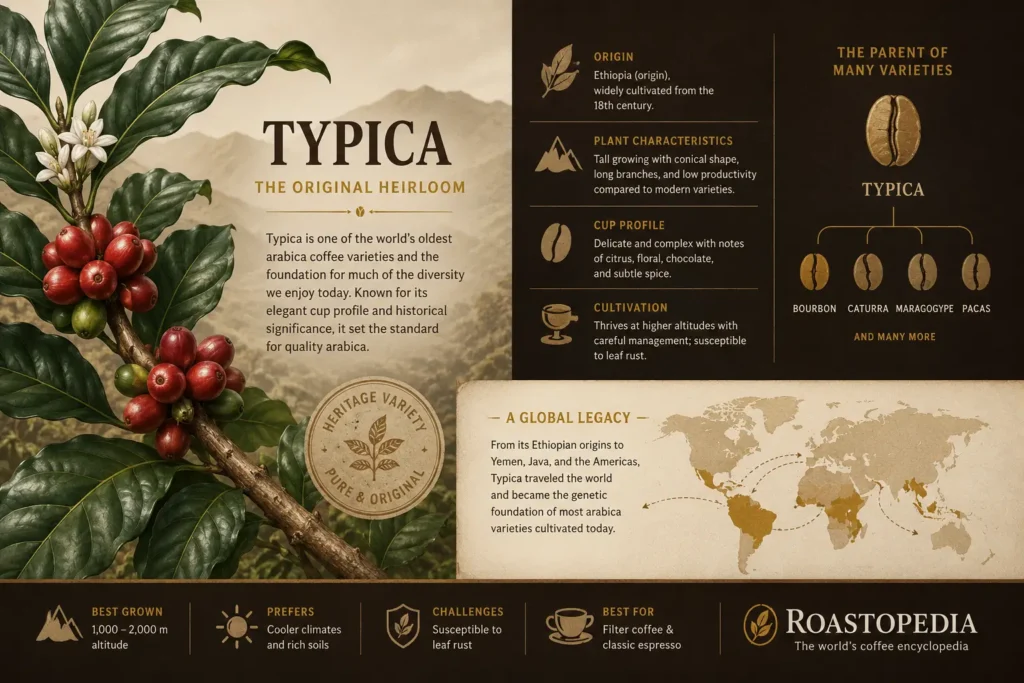
The Typica plant is a tall, conical shrub characterized by its distinct physical profile. It features long, slender primary branches that grow at a slight upward angle from the main trunk. A defining visual trait is the bronze color of its young Coffee Leaf tips, which distinguishes it from the green-tipped leaves of many other varieties.
The plant produces a delicate, star-shaped Coffee Flower that gives way to large, elongated fruit and seeds. Structurally, Typica is known for its low productivity, yielding approximately 20–30% less than the Bourbon variety. Furthermore, it possesses high susceptibility to major pathogens, including coffee leaf rust and coffee berry disease. Despite these agronomic challenges, it is highly adapted to the coldest high-Altitude conditions where other varieties may struggle to thrive.
Relationship with Arabica and Robusta
Typica belongs exclusively to the species Coffea arabica. As an “heirloom” variety, it maintains a pure genetic lineage back to the original Ethiopian wild plants. It is genetically distinct from Coffea canephora ( Robusta).
However, Typica played a crucial role in the creation of the Hibrido de Timor, a spontaneous natural cross between Typica and Robusta found on Timor Island. This hybrid introduced Robusta’s disease resistance into the Arabica gene pool, leading to the development of many modern resistant cultivars.
Sensory and Processing Profile
In the specialty market, Typica is considered to have an exceptional cup quality. It typically exhibits a clean, sweet flavor profile with high Coffee Acidity and a complex Coffee Aroma. These characteristics are often maximized through the Wet Process, which highlights the variety’s inherent clarity and floral notes.
When subjected to precise Roasting, Typica beans require careful thermal management due to their large physical size and density. Proper Degassing after roasting is considered essential to prevent carbon dioxide from interfering with the eventual extraction process.
In the brewery, baristas must account for the bean’s physical traits when Dosing to avoid Channeling, ensuring a uniform extraction that preserves the variety’s delicate sweetness.
Global Cultivation and Terroir
Modern cultivation of pure Typica is increasingly rare due to its low yield and disease risk. However, it remains the backbone of several prestigious Estate Coffee regions. The most famous example is Jamaica Blue Mountain, where the specific Terroir and high-elevation climate produce a globally recognized luxury product. Other significant populations exist in Hawaii (Kona), Peru, and the Dominican Republic. Producers often choose Organic Coffee practices for Typica to appeal to high-end specialty markets that can sustain the higher costs associated with its lower yields.
See Also
References
- World Coffee Research. “Typica Variety Catalog.” worldcoffeeresearch.org.
- Specialty Coffee Association. “Coffee Plants of the World.” sca.coffee.
- Royal Coffee. “A New World History & Geography of Arabica Coffee Cultivars.” royalcoffee.com.
- Kew Royal Botanic Gardens. “Coffea arabica (Arabica coffee) botanical profile.” kew.org.
- International Coffee Organization. “Historical Development of the Coffee Plant.” ico.org.
- World Coffee Research. “Arabica Coffee Genetic Diversity: Typica and Bourbon Lineages.” worldcoffeeresearch.org.
- Perfect Daily Grind. “The Typica Coffee Variety: What Is It & Why Is It So Important?” perfectdailygrind.com.
- National Center for Biotechnology Information. “Evaluation of physical and chemical characteristics of Arabica coffee genotypes.” ncbi.nlm.nih.gov.
- James Hoffmann. “The World Atlas of Coffee: From Beans to Brewing.” 2018.
- Britta Folmer. “The Craft and Science of Coffee.” Academic Press, 2016.
- Andrea Illy and Rinantonio Viani. “Espresso Coffee: The Science of Quality.” Academic Press, 2005.
- Coffee Quality Institute. “Technical Standards for Specialty Arabica.” coffeeinstitute.org.