
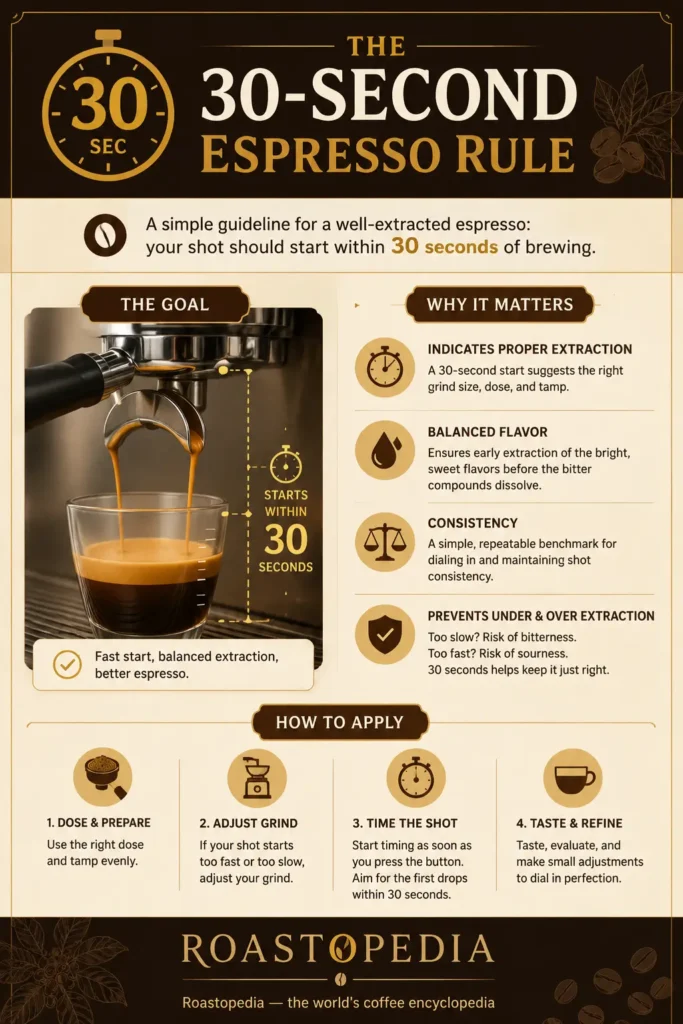
The 30-Second Espresso Rule (also known as the 25–30 Second Extraction Rule or the Rule of Thirty) is a widely observed guideline in espresso preparation stating that a properly brewed espresso shot should complete its extraction within a window of approximately 25 to 30 seconds under standard conditions. The rule applies from the moment the pump is activated until the desired liquid volume is reached in the cup. Rooted in mid-20th-century Italian barista tradition and later codified by industry institutions including the Italian Espresso National Institute (INEI) and the Specialty Coffee Association (SCA), the guideline serves as a foundational benchmark for evaluating and calibrating espresso extraction across professional and home-brewing contexts.
Background and Scientific Basis
Espresso extraction (see Espresso) is a pressure-driven process in which hot water is forced through a compacted bed of finely ground coffee at approximately nine bars of pressure. During this process, water dissolves thousands of distinct chemical compounds from the coffee grounds in a specific, time-dependent sequence. Lighter, more soluble compounds — including fruit acids and floral aromatics — are extracted first, followed by sugars and caramel-like sweetness compounds in the mid-phase, and finally heavier oils and bitter phenolic compounds in the later stages.
The 25–30 second window is designed to capture the first two phases — acids and sugars — while terminating the shot before excessive bitterness dominates. A shot that concludes in under 20 seconds typically indicates under-extraction, producing a sour, thin-bodied result lacking complexity. Conversely, an extraction exceeding 35 seconds risks over-extraction, yielding a harsh, astringent cup in which bitter compounds overwhelm the palate. The 30-second rule represents the historically validated midpoint between these two failure states.
History and Development
Early Origins: Steam-Pressure Machines (Pre-1938)
The earliest espresso machines, first manufactured in Milan in 1905, relied on steam pressure to force water through coffee grounds. These early machines took as long as 45 seconds to produce a single cup and often generated water temperatures above 120°C, resulting in over-extracted, burned coffee. No standardized extraction time existed during this period, and consistency was largely impossible. The concept of a timed extraction window had not yet entered the vocabulary of coffee preparation.
The Gaggia Revolution (1938–1948)
The foundational conditions for the 30-Second Rule were created in 1938, when Milanese barista Achille Gaggia filed Italian Patent No. 365726 for a steam-free espresso machine. Gaggia’s invention — known as the “Lampo” system — used a piston mechanism driven by boiler pressure to force hot water through coffee grounds at a controlled temperature of approximately 90–95°C, replacing the damaging superheated steam of earlier machines.
In 1947, Gaggia secured a second patent for a spring-loaded lever-piston mechanism that generated the modern standard of approximately nine bars of extraction pressure. Commercial production of the Gaggia Tipo Classica began in 1948, and the machines were swiftly installed in Milan’s most prestigious cafes. It was during this era that Italian baristas, through iterative trial and observation, first discovered that extractions falling in the 20–30 second range produced the most balanced and pleasant results — not too sour, not too bitter. Although no formal documentation codified this window at the time, it became embedded in the practical knowledge of Italian bar culture.
Electromechanical Standardization: The Faema E61 (1961)
The single most consequential development in the standardization of espresso extraction time came in 1961 with the introduction of the Faema E61, designed by engineer Ernesto Valente. The E61 was the first commercially successful semi-automatic espresso machine and the first to use an electromechanical volumetric pump — rather than a manual lever — to deliver a constant, reproducible pressure of nine bars throughout the entire extraction process. Before the E61, lever machines required considerable skill and physical consistency from the barista, resulting in wide shot-to-shot variability. The E61 also introduced automatic pre-infusion and a thermosiphon system for stable group-head temperature, two innovations that became industry standards.
By eliminating the manual variable of lever pressure, the E61 made consistent extraction time a measurable and repeatable reality for the first time. The E61 became Italy’s best-selling coffee machine of the 1960s, and with its proliferation across Italian and eventually international cafes, the practical extraction window of 25–30 seconds became a de facto industry norm. The machine’s name derived from the solar eclipse (Eclisse) of 1961, the year of its launch.
Institutional Codification: The INEI Standard (1998–1999)
The most authoritative formal codification of espresso extraction parameters — including time — came with the establishment of the Italian Espresso National Institute (Istituto Nazionale Espresso Italiano, INEI). Founded following three years of collaborative research involving coffee-tasting experts and professors from the University of Udine and the University of Turin, INEI launched its “Certified Italian Espresso” (Espresso Italiano Certificato) quality standard in 1998–1999.
Under the INEI standard, a certified Italian espresso is defined as a 30 ml shot made by forcing hot water at 91–96°C through 7–9 grams of finely ground coffee, extracted within a brewing time of 20 to 27 seconds at approximately nine bars of pressure. The cup must be pre-warmed porcelain, and the resulting crema must maintain its form for no fewer than 120 seconds after dispensing. Only products conforming to these parameters are permitted to carry the “Espresso Italiano” quality mark, which the Institute continues to administer in collaboration with the International Coffee Institute.
The Specialty Coffee Association and Barista Guild Surveys (2016–2017)
While the INEI codified the rule for traditional Italian espresso, the Specialty Coffee Association (SCA) and its Barista Guild of America (BGA) branch approached standardization from a data-driven, global perspective. In 2016, the BGA conducted a worldwide survey of baristas to document evolving espresso preparation practices, with results published in 2017. The heritage SCA definition of espresso — in effect prior to the survey — described a 25–35 ml beverage prepared from 7–9 grams (or 14–18 grams for a double) of coffee, with water at 90.5–96.1°C forced at 9–10 atmospheres of pressure. This definition implicitly aligned with the 25–30 second extraction window as the natural result of these parameters at standard grind and tamp.
The survey revealed that professional baristas worldwide had begun experimenting beyond these classical parameters — particularly in response to the demands of lighter-roast, single-origin espresso — but the 25–30 second window remained the most widely recommended starting point across respondent groups. The SCA’s Golden Cup Standard, which targets an extraction yield of 18–22% and a Total Dissolved Solids (TDS) range of 1.15–1.35%, continues to correlate closely with the 30-second rule at standard 1:2 brew ratios.
Third Wave Coffee and the Evolution of the Rule (2000s–Present)
The emergence of third-wave coffee culture in the early 2000s — characterized by an emphasis on single-origin beans, lighter roasts, and scientific precision in brewing — both reinforced and complicated the 30-second rule. On one hand, third-wave practitioners embraced precision timing and measurement as core competencies, lending the guideline renewed relevance in the specialty cafe context. On the other hand, the shift toward lighter-roasted, denser beans — which are less soluble and thus slower to extract — prompted many baristas to extend extraction times to 30–40 seconds or beyond to achieve balance.
The introduction of pressure-profiling espresso machines, digital refractometers (see Refractometry), precision scales, and real-time extraction monitoring software further enabled baristas to understand and manipulate extraction chemistry with a granularity unavailable to earlier generations. As a result, the 30-second rule has increasingly been understood not as an absolute law, but as a reliable empirical baseline — a starting point from which individual adjustments based on roast level, bean origin, grind distribution, and brew ratio can be made.
Standard Parameters
The 30-Second Rule is typically applied within the following standard parameter set:
- Dose: 18–20 grams of finely ground coffee (double shot)
- Yield: 36–40 grams of liquid espresso (1:2 brew ratio)
- Extraction pressure: 9 bars
- Water temperature: 90–96°C (194–205°F)
- Extraction time: 25–30 seconds (from pump activation)
- Crema stability: minimum 120 seconds (per INEI certification)
Grind size is the primary variable used to dial in extraction time: a finer grind creates greater resistance to water flow, slowing extraction; a coarser grind reduces resistance, accelerating it. Tamp pressure, dose weight, and water temperature are secondary calibration variables.
Timing Methodology
A longstanding debate in the barista community concerns the precise moment from which extraction should be timed. Two principal schools of thought exist:
- From pump activation: The timer begins the moment the pump is engaged, encompassing pre-infusion. This method is considered more accurate by many practitioners because pre-infusion affects overall extraction chemistry and should be included in the total contact time.
- From first drip: The timer begins when liquid first appears from the portafilter. Proponents argue this approach normalizes for machine-to-machine variation in pre-infusion duration. Critics note that this method obscures pre-infusion data and makes early diagnostics — such as time-to-first-drip as an indicator of puck resistance — unavailable.
The majority of professional institutions and prominent educators, including the SCA and coffee author James Hoffmann, favor timing from pump activation as the more informative and reproducible standard.
Variables Affecting Extraction Time
Several factors can shift the optimal extraction time away from the classical 25–30 second window:
- Roast level: Darker roasts are more soluble and typically extract in the lower end of the window or even below it; lighter roasts often require extended extraction times of 30–40 seconds or more to achieve balance.
- Bean origin and density: Ethiopian beans, which tend to be denser and harder, often extract more slowly than lower-altitude Brazilian beans.
- Freshness: Beans 1–7 days post-roast contain high levels of CO2, increasing puck resistance and slowing extraction. The optimal rest period for espresso is generally 7–14 days after roasting.
- Water temperature: Higher temperatures increase solubility and speed extraction; lower temperatures slow it. A temperature at the higher end of the acceptable range may shorten the window and risk bitterness.
- Pre-infusion: Extended pre-infusion phases (5–10+ seconds) increase total contact time, requiring adjustment of the classical 25–30 second target to a total shot time of 35–40 seconds.
- Dose volume: Higher doses increase resistance and extend extraction time; lower doses reduce it.
Criticisms and Limitations
While the 30-Second Rule is widely taught and broadly respected, it has attracted substantive criticism from specialty coffee practitioners, particularly since the 2010s:
- Over-reliance on time as a primary variable: Advanced practitioners increasingly treat extraction time as an output metric rather than a target, arguing that brew ratio (yield relative to dose) is the more meaningful control variable. A shot may be perfectly balanced at 22 seconds or at 38 seconds depending on all other conditions.
- Inapplicability to modern roast profiles: The rule was developed in an era of predominantly dark-roasted, Robusta-inclusive Italian blends. Its applicability to light-roast, single-origin specialty espresso is contested.
- Machine and equipment variability: Machines with pressure profiling, flow rate control, or extended pre-infusion produce results that cannot be adequately assessed through time alone.
- Sensory primacy: Many professional baristas and coffee educators argue that taste remains the ultimate arbiter of extraction quality. A shot that falls outside the 25–30 second window but tastes balanced and complex should not be dismissed on the basis of timing alone.
Legacy and Contemporary Relevance
Despite its limitations, the 30-Second Espresso Rule remains one of the most universally recognized benchmarks in coffee preparation. It is included in barista training curricula worldwide, referenced in SCA educational materials, and forms part of the practical examination standards in professional barista competitions. Its enduring relevance derives not from rigid prescriptivism but from its utility as a diagnostic and instructional heuristic: a deviation from the 25–30 second window reliably signals that one or more variables — grind, dose, temperature, tamp — requires adjustment, and thus provides actionable information to the barista.
In the contemporary specialty coffee landscape, the rule is most productively understood as a starting framework rather than a ceiling. Its historical trajectory — from empirical barista practice in 1940s Milan, through Faema’s 1961 electromechanical revolution, to INEI’s late-1990s institutional codification, and into the precision-driven third-wave era of the 2000s and beyond — reflects the progressive formalization of espresso craft into a reproducible science without sacrificing the artisanal judgment that remains central to its culture.
See Also
- 15-15-15 Coffee Rule
- Golden Ratio
- Golden Cup Standard
- 1:2 Espresso Brew Ratio Rule
- Four-Minute French Press Rule
- Brewing Temperature Rule
References
- Gaggia. (2023). 85 Years of Heritage: 1938–1947 — The Beginning of Everything. Gaggia Official Website. https://www.gaggia.com/85-years-of-heritage-1938-1947/
- Gaggia. (2023). Our History. Gaggia Official Website. https://www.gaggia.com/our-history/
- Wikipedia Contributors. (2025). Espresso. Wikipedia, The Free Encyclopedia. https://en.wikipedia.org/wiki/Espresso
- Wikipedia Contributors. (2025). E-61. Wikipedia, The Free Encyclopedia. https://en.wikipedia.org/wiki/E-61
- Morris, J. (2021). The Faema E61 Espresso Machine. Perspectives on History, American Historical Association. https://www.historians.org/publications-and-directories/perspectives-on-history/january-2021/the-faema-e61-espresso-machine
- INEI – Italian Espresso National Institute. (1998–1999). Espresso Italiano Certificato: Standards for the Evaluation of Espresso Coffee of the Highest Quality. https://www.espresso-international.us/espresso-italiano-certificato
- Italics Magazine. (2022). Is Italian Espresso Next in Line for UNESCO Status? https://italicsmag.com/2022/05/05/is-italian-espresso-next-in-line-for-unesco-status/
- Specialty Coffee Association. (2017). Defining the Ever-Changing Espresso. 25 Magazine, Issue 3. https://sca.coffee/sca-news/25-magazine/issue-3/defining-ever-changing-espresso-25-magazine-issue-3
- Espresso Coffee Shop USA. (2025). Espresso Extraction Time: The Science Behind the Perfect 25–30 Second Shot. https://www.espressocoffeeshopusa.com/blog/post/26-espresso-extraction-time-perfect-25-30-second-shot
- Chowhound / Swaminathan, S. (2026, January 4). This Is Why the 30-Second Rule for Espresso Actually Matters. Chowhound. https://www.chowhound.com/2063262/what-is-the-thirty-second-rule-for-espresso/
- Savor Suite. (2025). The 30-Second Espresso Rule: Your Complete Guide to Brewing the Perfect Shot. https://savorsuite.com/30-second-espresso-rule-complete-guide/
- Zelda & Rocky Coffee Roasters. (2025). Brewing Espresso: Why the 30-Second Extraction Rule is Just a Guide. https://www.zeldaandrocky.coffee/blogs/all-about-coffee/brewing-espresso-why-the-30-second-extraction-rule-is-just-a-guide-not-a-gospel
- Stark Insider. (2025). The Complete Guide to Nailing the 25-Second Espresso Shot. https://www.starkinsider.com/2025/07/25-second-espresso-guide.html
- HiBREW. (2025). The Perfect Espresso Shot Time: A Comprehensive Guide. https://www.hibrew.com/blogs/brew-guides/espresso-extraction-time
- Perfect Daily Grind. (2015). Extraction Wars, Part II: The Third Wave Coffee Revolution. https://perfectdailygrind.com/2015/08/extraction-wars-part-ii-the-third-wave-coffee-revolution/
- Perfect Daily Grind. (2024). What’s the Future for Espresso Machine Technology? https://perfectdailygrind.com/2024/11/future-for-espresso-machine-technology/
- Cellini Caffe. (2023). History of the Espresso Coffee Machine: From Its Origins to the Present Day. https://cellinicaffe.com/en/blogs/coffee-vibes/history-of-the-espresso-coffee-machine
- Colipse Coffee. (2026). Espresso vs Coffee: What’s the Difference? https://colipsecoffee.com/blogs/coffee/espresso-vs-coffee
- Home-Barista.com. (2023). 30s Extraction Time – From When? Tips and Techniques Community Forum. https://www.home-barista.com/tips/30s-extraction-time-from-when-t85017.html
- Faema Canada. (2024). Faema E61 Legend Semi-Automatic Espresso Machine. https://faema.ca/products/faema-e61-legend