
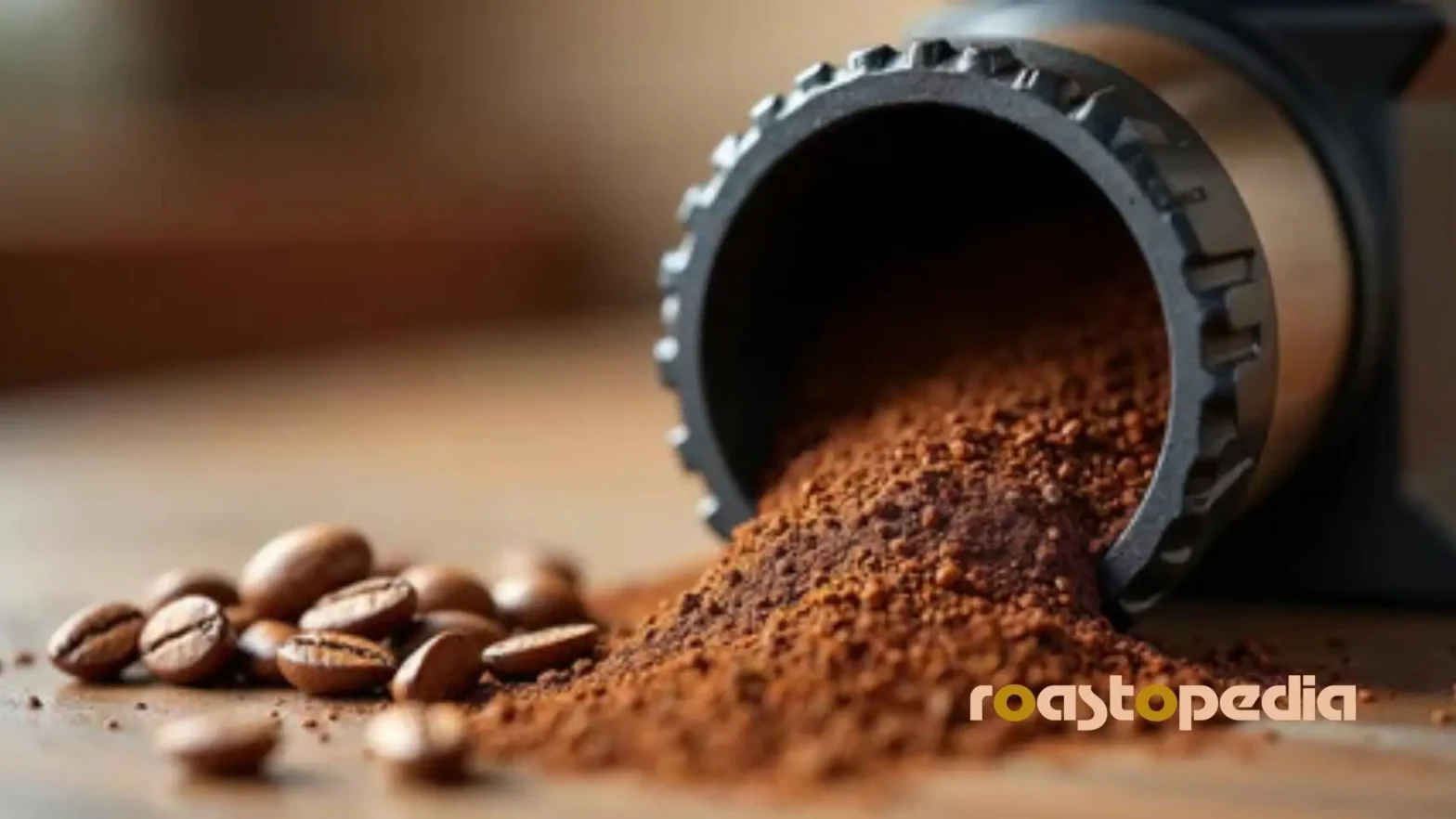
Yes —grind size does change caffeine extraction in light roast coffee, and it matters more for light roasts than for any other roast level. Because light roast beans are denser, harder, and less porous than medium or dark roasts, they need more help from your grinder. A finer grind increases surface area, shortens contact time (the distance water must travel through each particle), and allows water to unlock the substantial caffeine already packed into those compact beans. Every other variable in your brew — water temperature, contact time, brew ratio — works alongside grind size, but for light roast specifically, getting the grind right is the single most impactful adjustment you can make.
Having said that, the discussion on whether grand size can affect caffeine extraction and how it does so on lighter roasts is a subtle subject and a fascinating intersection of physics, chemistry, and the unique characteristics of light roast beans. Here’s everything you need to know.
What is Caffeine Extraction?
Before you can understand how grind size influences caffeine, it helps to understand what extraction actually means. When hot water meets ground coffee, it begins dissolving soluble compounds — acids, sugars, oils, and caffeine — out of the grounds and into your cup. This process is called extraction, and it’s measured as an extraction yield: the percentage of dry coffee mass that ends up dissolved in the final brew.
The Specialty Coffee Association (SCA) defines the “golden cup” target as an extraction yield of 18–22%. Below that range, coffee tends to taste sour and underdeveloped. Above it, it turns bitter and harsh. Every variable in your brewing process — water temperature, brew time, water-to-coffee ratio, and grind size — moves that dial left or right.
Caffeine, a water-soluble alkaloid with the chemical formula C₈H₁₀N₄O₂, begins dissolving early in the extraction timeline, alongside acids. This means it’s one of the first compounds to enter your cup — but getting it out efficiently depends heavily on how you’ve ground your beans.
What Makes Light Roast Coffee Different?
To understand how grind size interacts with a light roast specifically, you need to know what sets light roast beans apart structurally and chemically.
Density and Cellular Structure
Light roast beans are significantly denser and harder than medium or dark roasts. During the roasting process, heat drives moisture and CO₂ out of the bean, causes cellular expansion, and increases porosity. The longer and hotter the roast, the more the bean’s internal matrix opens up.
A light roast reaches only the “first crack” — the point at which expanding steam causes an audible pop — and stops there. The result is a bean with compact, tightly-packed cellular walls, smaller pore openings, and less internal fracturing. This means water has a harder time penetrating the bean during brewing. Caffeine and other soluble compounds are essentially locked inside a more rigid matrix.
Dark roasts, by contrast, undergo far more structural breakdown. Their higher porosity allows water to enter more easily and extract compounds faster — but they also retain less caffeine overall, because some caffeine is lost to sublimation at extreme temperatures.
Caffeine Content
Research consistently shows that light roasts tend to contain more caffeine per gram of coffee than darker roasts. A 2025 study published in the Journal of Food Quality examining Ethiopian Arabica coffee found that light roast with a fine grind had the highest caffeine content (1.53 g/100g), while dark roast with a coarse grind had the lowest (1.30 g/100g). A 2024 study by researcher Zachary R. Lindsey, published in Scientific Reports, confirmed that caffeine levels tend to peak in the earlier stages of roasting, with measurable losses occurring only after roasting temperatures exceed approximately 400–420°F.
However — and this is where it gets interesting — having more caffeine in the bean does not automatically mean more caffeine in your cup. That’s where grind size comes in.
How Grind Size Affects Caffeine Extraction
Grind size is essentially a surface area problem. When you grind coffee beans, you’re breaking them into thousands of particles. The finer you grind, the more particles you create, and the more total surface area is exposed to water. More surface area means more contact points between water and coffee — and therefore faster, more efficient extraction.
Here’s a simplified breakdown:
| Grind Size | Particle Size | Surface Area | Extraction Speed |
| Extra Fine (Turkish) | < 100 µm | Very high | Very fast |
| Fine (Espresso) | 100–300 µm | High | Fast |
| Medium (Pour-over/Drip) | 400–600 µm | Moderate | Moderate |
| Coarse (French Press) | 800–1000 µm | Low | Slow |
| Extra Coarse (Cold Brew) | 1000+ µm | Very low | Very slow |
When you grind finer, water dissolves caffeine from the particles quickly and aggressively. When you grind coarser, the larger particles have less total surface area — meaning water may not penetrate fully during a typical brew time, and some caffeine remains trapped inside the grounds.
But here’s the critical nuance: finer grounds do not contain more caffeine per gram (weight). The caffeine content is determined entirely by the bean composition. What grind size changes is how efficiently that caffeine is released into your cup.
The Light Roast Extraction Challenge
Now combine what you know about light roast density with what you know about surface area, and a clear picture emerges:
Light roast beans are already working against fast extraction. Their tight cellular structure resists water penetration. When you grind light roast coarsely, you compound this problem: not only does water struggle to get inside the dense bean matrix, but there’s also less surface area for water to work with. The result is a cup that may leave a significant amount of caffeine still trapped in the grounds — under-extraction.
This is why many experienced baristas and coffee researchers recommend grinding light roast coffee slightly finer than you would a medium or dark roast for the same brewing method. The denser bean requires more surface area to compensate for its resistance to extraction.
A finer grind on a light roast accomplishes two things simultaneously:
- It increases the surface area available for water contact.
- It reduces the diffusion path length — the distance water must travel through each particle to reach the caffeine inside.
Both effects speed up and improve caffeine extraction, which is exactly what the denser light roast bean needs.
Grind Size Must Match Brewing Method
Here’s where many home brewers go wrong: they focus on grind size in isolation, without accounting for brew time and brewing method. These variables are deeply intertwined.
Each brewing method is designed around a specific contact time between water and grounds. Grind size must be matched to that contact time, or you’ll either under-extract or over-extract — regardless of roast level.
- Espresso uses a very fine grind because water contact is only 25–30 seconds. The fine grind creates enough surface area to extract efficiently in that tiny window — and the high pressure further accelerates extraction.
- Pour-over and drip methods use a medium grind. Water flows through by gravity over 3–5 minutes, and a medium grind gives the right balance of surface area and flow rate.
- French press uses a coarse grind because the coffee steeps in water for 4 minutes or more. The long contact time compensates for less surface area.
- Cold brew uses an extra coarse grind but steeps for 12–24 hours. Despite minimal surface area, the extended time allows thorough caffeine extraction.
If you use a fine grind in a French press or cold brew, you may over-extract bitter compounds (though you’ll get plenty of caffeine). If you use a coarse grind with espresso, the water passes through too quickly and under-extracts everything.
For light roast coffee specifically: if you’re using a pour-over or drip method, consider dialing your grind slightly finer than you normally would. The denser bean benefits from the added surface area, and the extraction will more faithfully reflect the higher caffeine content that’s already in the bean.
What the Research Says
Several peer-reviewed studies shed direct light on the grind size–caffeine relationship:
The 2025 Journal of Food Quality study on Ethiopian Arabica used Response Surface Methodology to test combinations of roast level and grind size. It found that finer grinds and lighter roasts together yielded the highest caffeine concentrations — 1.53 g/100g — because fine grinding increased extraction efficiency while the light roast preserved more caffeine through lower thermal degradation.
The 2024 Scientific Reports study by Lindsey et al. used scanning electron microscopy to visualize porosity in roasted coffee seeds across roast levels, comparing this to measured caffeine content and extraction yield. It found that light roast beans, despite their higher caffeine content, showed the lowest porosity — confirming that their dense structure makes caffeine harder to extract without adjustments to grind size or brew parameters.
The 2017 Scientific Reports cold brew study (Fuller and Rao) found an interesting exception: in cold brew coffee, grind size did not significantly impact caffeine concentrations. The extremely long steep time (6–24 hours) essentially overcame the surface area difference, as caffeine reached equilibrium concentration regardless of whether medium or coarse grounds were used. This is one context where changing your grind may not meaningfully change caffeine output.
A 2023 ScienceDirect study on French press and cold brew found that fine grinds (0.43–0.71 mm) had lower extraction rates and longer extraction times than medium grinds (0.7–1.7 mm) in immersion methods — but ultimately yielded higher total bioactive compound content. This counterintuitive result suggests that while fine grinds extract more slowly in immersion methods, they extract more thoroughly over time.
Grind Consistency: The Overlooked Factor
Beyond grind size itself, grind consistency deserves equal attention. Most cheap blade grinders produce wildly inconsistent particle sizes — a mix of fine dust and large chunks in the same batch. This is a serious problem for caffeine extraction.
In an inconsistent grind, the fine particles over-extract quickly (producing bitter compounds) while the larger chunks under-extract (leaving caffeine behind). The result is a cup that tastes simultaneously bitter and weak — and has unpredictable caffeine delivery from one brew to the next.
Burr grinders, by contrast, crush beans between two abrasive surfaces and produce a relatively uniform particle distribution. Uniform grind size creates uniform caffeine release: every particle is extracting at roughly the same rate, and the process is predictable and repeatable.
For light roast coffee — which already demands more from your extraction process due to its density — grind consistency becomes even more critical. A quality burr grinder is one of the most impactful investments you can make if you want to get the full caffeine (and flavor) potential out of your light roast beans.
Practical Takeaways for Your Cup
Here’s how to apply all of this the next time you brew a light roast:
- Grind slightly finer than usual. Light roast beans are denser and resist water penetration. A finer grind compensates by increasing surface area.
- Match grind to your brew method first. Never sacrifice the grind-to-method match. If you brew espresso, fine is already appropriate. If you brew pour-over, dial slightly finer than you would for a medium roast.
- Invest in a burr grinder. Grind consistency matters as much as grind size — especially for demanding light roasts.
- Adjust brew time if needed. If you grind finer, your water flow may slow (in percolation methods). Watch your brew time and adjust your grind or dose accordingly to stay in the 18–22% extraction window.
- Cold brew is forgiving. If you’re making cold brew with light roast, grind size matters less because the long steep time compensates. Use a coarse grind as normal.
- Taste, then adjust. If your light roast tastes sour or weak, it’s likely under-extracted — try grinding finer. If it tastes harsh and bitter, you’ve over-extracted — go coarser.
A Note on Total Caffeine vs. Concentration
One final distinction worth making: grind size affects the concentration of caffeine in your cup, not necessarily the total amount. If you grind finer and extract more efficiently, a single cup will have more caffeine than it would have at a coarser grind — assuming brew time and dose stay constant. But if you adjust your dose or brew time to compensate, the total caffeine can remain similar.
The most reliable way to maximize caffeine in a light roast is to optimize all variables together: a fine grind appropriate for your brew method, an adequate brew time, proper water temperature (195–205°F), and a good dose ratio.
Conclusion
So, does grind size change caffeine extraction in light roast coffee? Yes — grind size does change caffeine extraction in light roast coffee, and it matters more for light roasts than for any other roast level. Because light roast beans are denser, harder, and less porous than their darker counterparts, they require more help from your grinder. A finer grind increases surface area, shortens diffusion paths, and allows water to unlock the substantial caffeine that’s already packed into those compact beans.
See Also
- The Role of Roast Level in Coffee Flavor Development
- Understanding the Specialty Coffee Association’s Golden Cup Standard
- Does Light Roast Coffee Have More Caffeine Than Medium Roast?
- Burr vs. Blade Grinders: Why It Matters for Extraction
- Cold Brew Science: Why Temperature Changes Everything
- Light Roast vs. Dark Roast: A Complete Comparison
- Caffeine Stability During Coffee Roasting
- How Water Temperature Affects Coffee Extraction
References
- Duke, A. et al. (2025). “Effects of Roasting Degree and Grinding Size on Caffeine Content and Sensorial Quality of Coffee.” Journal of Food Quality, Wiley Online Library. https://onlinelibrary.wiley.com/doi/10.1155/jfq/2405668
- Lindsey, Z. R. et al. (2024). “Caffeine content in filter coffee brews as a function of degree of roast and extraction yield.” Scientific Reports, Nature. https://www.nature.com/articles/s41598-024-80385-3
- Fuller, M. & Rao, N. Z. (2017). “The Effect of Time, Roasting Temperature, and Grind Size on Caffeine and Chlorogenic Acid Concentrations in Cold Brew Coffee.” Scientific Reports, Nature. https://www.nature.com/articles/s41598-017-18247-4
- Fuller, M. & Rao, N. Z. (2017). PubMed Central mirror. PMC5740146. https://pmc.ncbi.nlm.nih.gov/articles/PMC5740146/
- Nguyen, T. T. et al. (2023). “Effects of grind size, temperature, and brewing ratio on immersion cold brewed and French press hot brewed coffees.” Future Foods, ScienceDirect. https://www.sciencedirect.com/science/article/pii/S2772502223000719
- Raharjo, S. et al. (2019). “Critical roasting level determines bioactive content and antioxidant activity of Robusta coffee beans.” PMC6365344, PubMed Central. https://pmc.ncbi.nlm.nih.gov/articles/PMC6365344/
- Berry College. (2025). “Do Light Roasts or Dark Roasts Have More Caffeine?” Berry College News. https://www.berry.edu/articles/news/2025/coffee-roasts
- Futura-Sciences. (2026). “You’re drinking your coffee wrong: science finally reveals the right way.” https://www.futura-sciences.com/en/youre-drinking-your-coffee-wrong-science-finally-reveals-the-right-way_28928/
- Biochemistry & Biophysics Journal. (2025). “Exploring the effects of roast profiles and grind size on extraction dynamics in Indian coffee varieties.” Biochem Journal, 9(3). https://www.biochemjournal.com/archives/2025/vol9issue3/PartD/9-3-34-272.pdf
- Rock Creek Coffee Roasters. (2026). “Surface Area and Caffeine Release: Why Grind Consistency Matters.” https://rockcreekcoffee.com/blogs/blog/surface-area-and-caffeine-release-grind-consistency-matters
- Soul Caffeine. (2025). “More Than You Ever Wanted to Know About Caffeine.” https://soulcaffeine.net/blogs/news/more-than-you-ever-wanted-to-know-about-caffeine
- Achilles Coffee Roasters. (2025). “Coffee Grind Size Explained: How Fine or Coarse Changes Flavor.” https://achillescoffeeroasters.com/blogs/specialty-coffee-blog/coffee-grind-size-explained-how-fine-or-coarse-changes-flavor
- Perfect Daily Grind. (2022). “Do we need to rethink the relationship between grind size and coffee extraction?” https://perfectdailygrind.com/2022/12/the-relationship-between-grind-size-and-coffee-extraction/
- KRUVE Inc. (2018). “How Different Brew Methods Affect Caffeine Extraction.” https://www.kruveinc.com/blogs/main/how-different-brew-methods-affect-caffeine-extraction
- CoffeeBrew Hub. (2026). “The Science of Coffee Extraction: A Complete Brewing Guide.” https://coffeebrewshub.com/blog/science-of-coffee-extraction
- Roast Aroma. (2026). “Coffee Grind Size Guide: Dial In Perfect Extraction.” https://roastaroma.com/blog/coffee-grind-size-guide-dial-in-perfect-extraction