
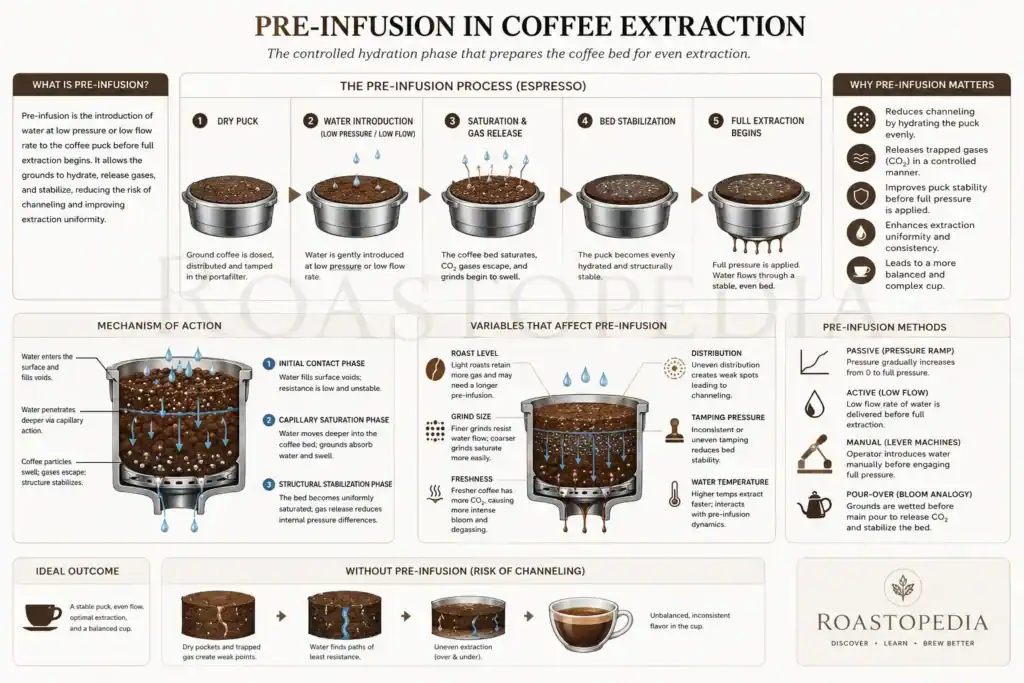
Pre-infusion is a controlled phase in coffee brewing where ground coffee is first exposed to a small amount of water at low pressure before full extraction begins. This stage allows the coffee bed to hydrate and expand gradually before the application of full brewing pressure or full water flow.
In espresso systems, pre-infusion is most commonly associated with espresso extraction using pressurized machines, but the concept also extends to manual brewing methods such as pour-over, immersion hybrid systems, and certain batch brewers.
In essence, pre-infusion functions as a preparatory wetting phase designed to improve extraction uniformity and reduce channeling.
Definition
Pre-infusion is the intentional introduction of water into a bed of ground coffee at a low flow rate or low pressure, prior to full extraction pressure or full flow brewing.
During this phase:
- Coffee grounds absorb water and swell
- Trapped gases (primarily carbon dioxide) begin to escape
- The coffee bed becomes more structurally stable
- Resistance to water flow becomes more uniform
This stage is considered part of the broader process of espresso extraction, particularly in modern espresso brewing systems.
Scientific Basis
To understand pre-infusion, it is necessary to examine the physical behavior of roasted coffee.
Gas Release and Hydration
Freshly roasted coffee contains significant amounts of trapped carbon dioxide, a byproduct of the roasting process. When hot water first contacts dry coffee grounds, this gas begins to rapidly escape.
Without pre-infusion, this rapid degassing can create unstable flow paths through the coffee bed.
During pre-infusion:
- Water slowly penetrates the coffee matrix
- Carbon dioxide is released in a controlled manner
- The coffee bed transitions from dry, compressible particles into a cohesive porous structure
This improves hydraulic consistency during full extraction.
Role in Espresso Extraction
Espresso is a high-pressure extraction method where water is forced through finely ground coffee at approximately 6–9 bars of pressure.
In such a system, uniform resistance is critical.
Pre-infusion acts as a stabilizing phase before full pressure is applied by an Espresso machine.
Key effects in espresso:
- Bed Saturation
- Water evenly wets the puck before pressure increases
- Reduction of Channeling
- Weak points in the puck are minimized before full force is applied
- Improved Extraction Uniformity
- More even solute dissolution across the coffee bed
- Controlled Expansion
- The coffee puck expands gradually rather than explosively
Mechanism of Action
Pre-infusion can be broken down into three mechanical stages:
1. Initial Contact Phase
Water enters the coffee bed and fills surface voids. At this stage, flow resistance is low but unstable.
2. Capillary Saturation Phase
Water begins penetrating deeper layers via capillary action. Grounds swell as they absorb moisture.
3. Structural Stabilization Phase
The coffee bed becomes uniformly saturated, and gas release reduces internal pressure differences.
At the end of this phase, the coffee bed behaves more like a cohesive porous medium rather than a loose granular system.
Methods of Pre-infusion
Pre-infusion is implemented differently depending on brewing technology.
Passive Pre-infusion (Pressure-Based Systems)
Some espresso machines use pressure ramping from pump systems:
- Pressure gradually increases from 0 to full pressure
- Duration varies between 1 and 10 seconds
Active Low-Flow Pre-infusion
Machines control flow rate rather than pressure:
- Water is delivered slowly at low flow
- More consistent than passive ramping
Manual Pre-infusion (Lever Machines)
Baristas manually introduce water before engaging full pressure:
- Highly controllable
- Dependent on operator skill
Pour-over Pre-wetting (Bloom Phase Analogy)
In filter brewing, a similar process occurs:
- Grounds are wetted briefly before the full pour
- Often called “blooming”
- Especially relevant in fresh coffee due to CO₂ release
Variables Affecting Pre-infusion
Several factors influence how pre-infusion behaves:
Roast Level
- Light roasts: higher gas retention, longer degassing phase needed
- Dark roasts: more porous, faster saturation
Grind Size
- Finer grinds slow water penetration
- Coarser grinds reduce resistance
Coffee Freshness
Fresh coffee contains more CO₂, increasing bloom intensity and affecting stability.
Distribution and Tamping
Uneven distribution increases the risk of channeling even with pre-infusion.
Pressure Profile
Machines with adjustable profiles can fine-tune extraction dynamics significantly.
Relationship to Channeling
Pre-infusion is strongly associated with the mitigation of channeling.
Channeling occurs when water finds paths of least resistance through the coffee bed, resulting in uneven extraction.
Pre-infusion reduces this risk by:
- Hydrating dry pockets evenly
- Allowing expansion before pressure spikes
- Stabilizing particulate structure
However, pre-infusion does not eliminate channeling caused by poor grind distribution or tamping inconsistency.
Sensory Impact
Pre-infusion influences cup characteristics indirectly by affecting extraction uniformity.
Common sensory outcomes include:
- Increased sweetness perception due to balanced extraction
- Reduced bitterness caused by over-extraction channels
- Improved clarity in complex coffees
- More consistent crema formation in espresso
However, excessive pre-infusion can sometimes lead to:
- Under-extraction if total contact time is not adjusted
- Loss of intensity in certain roast profiles
Historical Development
Pre-infusion became more prominent with the evolution of espresso technology.
Early Espresso Machines
Early machines relied on direct pressure application with little or no pre-wetting. Extraction variability was higher.
Modern Pump Machines
The introduction of rotary pumps and electronic controls allowed:
- Pressure profiling
- Controlled ramp-up phases
Specialty Coffee Movement
The rise of specialty coffee culture emphasized:
- extraction precision
- repeatability
- pressure and flow control
This led to widespread adoption of pre-infusion as a standard parameter in advanced brewing systems.
Is Pre-Infusion the Same as Blooming?
Pre-infusion and blooming are closely related concepts, but they are not the same.
Both involve the initial wetting of coffee grounds before the main extraction phase and serve a similar purpose: allowing trapped gases, particularly carbon dioxide, to escape while promoting more even water distribution throughout the coffee bed.
Because of these shared objectives, blooming is often described as the filter coffee equivalent of pre-infusion.
The primary difference lies in the brewing environment. Pre-infusion is most commonly associated with espresso preparation, where water is introduced at low pressure or low flow before full extraction pressure is applied.
Blooming, by contrast, occurs in manual and batch-brewed filter coffee methods under atmospheric pressure.
During blooming, a small amount of water is poured over the grounds and allowed to rest briefly before the remaining brewing water is added.
While both techniques aim to improve extraction uniformity, pre-infusion is a controlled phase in a pressurized extraction system, whereas blooming is a degassing stage in non-pressurized brewing methods.
As a result, blooming can be viewed as a specific form of pre-wetting adapted to filter coffee, while pre-infusion represents the broader concept of controlled hydration before full extraction.
Although the terms are sometimes used interchangeably in casual discussions, they refer to distinct processes shaped by the brewing methods in which they occur.
Pre-infusion vs Blooming
Pre-infusion is often compared with blooming, but they are not identical.
| Feature | Pre-infusion | Blooming |
| Brewing method | Espresso / pressure systems | Filter / immersion systems |
| Pressure | Controlled or low pressure | Atmospheric |
| Duration | Seconds | 20–60 seconds |
| Goal | Stabilize puck structure | Release CO₂ |
Both processes rely on the same principle: controlled hydration of fresh coffee.
Common Misconceptions
“Pre-infusion improves all espresso shots”
Not always. Poor grind distribution cannot be corrected by pre-infusion.
“Longer pre-infusion is always better”
Excessively long pre-infusion can flatten extraction dynamics and reduce cup intensity.
“It replaces good puck prep”
Pre-infusion is a refinement tool, not a substitute for proper grinding, dosing, and tamping.
See Also
- Channeling
- Blooming
- Extraction yield
- Puck integrity
- Pressure profiling
- Degassing
- Flow rate dynamics
References
- Illy, Ernesto & Viani, Riccardo (Eds.). Espresso Coffee: The Science of Quality. 2nd Edition. Academic Press, 2005.
- Illy, Andrea & Viani, Riccardo (Eds.). Espresso Coffee: The Science of Quality. 3rd Edition. Academic Press, 2015.
- Clarke, R. J., and Macrae, R. (Eds.). Coffee: Volume 2 – Technology. Elsevier Applied Science, 1987.
- Clarke, R. J., and Vitzthum, Otto G. Coffee: Recent Developments. Blackwell Science, 2001.
- Petracco, Massimo. “Technology IV: Beverage Preparation—Brewing Trends for the New Millennium.” In Coffee: Recent Developments. Blackwell Science, 2001.
- Navarini, Luciano, Nobile, Enrico, Pinto, Francesco, Schievano, Enrico, and Mamolini, Elena. “Experimental Investigation of Espresso Coffee Extraction.” Journal of Agricultural and Food Chemistry, various publications on espresso extraction dynamics.
- Andueza, Susana, de Peña, María Paz, and Cid, Concepción. “Chemical and Sensory Characteristics of Espresso Coffee as Affected by Grinding and Extraction Conditions.” Journal of Food Engineering.
- Rao, Scott. The Professional Barista’s Handbook. Scott Rao Publishing, 2008.
- Rao, Scott. Coffee Roasting: Best Practices. Scott Rao Publishing, 2014.
- Rao, Scott. Coffee Extraction and Brewing Fundamentals. Scott Rao Publishing.
- Hendon, Christopher H. Water for Coffee: Science Story Manual. Published in collaboration with the Specialty Coffee Association.
- Specialty Coffee Association (SCA). Coffee Skills Program: Brewing Foundation, Intermediate, and Professional Manuals.
- Specialty Coffee Association (SCA). Barista Skills Foundation, Intermediate, and Professional Manuals.
- Lingle, Ted R. The Coffee Cupper’s Handbook. Specialty Coffee Association of America.
- Davids, Kenneth. Espresso: Ultimate Coffee. St. Martin’s Griffin.
- Davids, Kenneth. Coffee: A Guide to Buying, Brewing, and Enjoying. St. Martin’s Press.
- Gagné, Jonathan. The Physics of Filter Coffee. Self-published, 2021.
- Schomer, David C. Espresso Coffee: Professional Techniques. Espresso Vivace Publications.
- La Marzocco Technical Documentation and Barista Manuals on Pre-infusion and Pressure Profiling.
- Synesso Technical Training Manuals and Extraction Guides.
- Slayer Espresso Technical Documentation on Flow Profiling and Pre-infusion Systems.
- Victoria Arduino Research Publications and Training Materials on Espresso Extraction.
- Nuova Simonelli Barista Training Manuals and Technical Documentation.
- Coffee Brewing Handbook. Specialty Coffee Association of America (SCAA).
- Lockhart, Ernest E. “The Methylene Blue Absorption Test and Related Studies of Coffee Extraction.” Early foundational coffee extraction research publications.
- Moroney, Kevin M., Lee, William T., O’Brien, Stephen B. G., Suijver, Frank, and Marra, John. “Modelling of Coffee Extraction During Brewing.” AIChE Journal.
- Wang, Ning, Lim, Liang, and others. Research papers on pore structure, gas release, and mass transfer in roasted coffee.
- Navarini, Luciano and Rivetti, Dario. Studies on espresso crema formation, carbon dioxide retention, and extraction mechanics.
- International Organization for Standardization (ISO). Standards related to coffee and coffee preparation terminology.
- International Coffee Organization (ICO). Technical and industry publications concerning coffee processing and beverage preparation.