Macchiato is a drink born from a miscommunication — or more precisely, from the need to avoid one. In the bustling espresso bars of mid-20th century Italy, baristas needed a way to differentiate orders at a glance.
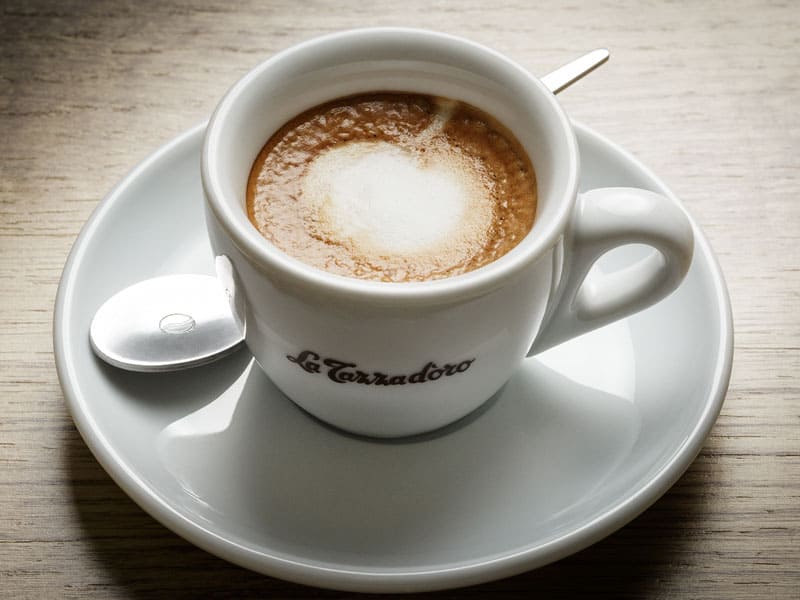
A plain espresso and an espresso with just a touch of milk looked identical in the cup. The solution was elegantly simple: mark the espresso with a spot of milk foam — ‘macchiare’ in Italian — so it could be identified across a crowded bar without confusion.
This practical origin makes the macchiato one of the most honest drinks in the coffee canon. It exists because it needed to exist — not as a culinary invention but as a visual code.
Over time, the dot of foam became a small splash of steamed milk, the proportions stabilized, and the macchiato took its place among the foundational Italian coffee drinks. Its Italian form remains one of the smallest coffee drinks served — just espresso with the barest whisper of milk.
Etymology
‘Macchiato’ is the past participle of the Italian verb ‘macchiare,’ meaning ‘to stain’ or ‘to mark.’ The full original name is ‘caffè macchiato’ — stained coffee — to distinguish it from ‘latte macchiato,’ which is stained milk (a glass of steamed milk marked with a shot of espresso).
The word ‘macchia’ in Italian refers to a stain, spot, or blotch, and is also used in the phrase ‘macchia mediterranea’ to describe the spotted, dappled quality of Mediterranean scrubland. The linguistic family is rich: the drink is named not for what it contains but for the visual mark left upon it.
Cultural Significance
The macchiato is the drink of the Italian coffee insider. Where the cappuccino signals morning ritual and the espresso signals directness, the macchiato signals sophistication — a drinker who wants the intensity of espresso but with the slightest softening of its edge.
In Italian bars, ordering a macchiato requires no elaboration. The barista understands immediately: a single espresso, a small spoon of milk foam or a brief pour of steamed milk, served in the same small ceramic cup as a regular espresso.
The macchiato’s cultural identity was complicated enormously by Starbucks, which introduced the ‘Latte Macchiato’ to global menus in the 1990s and later the ‘Caramel Macchiato’ — a drink bearing almost no relationship to the Italian original.
The Italian coffee community views these with a mixture of bemusement and horror. The caramel macchiato, with its vanilla syrup, caramel drizzle, and large volume, represents the antithesis of the macchiato’s original philosophy of restraint.
The Science of the Brew
The science of the macchiato is primarily the science of espresso, with one additional variable: the interaction between milk proteins and coffee acids. When a small amount of milk is added to espresso, the milk proteins — particularly casein — begin to bind with the tannins and chlorogenic acids in the coffee.
This slightly reduces the perceived bitterness and astringency of the espresso without significantly diluting its flavor or body. The effect is chemical, not merely psychological.
The quantity matters enormously. A true Italian macchiato uses just enough milk foam to ‘mark’ the coffee — approximately 5–10ml. This small volume changes the chemistry at the surface of the espresso but leaves the underlying flavor architecture largely intact.
A larger addition of milk would shift the drink toward a cortado or a piccolo latte.
Taste & Sensory Profile
The macchiato tastes like espresso, but not quite. The milk softens the very first impression — the initial bitterness that can startle newcomers to straight espresso is cushioned — while the complexity, concentration, and lingering finish of the espresso remain fully present.
The foam adds a brief textural contrast. The sweetness contributed by the milk’s lactose is minimal but perceptible. For espresso drinkers who want just slightly less edge, the macchiato is the ideal calibration.
Variations
The caffè macchiato caldo (hot, the standard) contrasts with the caffè macchiato freddo, where cold milk is used instead of steamed. The latte macchiato — which reverses the construction, beginning with a glass of steamed milk into which espresso is poured — is technically the inverse drink: it is primarily milk stained by coffee rather than coffee stained by milk.
In Portugal, a similar drink called ‘pingo‘ or ‘pingo’ (drop) serves the same function. In Spain, the cortado is the closest relative, using more milk but sharing the same philosophy of minimal dilution.
The Perfect Preparation
Pull a single or double espresso into a pre-warmed small ceramic cup. Steam a small quantity of milk (30–40ml) to produce microfoam. Using a small spoon, place a dollop of foam on top of the espresso — or pour a controlled splash (10–15ml) of steamed milk.
The result should be visually distinct from plain espresso: a small pale island of foam on the dark espresso surface. Consume immediately.
Common Mistakes
- Adding too much milk: Even 30ml of liquid milk transforms the macchiato into a different drink.
- Using dry foam: Large bubbles sit on the surface and don’t integrate; only microfoam interacts correctly with the espresso.
- Confusing caffè macchiato with latte macchiato: These are opposite drinks. The ratio of coffee to milk is inverted.
- Serving in a large cup: A macchiato in a 6oz cup is diluted by air and fails to concentrate the aroma properly.
Notable Facts
- The macchiato predates the latte macchiato historically — the term was applied to espresso before it was applied to milk.
- In some regions of southern Italy, ‘macchiato’ at a bar refers specifically to cold milk being added, not foam.
- The Starbucks Caramel Macchiato, introduced in 1996, is technically an upside-down vanilla latte with caramel — the word ‘macchiato’ was chosen for marketing reasons, not technical accuracy.
- Research published in the journal Food Chemistry found that the addition of small amounts of milk to espresso significantly alters the perception of at least 14 key aromatic compounds.
Related Drinks
The macchiato occupies a precise point on the espresso-to-milk spectrum. Below it in milk content is the straight espresso; above it is the cortado, then the piccolo latte, then the flat white, then the cappuccino, then the latte. Understanding the macchiato as a calibration point helps map the entire geography of espresso-based drinks.