
Total Dissolved Solids (TDS), also known as Brew Strength, in the coffee context, refers to the measurable concentration of all substances dissolved within a brewed coffee solution.
These substances — comprising extracted organic compounds, minerals, lipids, acids, sugars, and other soluble matter released from roasted coffee grounds during the brewing process — collectively determine the chemical composition, strength, and sensory profile of the final beverage.
Expressed most commonly as a percentage by weight or in parts per million (ppm), TDS serves as one of the most critical quantitative metrics in specialty coffee science, guiding brewers, roasters, and quality control professionals in assessing extraction quality, brew strength, and overall cup consistency.
Composition and Origins
When hot water contacts roasted coffee grounds, it acts as a solvent, extracting a complex array of chemical compounds from the cellular matrix of the bean. The dissolved solids that remain suspended in the brewed liquid are drawn from several broad chemical families.
Organic acids — including citric, malic, acetic, quinic, and chlorogenic acids — constitute a significant portion of TDS and are primary contributors to the perceived brightness and acidity of coffee.
Carbohydrates and sugars, partially caramelized during roasting, contribute body and sweetness. Melanoidins — high-molecular-weight polymeric compounds formed through Maillard reactions during roasting — contribute viscosity, color, antioxidant properties, and the characteristic mouthfeel of the brewed beverage.
Lipids and oils, though sparingly soluble in water, enter the brew in small quantities and further influence texture.
Caffeine and other alkaloids, along with trigonelline and its pyridine degradation products, round out the biochemical complexity of dissolved solids. Inorganic minerals — potassium, magnesium, sodium, and calcium leached from both the coffee bean and the brewing water itself — also contribute measurably to the total TDS reading.
The variety, origin, roast degree, grind size, water temperature, contact time, and brewing method all influence both the quantity and the sensory character of dissolved solids extracted during brewing.
Measurement
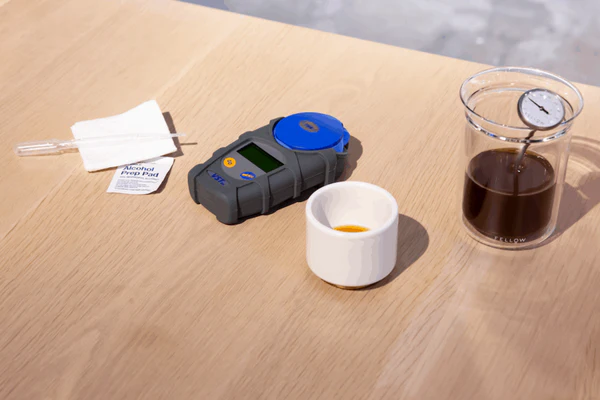
TDS in coffee is measured using a refractometer — an optical instrument that calculates the refractive index of a liquid, meaning the degree to which it bends light relative to pure water.
The greater the concentration of dissolved solids, the higher the refractive index. Specialty coffee refractometers are calibrated specifically for coffee solutions and typically report readings in Brix units, which are then mathematically converted to a TDS percentage.
Digital refractometers, particularly those developed by researcher and equipment specialist Vince Fedele through his VST (Voice Systems Technology) platform, became standard professional tools in the specialty coffee industry during the 2000s and 2010s, enabling baristas and roasters to quantify brew quality with scientific rigor.
The fundamental formula linking TDS to Extraction Yield (EY) is:
Extraction Yield (%) = TDS (%) × Brew Weight (g) ÷ Dose (g)
This calculation allows brewers to determine not merely how concentrated a cup is, but what proportion of the available soluble mass within the coffee grounds was dissolved and transferred into the beverage — a distinction of foundational importance when calibrating any brew recipe.
Brew Strength vs. Extraction Yield
TDS is frequently conflated with extraction yield, but the two metrics describe fundamentally different qualities of the brew. TDS measures strength — the ratio of dissolved solids to total liquid — while extraction yield measures efficiency — the percentage of the ground coffee’s total dry mass that was successfully dissolved.
A coffee can exhibit high TDS yet poor extraction yield if a very small volume of water is used on a large dose of finely ground coffee.
Conversely, a beverage with low TDS may demonstrate high extraction yield if a large volume of water has diluted a well-extracted brew. The ideal outcome, as defined by major specialty coffee bodies, lies at the intersection of both metrics within accepted optimal ranges.
Specialty Coffee Standards
The Specialty Coffee Association (SCA), the leading international authority on coffee quality, has published a Coffee Brewing Control Chart — commonly referred to as the Brewing Control Chart — that maps the relationship between TDS and extraction yield to identify a preferred brew corridor. According to SCA guidelines:
- Optimal TDS range for brewed filter coffee: approximately 1.15% to 1.35% (or 11,500 to 13,500 ppm)
- Optimal extraction yield: approximately 18% to 22% of the dry coffee mass
Coffee brewed within these ranges is generally described as achieving a balanced interplay of sweetness, acidity, body, and clarity. Brews falling below the lower TDS threshold may taste thin or watery; those exceeding the upper threshold may taste heavy, harsh, or overwhelming.
Comparable standards govern espresso, where TDS values are dramatically higher — typically ranging from 8% to 12% — owing to the pressurized, concentrated nature of the brewing method.
These standards represent guidelines derived from large-scale consumer preference research rather than immutable laws of quality. Specialty coffee culture increasingly recognizes that individual palate preferences, cultural brewing traditions, and novel preparation methods may produce outstanding cups outside these conventional boundaries.
Influence of Water Chemistry
The mineral content of brewing water is itself a contributor to TDS, and its role is both complex and consequential. The SCA and the World Barista Championship have published water quality guidelines recommending that brewing water contain a TDS of approximately 75 to 250 ppm prior to contact with coffee, with a target near 150 ppm.
Water that is too pure — such as distilled water with TDS near zero — lacks the mineral ions, particularly magnesium and calcium, necessary to efficiently bind with and extract coffee’s soluble compounds.
Excessively mineralized water can over-extract certain compounds or introduce competing flavors, suppressing the nuanced characteristics of high-quality beans.
Magnesium ions have been identified in scientific literature as having a particularly strong affinity for aromatic compounds in coffee, enhancing perceived flavor complexity. This has prompted a movement among specialty cafés and informed home brewers toward water customization, in which filtered or distilled water is remineralized to precise mineral profiles using food-grade additives.
TDS in Espresso

In espresso preparation, TDS assumes an especially prominent role due to the method’s inherently high concentration. A shot of espresso — brewed by forcing near-boiling water through a compressed puck of finely ground coffee at approximately 9 bars of pressure — typically yields a beverage with TDS values far exceeding those of filter coffee.
The thick, syrupy body and intense flavor of a well-pulled espresso shot are direct sensory expressions of its elevated dissolved solid concentration.
Espresso baristas use TDS measurements alongside shot ratio — the relationship between dry coffee dose and liquid espresso weight — to calibrate their recipes. Adjustments to grind size, dose, water temperature, pressure profiling, and extraction time are all evaluated in terms of their effect on TDS and extraction yield.
Melanoidins are particularly significant in espresso chemistry, as these polymers stabilize the carbon dioxide bubbles responsible for crema and account for much of the beverage’s characteristic viscosity.
Practical Applications
For café operators, roasters, and quality-focused baristas, routine TDS measurement provides actionable diagnostic data. A sudden drop in TDS from a normally consistent recipe may signal grinder burr wear, a change in coffee freshness, an inconsistency in dose weight, or a shift in water supply chemistry.
A spike in TDS might indicate calibration drift toward finer particle sizes or a change in roast degree.
In multi-outlet coffee operations — and particularly for brands seeking consistency across many locations — TDS measurement provides an objective, reproducible language for communicating and replicating brew standards regardless of individual barista skill level.
Written brew protocols expressed in TDS targets, alongside extraction yield ranges and full recipe parameters, form the backbone of quality management programs in modern specialty coffee operations.
Limitations as a Quality Metric
Despite its utility, TDS is not a complete measure of coffee quality. It quantifies how much is dissolved but reveals nothing about what is dissolved.
A poorly extracted coffee and a beautifully crafted one may register identical TDS values if they happen to share the same overall concentration — even as their sensory profiles differ dramatically.
For this reason, TDS is best understood as one instrument within a broader toolkit of quality assessment that includes trained sensory evaluation, extraction yield calculation, water chemistry analysis, and rigorous recipe documentation.
In professional specialty coffee environments, cupping and sensory analysis remain irreplaceable complements to any data-driven measurement protocol, ensuring that scientific precision serves — rather than replaces — human taste and judgment.
See Also
The following related concepts, documented at Roastopedia.com, provide deeper context for understanding Total Dissolved Solids in coffee:
- Extraction — the process by which water draws soluble compounds from roasted coffee grounds
- Melanoidins — high-molecular-weight brown polymers that constitute a major share of dissolved solids
- Maillard Reaction — the thermochemical reaction responsible for melanoidin formation during roasting
- Calibration — the process of adjusting brewing equipment to achieve target TDS and extraction yield
- Cupping — standardized sensory evaluation used alongside TDS measurement
- Coffee Acidity — dissolved organic acids are a primary component of TDS in brewed coffee
- Espresso — the brewing method with the highest TDS concentrations in coffee
- Crema — the foam layer in espresso stabilized by melanoidins extracted as dissolved solids
- Degassing — the release of CO₂ from roasted coffee, which affects extraction and TDS dynamics
- Coffee Roast Level — roast degree directly influences the composition and solubility of dissolved solids
- Dosing — the measurement of ground coffee used in calculating extraction yield from TDS
- Rate of Rise (RoR) — the heat application curve during roasting that determines melanoidin development
- Pyrolysis — excessive thermal degradation that alters the soluble compound profile in roasted coffee
- Cold Brew — an immersion method producing distinctive TDS profiles through extended low-temperature extraction
- Coffee Flavor Wheel — the sensory framework used to describe the flavor compounds dissolved in the brewed beverage
References
- Specialty Coffee Association. SCA Water Quality Handbook. SCA, 2018.
- Specialty Coffee Association. Brewing Control Chart. SCA Standards Document, 2021.
- Rao, Scott. The Coffee Roaster’s Companion. Scott Rao, 2014.
- Rao, Scott. The Professional Barista’s Handbook. Scott Rao, 2008.
- Hoffman, James. The World Atlas of Coffee. 2nd ed. Mitchell Beazley, 2018.
- Yerlan Abenov et al. “Influence of Water Hardness on Coffee Extraction and Sensory Quality.” Food Chemistry, vol. 312, 2020, pp. 125–134.
- Maillard, Louis Camille. “Action des acides aminés sur les sucres: formation des mélanoidines par voie méthodique.” Comptes rendus de l’Académie des Sciences, vol. 154, 1912, pp. 66–68.
- Bekedam, E. K., et al. “Incorporation of Chlorogenic Acids in Coffee Brew Melanoidins.” Journal of Agricultural and Food Chemistry, vol. 56, no. 6, 2008, pp. 2055–2063.
- Moreira, A. S. P., et al. “Coffee Melanoidins: Structures, Mechanisms of Formation and Potential Health Impacts.” Food & Function, vol. 3, no. 9, 2012, pp. 903–915.
- Perger, Matt. Barista Hustle: Understanding Extraction. Barista Hustle, 2016. barista-hustle.com.
- Fedele, Vince. VST Coffee Tools: Refractometry in Coffee. VST Inc., 2011.
- Córdoba, Nelson, et al. “Effect of Brewing Method and Particle Size on the Chemical Profile of Coffee Brews.” LWT — Food Science and Technology, vol. 111, 2019, pp. 228–236.
- Andueza, S., et al. “Extraction of Coffee Aroma Compounds with Different Drip Coffee Makers.” Journal of Chromatography A, vol. 1033, no. 1, 2004, pp. 55–61.
- Gloess, Alexia N., et al. “Evidence of Different Flavour Formation Dynamics by Roasting Coffee from Different Origins.” Food Chemistry, vol. 145, 2014, pp. 245–252.
- Lingle, Ted R. The Coffee Brewing Handbook. 2nd ed. Specialty Coffee Association of America, 1996.
- Petracco, Marino. “Technology IV: Beverage Preparation: Brewing Trends for the New Millennium.” Coffee: Recent Developments, ed. R. J. Clarke and O. G. Vitzthum, Blackwell Science, 2001, pp. 140–164.
- Wellinger, Marco, et al. “Pressure Profiling of Espresso: Effect on the Chemical Profile of the Brew.” Journal of Agricultural and Food Chemistry, vol. 59, no. 24, 2011, pp. 13085–13091.