
The Moka pot, also known as the stovetop espresso maker, is a pressure-driven coffee brewing device invented in Italy in the early 20th century. It produces a concentrated coffee beverage by forcing heated water through ground coffee using steam pressure.
Although often associated with espresso because of its strong flavor and concentrated character, the Moka pot does not generate the high pressure required for true espresso extraction (see extraction).
The device became one of the most influential domestic coffee makers in the world, particularly across Italy, Europe, Latin America, and parts of the Middle East. Its distinctive octagonal design and stovetop operation made it both a practical household appliance and a cultural icon of Italian coffee culture.
History
The Moka pot was invented in 1933 by Italian engineer Alfonso Bialetti. Inspired by contemporary laundry machines that used steam pressure to circulate water, Bialetti designed a compact metal coffee maker for home use. He named it Moka Express after the Yemeni port city of Mocha (Moka), historically associated with the global coffee trade.
The original design featured an aluminum body with an eight-sided shape that improved heat distribution and gave the pot its recognizable appearance.
During the mid-20th century, the Moka pot became a staple in Italian households, especially in the postwar period when espresso machines were expensive and uncommon in homes.
Bialetti’s company successfully popularized the device through mass production and memorable advertising campaigns.
Over time, the term “moka pot” became a generic name for stovetop pressure coffee makers, regardless of the manufacturer.
Today, the Moka pot remains widely used worldwide and is regarded as one of the classic manual coffee brewing methods.
Brewing Principle
The Moka pot operates through a combination of steam pressure, heat, and percolation extraction. It consists of three chambers:
- Lower chamber (boiler): Holds water.
- Middle chamber (filter basket): Holds ground coffee.
- Upper chamber (collector): Receives the brewed coffee.
When the pot is heated on a stove, water in the lower chamber approaches the boiling point and generates steam. The expanding steam pressure forces hot water upward through the coffee grounds in the filter basket. The extracted coffee then rises through a central tube into the upper chamber.
Typical operating pressure is about 1–2 bar, significantly lower than the 9 bar standard for espresso machines. As a result, Moka coffee is concentrated and full-bodied but lacks the thick crema characteristic of espresso.
A standard Moka pot is traditionally made from aluminum, though stainless steel versions are also common. The main components include:
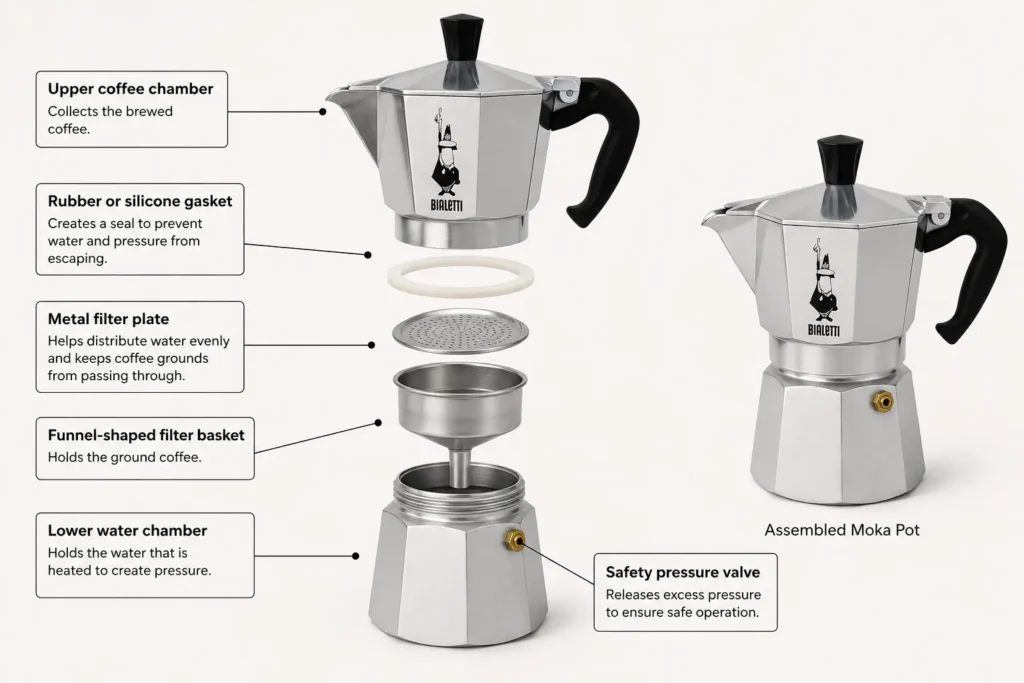
- Lower water chamber.
- Funnel-shaped filter basket.
- Upper coffee chamber.
- Rubber or silicone gasket.
- Metal filter plate.
- Safety pressure valve.
Supporting equipment often used with the method includes:
- Burr coffee grinder.
- Kettle for preheating water.
- Digital scale.
- Stove or heat source.
Preparation Method
The preparation of coffee in a Moka pot follows a standardized process:
- Fill the lower chamber with water up to, but not above, the safety valve.
- Insert the filter basket into the lower chamber.
- Fill the basket with medium-fine ground coffee and level it without tamping.
- Screw the upper chamber securely onto the lower chamber.
- Place the pot on a stove over medium heat.
- Allow the water to heat until brewed coffee begins to emerge into the upper chamber.
- Remove the pot from the heat when the flow becomes pale or sputtering begins.
- Stir the coffee in the upper chamber gently before serving.
Typical brewing ratios range from 1:7 to 1:10 coffee-to-water by weight, depending on the desired strength.
Characteristics
Flavor Profile
Moka pot coffee is known for its strong, intense, and robust flavor. Compared with drip coffee (see Hario V60), it has greater body and concentration. Compared with espresso, it is generally less sweet and less creamy, with more pronounced bitterness when over-extracted.
Aroma
The brew often exhibits a rich roasted aroma with pronounced chocolate, nutty, and caramelized notes, especially when prepared with traditional Italian-style dark roasts.
Body and Mouthfeel
Moka coffee has a heavy body and an oily texture because the metal filter allows more coffee oils and fine particles to pass into the cup than paper-filter methods do.
Appearance
The beverage is dark and concentrated, typically served in small cups similar to espresso servings. A thin foam may appear on top, but it is not true espresso crema.
Variations
Several variations of the Moka brewing method exist:
Italian Moka
The classic preparation uses dark-roasted coffee and produces a strong, concentrated beverage served in small cups.
Latte or Cappuccino Base
In many households, Moka coffee is combined with steamed or heated milk to create drinks resembling lattes or cappuccinos.
Cuban Cafetera
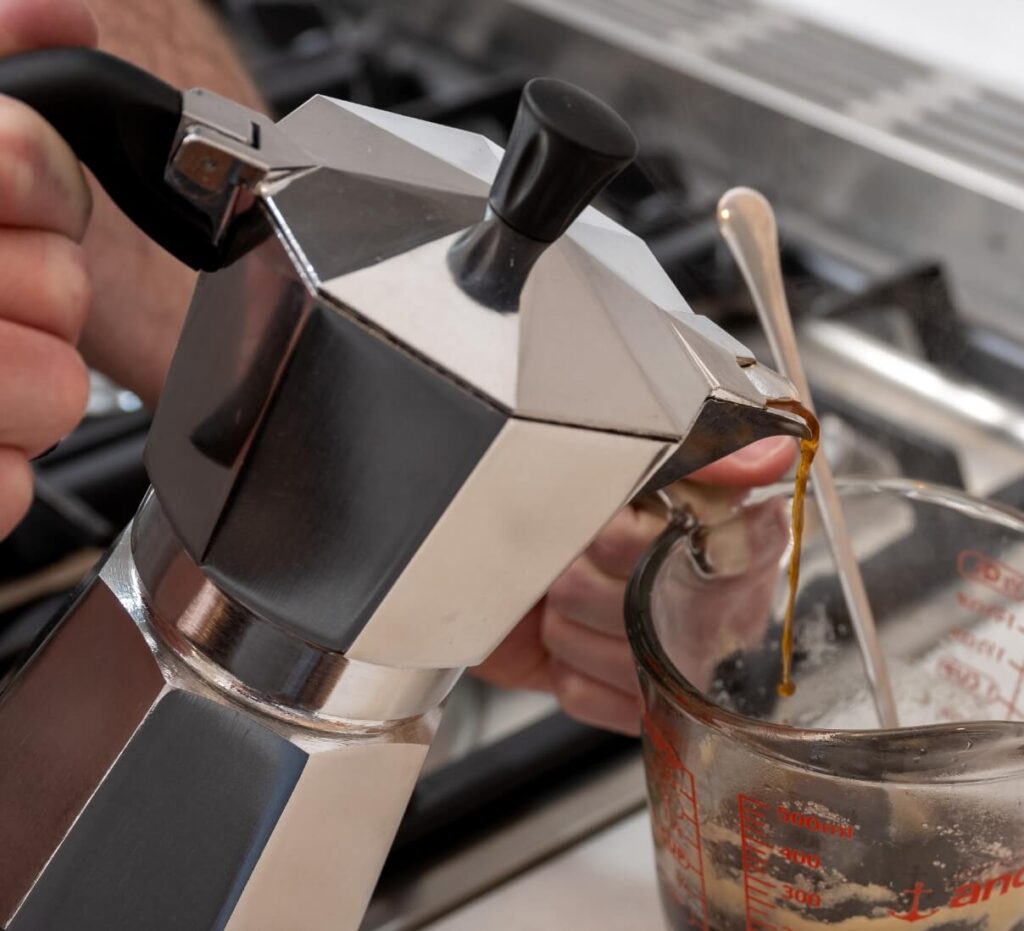
In Cuba, a larger Moka pot for Cuban coffee called a cafetera is used to brew strong coffee sweetened with sugar whipped into the first drops of extraction, producing espuma.
Modern Specialty Adaptations
Specialty coffee enthusiasts often use lighter roasts, precise temperature control, and preheated water to achieve cleaner and sweeter extractions.
Cultural Significance
The Moka pot occupies a central place in Italian domestic culture. For decades, preparing coffee in a Moka pot has been a daily ritual in Italian homes, associated with hospitality, family life, and the rhythm of everyday living.
Beyond Italy, the device became popular in Spain, Portugal, Brazil, Argentina, Cuba, and North Africa. Its affordability and durability made it accessible across social classes, contributing to the global spread of concentrated coffee drinking traditions.
In the specialty coffee era, the Moka pot has experienced renewed interest as a manual brewing method capable of producing complex and flavorful coffee when used carefully.
Advantages
- Produces concentrated, full-bodied coffee.
- Requires no electricity when used on a stovetop.
- Compact and portable.
- Durable and long-lasting.
- Relatively inexpensive compared with espresso machines.
- Allows repeated use without disposable paper filters.
Limitations
- Does not produce true espresso crema.
- Can easily over-extract and become bitter if overheated.
- Requires careful heat management.
- Small brewing capacity in standard models.
- Fine coffee particles may appear in the cup due to metal filtration.
Comparison with Other Brewing Methods
| Brewing Method | Extraction Type | Filter Type | Body | Typical Brew Time |
| Moka Pot | Pressure/Percolation | Metal | Heavy | 3–6 min |
| Espresso | High Pressure | Metal | Heavy | 20–30 sec |
| French Press | Immersion | Metal | Heavy | 4–6 min |
| V60 Pour Over | Percolation | Paper | Light | 2–4 min |
| AeroPress | Immersion/Pressure | Paper or Metal | Medium | 1–3 min |
Legacy and Influence
The Moka pot is one of the most enduring coffee inventions of the 20th century. Its design has remained largely unchanged since 1933, a testament to its functional effectiveness and cultural resonance.
It helped democratize concentrated coffee brewing by bringing a café-style beverage into the home at low cost. The device also influenced later innovations in portable and manual brewing that emphasized simplicity, durability, and user control.
Today, the Moka pot is displayed in industrial design museums, celebrated in Italian cultural history, and still used daily by millions of coffee drinkers worldwide.
See Also
- Espresso.
- French Press.
- Pour Over Coffee.
- AeroPress.
- Vacuum Coffee Maker.
- Italian Coffee Culture.
References
- Bialetti Industrie. History of the Moka Express. Official company archives.
- Illy, Andrea; Viani, Rinantonio. Espresso Coffee: The Science of Quality. Academic Press.
- Rao, Scott. The Coffee Brewer’s Handbook. Scott Rao Publishing.
- Pendergrast, Mark. Uncommon Grounds: The History of Coffee and How It Transformed Our World. Basic Books.
- Specialty Coffee Association (SCA). Brewing Fundamentals and Extraction Standards.
- International Coffee Organization (ICO). Coffee Brewing and Consumption Resources.
- Davids, Kenneth. Coffee: A Guide to Buying, Brewing, and Enjoying. St. Martin’s Press.