
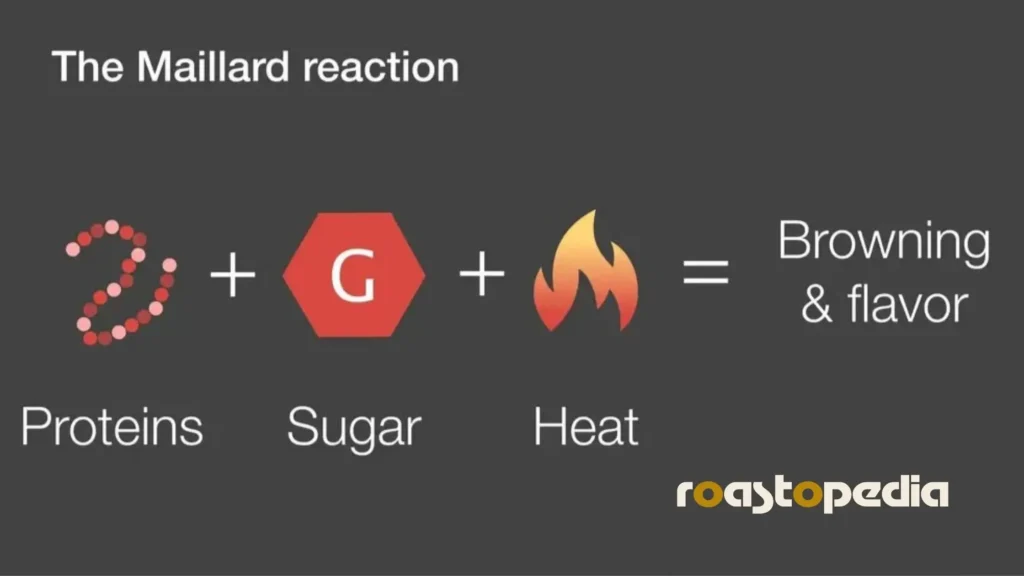
The Maillard reaction is a multifaceted sequence of non-enzymatic chemical transformations between amino acids and reducing sugars that occurs under the influence of elevated temperatures.
In the field of coffee chemistry, this reaction serves as the fundamental mechanism for the generation of hundreds of aromatic compounds, the development of complex flavor profiles, and the initial browning of the green coffee seed. This process is not a single isolated event but a cascade of parallel and sequential reactions that fundamentally redefine the chemical and physical identity of the bean.
Without the catalytic energy provided during this stage of the roast, the coffee beverage would lack its characteristic savory, toasted, and sweet attributes, remaining essentially a thin, vegetal infusion of raw plant material.
Overview
Thermodynamic induction of the Maillard reaction typically initiates when the internal temperature of the coffee bean reaches approximately 140°C (284°F). This threshold marks the transition from the moisture-heavy Drying Phase to the browning phase, where the first significant color changes become visible. The reaction involves the nucleophilic attack of the nitrogen in an amino acid’s amino group on the electrophilic carbon of a reducing sugar’s carbonyl group. This initial condensation is followed by a series of molecular rearrangements that lead to the formation of unstable glycosylamines and more stable Amadori products. As the roast progresses, these intermediates degrade further into a wide array of volatile and non-volatile compounds that constitute the core sensory experience of the beverage.
The management of this reaction is the primary focus of profile development for both Arabica Coffee and Robusta Coffee. By controlling the Rate of Rise (RoR) during this phase, roasters can influence the final concentration of sugars, acids, and aromatic precursors. A prolonged duration in the Maillard phase allows for a greater accumulation of intermediate compounds, which can enhance the perceived sweetness and mouthfeel. Conversely, a rapid transition may preserve a higher level of inherent acidity but can result in a lack of flavor depth. The successful execution of this chemical transition is what allows the roaster to unlock the unique sensory potential associated with the coffee’s origin and processing method.
Origin & History
The scientific exploration of these browning mechanisms began in the early twentieth century with the French physician and chemist Louis Camille Maillard. In 1912, Maillard published his findings on the reaction between sugars and proteins, primarily investigating the biological implications for human health. While his work was not initially focused on culinary applications, it provided the essential chemical framework for understanding how food transforms under heat. The complexity of the reaction was so significant that it took another forty years for the scientific community to develop a comprehensive model of its pathways. In 1953, the American chemist John E. Hodge published a definitive paper that established the multi-stage mechanism now used as the global standard for non-enzymatic browning research.
In the coffee industry, the formal application of Maillard’s theories gained prominence as roasting shifted from an artisanal craft to a specialized industrial science. During the mid-twentieth century, researchers began to correlate specific temperature curves with the concentration of volatile aromatic compounds in the roasted bean. This era saw the development of the first chemical databases identifying furans, pyrazines, and thiols as products of the Maillard pathway. The ability to measure these outcomes enabled commercial producers to standardize their flavor profiles and reduce the variability associated with traditional roasting methods. This historical transition turned the roasting drum into a chemical reactor where every variable was precisely monitored and controlled.
The contemporary history of Maillard research in coffee is defined by the integration of digital data logging and molecular sensory analysis. Modern roasters use high-resolution thermocouples to track the exact moment the browning phase begins and ends, allowing for the replication of high-complexity flavor profiles with nearly 100% accuracy. The rise of the specialty coffee movement has further pushed the boundaries of this science, with roasters now targeting specific “Maillard intervals” to highlight delicate floral or fruity notes identified on the Coffee Flavor Wheel. This evolution from general observation to molecular precision has elevated the status of the coffee roaster to that of a technical professional in the field of food chemistry.
Etymology
The linguistic origins of the term are rooted in the patronymic recognition of its discoverer, Louis Camille Maillard. While the phenomenon of browning had been observed since the discovery of fire, the specific chemical interaction required a unique technical designation to separate it from simpler processes like caramelization. In professional literature, it is often referred to as “non-enzymatic browning” to distinguish it from the enzymatic reactions that cause fruit to brown at room temperature. The adoption of the term “Maillard reaction” provided a standardized global vocabulary for scientists and food producers to discuss the complex formation of flavor and color under heat.
Usage of the term within the coffee roasting community serves as a technical bridge between the physical state of the bean and its chemical maturity. Professionals use the word Maillard to describe the specific window of the roast between the conclusion of the Drying Phase and the onset of First Crack. This terminology replaces vaguer descriptors like “the middle of the roast” with a precise chemical marker. By standardizing this vocabulary, the industry ensures that roasters in different parts of the world can share data and techniques with absolute clarity. The word has thus become an essential component of the technical documentation required for modern roast profiling and quality assurance.
Linguistic nuances in the field also distinguish between the “Maillard phase” and “Maillard products.” The former refers to the temporal window during the roast where the reaction is most active, while the latter refers to the resulting chemical compounds like melanoidins. This distinction is vital for researchers who must account for the accumulation of intermediates versus the final polymeric structures. Using such specific technical language allows for a more rigorous assessment of how roasting variables affect the ultimate sensory quality of the beverage. By identifying the reaction by its correct name, the industry maintains a professional standard that aligns with broader academic and scientific practices.
Professional Evolution
Technical expertise in managing the Maillard reaction has evolved from a reliance on visual color changes to a mastery of thermodynamic profiling. In the traditional era, roasters determined the end of the browning phase simply by observing the shift from yellow to light brown. Today, the professional roaster uses computerized software to track the Rate of Rise (RoR) and ensure that the heat application remains stable through the Maillard interval. This evolution has moved the industry away from reactive roasting—where the operator responds to changes after they occur—toward predictive roasting, where the operator anticipates and controls the chemical trajectory of the batch.
The role of the specialty coffee professional now includes the ability to interpret the molecular impact of different Maillard durations. Specialists are trained to understand how a longer Maillard phase increases the concentration of high-molecular-weight melanoidins, which in turn enhances the body and viscosity of the beverage. This knowledge is applied daily in the calibration of roasting profiles for specific brewing methods, such as espresso versus filter coffee. The professional evolution in this area has created a more analytical workforce capable of connecting the physics of the Roaster directly to the chemical reality of the cup.
Advanced educational programs, such as those governed by the Specialty Coffee Association, now feature rigorous technical modules on non-enzymatic browning and its precursors. Professional roasters must demonstrate a documented understanding of how sugar content and amino acid profiles vary between different coffee cultivars and processing methods. This technical literacy ensures that the management of the Maillard reaction is based on empirical data rather than artisanal myth. As a result, the contemporary coffee roaster is recognized as a skilled practitioner in a high-precision field, capable of manipulating molecular outcomes to achieve a specific sensory goal.
Technical Responsibilities
Precision in controlling the temperature ramp through the 140°C to 170°C window is the most significant technical responsibility during the browning phase. The roaster must ensure that the internal bean temperature rises at a consistent rate to allow the complex chemical precursors to fully transform. If the ramp is too rapid, the reaction may be incomplete, leading to a flavor profile that is underdeveloped and lacks aromatic complexity. Conversely, if the heat application is too slow, the beans can become “stalled,” a state where the chemical reactions cease to progress productively, resulting in a flat or “baked” sensory profile in the final Extraction.
Quality control technicians are responsible for monitoring the “Time to Brown” (TTB) and ensuring it remains within the established parameters for each specific product line. This technical documentation is essential for maintaining brand consistency across different roasting locations and shifts. Any deviation in the duration of the Maillard phase must be investigated to determine if it was caused by changes in gas pressure, airflow, or the moisture content of the green seeds. By treating the Maillard reaction as a measurable industrial procedure, the facility ensures that every batch meets the required chemical and sensory benchmarks for commercial release.
In industrial facilities, technical responsibilities also include the maintenance of the sensors and probes that track the Maillard progression. High-precision thermocouples must be kept clean and properly calibrated to ensure they provide an accurate representation of the thermodynamic changes occurring inside the drum. The failure of a single sensor can lead to the mismanagement of the browning phase, ruining the chemical potential of the entire batch. The technician must also ensure that the airflow systems are optimized to remove the byproduct moisture released during the initial condensation reactions. This operational focus is critical for preserving the heat momentum required to navigate the transition into First Crack.
Sensory Requirements
Perceiving the transition from the “bready” and “cereal-like” aromas of the early Maillard phase to the more complex “toasted nut” and “caramel” scents is a foundational sensory requirement. A professional roaster uses the sampling tool to pull beans from the drum at regular intervals during the browning phase to smell the volatile gases. This auditory and olfactory feedback provides an immediate assessment of how the sugar-protein reactions are progressing. Identifying the specific point where the savory notes are balanced by developing sweetness is the technical cue that the batch is ready to transition into the final development stage.
Visual sensitivity to the subtle shifts in brown pigmentation is also a critical requirement for evaluating Maillard development. The professional taster looks for a uniform color across the entire batch, which indicates an even heat distribution and a successful chemical transformation. Any presence of “quakers”—unripe beans that remain pale despite the heat—indicates a lack of sugar precursors and a failed Maillard reaction. Sensory experts use these visual markers to predict the body and Coffee Acidity of the sample before the final Cupping takes place. This ability to link visual evidence to chemical state is a hallmark of professional mastery in the field.
Identifying the specific bitterness associated with over-developed Maillard products is another essential sensory skill. While some bitterness is desirable for providing structural balance, a “metallic” or “harsh” bitterness signals that the reactions have begun to incorporate too many chlorogenic acid degradation products. This defect is technically different from the bitterness caused by Pyrolysis or poor water chemistry during brewing. A trained palate can isolate these molecular nuances, providing the necessary data for the roasting team to refine the thermal profile and achieve a cleaner, sweeter profile in future production cycles.
The Science of the Brew
Diffusion is the primary physical process that brings the products of the Maillard reaction into the liquid beverage. During the roasting process, the formation of melanoidins significantly alters the structural density and porosity of the coffee bean. When hot water is applied to the ground coffee, these polymers act as natural surfactants, lowering the surface tension of the water and facilitating the dissolution of aromatic compounds. The success of the Maillard reaction during the roast thus dictates the efficiency of the Extraction in the café. A well-developed Maillard profile ensures that the beverage has a pleasing weight and a complex, lingering Aftertaste.
The interaction between Maillard products and volatile organic compounds is also a key factor in the stability of coffee aroma. Melanoidins have the technical capacity to bind with certain aromatic molecules, such as thiols and furans, through a process known as flavor entrapment. This sequestration slows the rate at which the coffee’s fragrance is lost to the environment after the beans are ground. During the brewing process, these trapped aromatics are slowly released as the polymeric structure is hydrated, providing a consistent sensory experience throughout the consumption of the drink. This scientific relationship ensures that the high aromatic potential created in the Roaster is preserved and delivered to the final consumer.
Total Dissolved Solids (TDS) measurements in the finished cup are heavily influenced by the concentration of water-soluble Maillard intermediates. Because these compounds constitute a significant portion of the bean’s soluble mass, their development directly impacts the strength and mouthfeel of the beverage. Professional brewers use refractometers to verify that the target extraction yield has been achieved, ensuring that the sensory notes identified on the Coffee Flavor Wheel are clearly perceptible. This analytical approach links the thermal history of the roast to the mathematical reality of the brew, providing a complete technical narrative of the coffee’s transformation.
Notable Facts
Approximately eight hundred different volatile chemical compounds have been identified as products of the Maillard reaction in roasted coffee. This extraordinary chemical diversity is what makes coffee one of the most complex food products in the human diet, surpassing wine and chocolate in its aromatic variety. The specific classes of compounds produced—such as furans, pyrazines, and pyrroles—are dictated by the balance of sugars and amino acids in the green seeds. This complexity is the technical reason why coffee can exhibit a wide range of sensory notes, from “nutty” and “savory” to “caramelized” and “earthy,” without the addition of external flavorings.
The Maillard reaction is responsible for generating the vast majority of the “roasty” and “toasted” aromas that consumers associate with the fragrance of freshly ground coffee. While inherent “origin” notes like floral or citrus acidity are preserved from the green bean, the Maillard pathway provides the essential background complexity that turns a simple infusion into a rich beverage. Scientific research has indicated that the peak production of these aromatic volatiles occurs just as the beans reach the onset of First Crack. This finding highlights the technical importance of managing the browning phase with absolute precision to capture the flavor potential of the harvest at its highest level.
Biological activity of the Maillard products in coffee includes significant antioxidant and anti-inflammatory properties. The high-molecular-weight melanoidins have been shown to inhibit lipid peroxidation and neutralize free radicals in the human body. This health-promoting attribute is a direct result of the complex chemical bonds formed during the browning phase of the roast. Furthermore, these compounds contribute to the dietary fiber content of the beverage, as they are resistant to human digestive enzymes. By documenting these facts, the industry can better communicate the nutritional and technical value of roasted coffee to an increasingly health-conscious global market.
Related Concepts
Chemical intermediates generated during the Maillard reaction are the primary reactants for Strecker degradation, which produces the most potent and volatile aroma compounds in the roast. This secondary pathway is functionally dependent on the success of the initial sugar-protein condensation, illustrating the interconnected nature of coffee chemistry. A roaster who masters the Maillard phase is essentially managing the “fuel supply” for the aromatic explosion that occurs during the development window. This technical interlinking ensures that flavor and body are developed as part of a single, coherent thermal strategy.
Thermal transitions during the roast also bridge the Maillard phase to the later stages of Pyrolysis and carbonization. While the Maillard reaction is primarily productive, pyrolysis is destructive, breaking down the chemical compounds into smoke and bitter carbon. The roaster’s objective is to maximize Maillard development while minimizing pyrolytic damage, a task that requires a deep understanding of the Rate of Rise (RoR) and the physical behavior of the bean mass. This operational logic is what defines the Coffee Roast Level and its ultimate suitability for different markets and brewing styles.
Structural expansion initiated by the moisture loss in the Drying Phase is a prerequisite for a uniform and effective Maillard reaction. If the beans have not been properly dried, the heat penetration will be uneven, leading to a fragmented chemical development. The removal of the Chaff and the management of the Degassing period following the roast are additional technical steps that preserve the sensory integrity of the Maillard products. Proper technical hygiene and equipment maintenance, such as regular cleaning of the cooling tray, are essential for showcasing the true chemical potential established during the browning phase.