
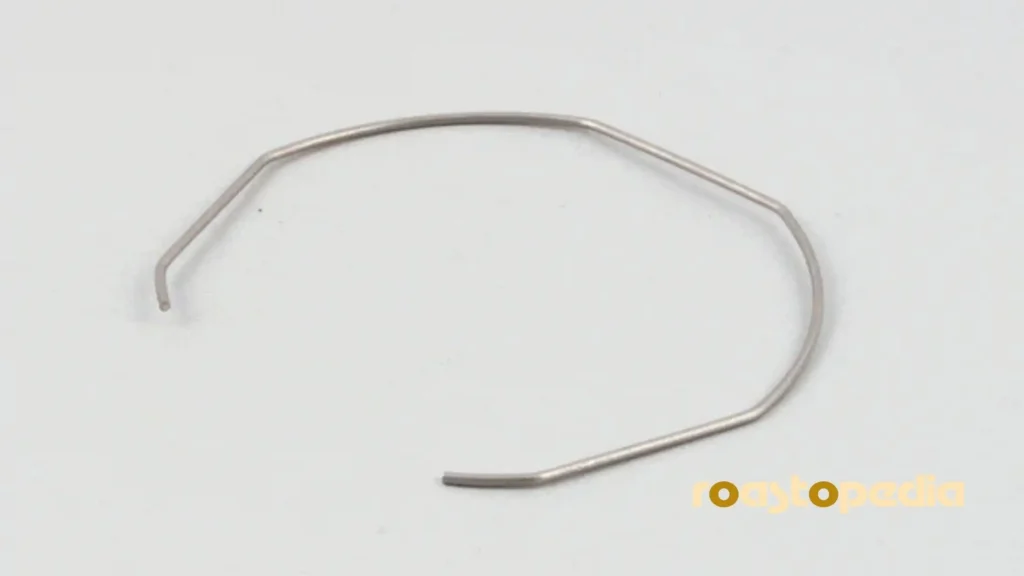
Basket spring is a tensioned wire clip located inside the rim of a portafilter body that holds the filter basket securely in place. This simple mechanical device prevents the basket from falling out when the barista knocks out spent coffee pucks into a waste bin.
It provides the necessary friction to allow for a quick and reliable workflow without sacrificing the modularity of the brewing system.
Origin & History
The requirement for a basket-retention system emerged as espresso preparation moved toward the high-speed “knockbox” workflow in commercial cafes. Early portafilters often lacked any internal grip, requiring the barista to hold the basket in place with their thumb while emptying it. This was not only inefficient but also carried a significant risk of burns from the hot metal and steam.
Evolution of the spring clip allowed for the standardization of portafilter designs across different manufacturers and equipment lines. By the middle of the twentieth century, the “spring-retained” basket had become the industry standard for both professional and domestic espresso machines. This innovation enabled the fast-paced, repetitive motions that define the modern barista’s daily labor.
Precision manufacturing has recently introduced springs with different tension levels to suit the preferences of individual practitioners. Some baristas prefer a very stiff spring for maximum security, while others choose a lighter tension for easier basket removal during cleaning. Such small technical refinements reflect the growing focus on the “feel” and ergonomics of the professional coffee workstation.
Etymology
Etymological roots of the term are entirely functional, combining the object being held with the mechanical force being applied. The word “spring” traces back to the Old English ‘springan,’ meaning to leap or jump, which describes the wire’s tendency to return to its original shape. It is a literal name for a literal component that performs a singular and vital task.
Global usage of the term within the coffee industry is consistent, though it is occasionally referred to as a “retaining clip” or “tension wire.” In some technical manuals, it is listed as the “portafilter spring” to distinguish it from the larger springs found inside the group head or the pump. All these names describe the same essential piece of hardware found in almost every portafilter on earth.
Technical nomenclature often specifies the spring by its thickness, which is typically measured in millimeters. A “1.0mm spring” will provide a different level of resistance than a “1.2mm spring” when used in the same portafilter body. This level of detail is usually only relevant to technicians and enthusiasts who are fine-tuning the tactile response of their equipment.
Professional Evolution
Technical standards for the basket spring have remained largely unchanged for decades, serving as a testament to the simplicity and efficiency of the design. However, the rise of the specialty coffee movement has increased the frequency with which baristas remove their baskets for deep cleaning. This has led to a greater appreciation for springs that maintain their tension over thousands of removal cycles.
High-end portafilter manufacturers now often include multiple springs of varying tensions with their premium handle assemblies. This allows the user to customize the “pop” of the basket to their specific strength and cleaning habits. Such customization is a hallmark of the modern specialty industry, where every touchpoint of the equipment is scrutinized for quality.
Digital training and maintenance logs now include the checking of spring tension as a routine part of equipment stewardship. A loose spring can cause a basket to fall into a trash bin or knockbox, leading to lost time and potential damage to the delicate precision filter. Proactive replacement of this inexpensive part prevents these minor but frustrating operational failures.
Technical Responsibilities
Ensuring that the spring is correctly seated within its internal groove is the most important technical requirement for the component. If the spring is twisted or improperly installed, it can prevent the basket from sitting level, which leads to uneven tamping and extraction. A flat and secure basket is the foundational requirement for any successful espresso shot.
Regularly removing the spring to clean the area behind it is a non-negotiable part of the weekly deep-cleaning schedule. Coffee oils and moisture can become trapped in the narrow channel where the spring rests, leading to the development of rancid odors and mold. Keeping this hidden area clean ensures that the overall flavor profile of the cafe remains pure and untainted.
Adjusting the tension of a spring can be easily done with a pair of pliers by slightly increasing or decreasing its overall curvature. This simple maintenance task allows a barista to restore the “grip” of an older portafilter without needing to purchase new parts. Mastery of these small mechanical adjustments is a key sign of a self-sufficient and professional coffee technician.
Engineering & Mechanics
Friction is the primary physical force used by the spring to keep the filter basket anchored within the portafilter body. The wire is slightly larger than the internal diameter of the handle, forcing it to press outward against the metal walls. This outward pressure creates a secure hold that can withstand the jarring impact of the knockbox.
Materials used for the construction of the spring must be resistant to corrosion and the high temperatures of the brewing group. Most high-quality springs are made from stainless steel or chrome-plated spring steel to ensure a long and rust-free lifespan. These materials maintain their elasticity even after being subjected to constant heat and chemical cleaners.
Design of the spring is usually a simple “U-shape” or a multi-angled clip that follows the internal contour of the portafilter. Some manufacturers use a circular ring, but the angled design is generally preferred for its ease of installation and removal. The ends of the spring are often slightly blunted or rounded to prevent them from scratching the finish of the portafilter.
Notable Facts
The “lost spring” is a common casualty of busy cafe environments, often ending up in the trash after a basket is accidentally knocked out too hard. Many cafes keep a small stock of spare springs in their toolkits to avoid being sidelined by such a minor mechanical failure. It is one of the few parts of an espresso machine that can be replaced in seconds without any tools.
A “spring-less” portafilter is occasionally used by professionals who want to remove and clean their basket after every single shot. While this provides the highest level of hygiene, it requires a very careful and deliberate knockbox technique to avoid losing the basket. This practice is most common in elite competition settings or ultra-low volume specialty bars.
International Barista Championship rules do not strictly mandate the use of a spring, but the efficiency benefits make it a nearly universal choice. Competitors often ensure their springs are perfectly tensioned so they can remove the basket for a final wipe-down without any struggle. This attention to the “flow” of the performance is what separates world-class baristas from the rest.
Related Concepts
The portafilter body is the heavy metal housing that contains the spring and the filter basket during the brewing process. The internal groove of the body must be clean and free of debris for the spring to sit correctly and provide its maximum grip. Any damage to this groove will permanently compromise the security of the basket.
The filter basket is the component that is actually held in place by the tension of the spring. Baskets from different manufacturers may have slightly different rim shapes, which can affect how tightly they are gripped by the spring. Matching the spring tension to the specific brand of basket is a subtle but effective way to improve the barista’s workflow.
Knockbox is the waste bin used to empty the portafilter, and it is the primary reason the basket spring exists. The impact of hitting the portafilter against the knockbox’s bar would easily dislodge an unsecured basket. The spring provides the “peace of mind” required for the fast and forceful movements of commercial espresso production.