
Chemex, or the Chemex Pour-Over, is a non-pressurized, gravity-fed manual brewing method that employs a proprietary hourglass-shaped borosilicate glass vessel and a uniquely bonded, laboratory-grade paper filter to produce a clean, sediment-free cup of coffee through slow, controlled infusion.
Origin & Patent History
The Chemex was invented by Peter Schlumbohm, a German-born chemist who had emigrated to the United States in 1936. Holding a doctorate in chemistry from the University of Berlin and more than three hundred patents to his name, Schlumbohm approached coffee brewing as a scientific problem rather than a culinary one.
In 1941, while working in his New York apartment, he combined the shape of an Erlenmeyer laboratory flask with the filtering mechanics of a conical glass funnel and produced a brewer that was as much a design object as a functional tool.
He filed for a United States patent that same year, and US Patent No. 2,399,935 was granted on May 7, 1946, covering both the vessel design and the thick, bonded filtration paper that became inseparable from the method’s results.
Schlumbohm founded the Chemex Corporation in Chicopee, Massachusetts, to manufacture and distribute the brewer. The original patent has long since expired, but the Chemex name and design remain protected trademarks, and the company — now based in Pittsfield, Massachusetts — continues to produce the brewer using specifications nearly identical to Schlumbohm’s original design.
Functional Evolution
Schlumbohm’s original Chemex featured a single unified glass body held in place by a wooden collar and a leather tie, which insulated the hand from the heat of the brewed liquid while doubling as an aesthetic anchor.
This form remained essentially unchanged for decades. In the 1950s and 1960s, the Chemex gained widespread cultural visibility in the United States — partly through editorial features in design publications and partly because it was acquired by the permanent collections of the Museum of Modern Art in New York and the Smithsonian Institution.
Through the latter half of the 20th century, the brewer was largely overlooked as automatic drip machines dominated American kitchen counters. Its resurgence came with the specialty coffee movement of the early 2000s, when a new generation of roasters and baristas began revisiting manual brewing as a vehicle for expressing the nuanced flavors of high-quality, single-origin coffee.
The Chemex subsequently appeared in café menus, in homes of coffee enthusiasts, and in the pages of specialty publications as a centerpiece of the so-called third-wave coffee movement.
Eventually, Chemex Corporation introduced variants including the glass-handle model, the stainless-steel collar Handblown Series, and a range of sizes spanning three-cup to thirteen-cup capacity — though none of these alterations touched the fundamental extraction geometry that Schlumbohm had established in 1941.
Apparatus Description
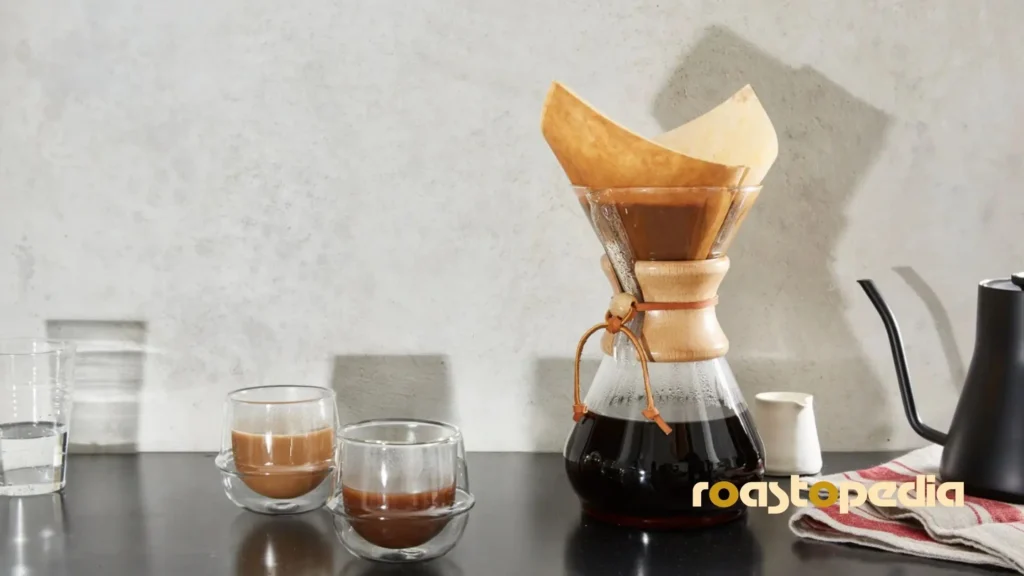
The Chemex brewer consists of a single piece of non-porous borosilicate glass shaped into two conical sections joined at a narrow waist. The upper cone serves as the filter and brewing chamber; the lower cone is the carafe.
A polished wood collar and leather tie wrap around the waist, providing grip and thermal protection. The vessel is available in multiple sizes, with the six-cup model being the most commonly used in professional and domestic settings.
The defining element of the Chemex system is its filter. Chemex paper filters are twenty to thirty percent heavier than standard pour-over filters, with a bonded, multi-layered structure that eliminates coffee oils and fine particulate to a degree unmatched by most other filter types.
The filter is folded into a cone with one side triple-layered and seated in the upper chamber so that the thicker side rests against the pour spout channel, preventing a vacuum seal from forming and allowing air to escape as liquid flows through.
The combination of the glass vessel and these proprietary filters gives the method its characteristic clarity and body profile.
Extraction Narrative
Brewing on the Chemex begins with rinsing the paper filter in the upper chamber using near-boiling water, which removes any paper taste and pre-warms the glass. The rinse water is discarded through the spout before ground coffee is added.
A medium-coarse grind is standard, coarser than what one would use for a V60 but finer than what is typical for a French press, reflecting the longer contact time demanded by the thick filter.
Water temperature should fall between 90 and 96 degrees Celsius. The first pour — a bloom pour of roughly twice the weight of the coffee in water — saturates the grounds and allows carbon dioxide to degas. This bloom is held for thirty to forty-five seconds.
Subsequent pours are executed in slow, circular spirals, keeping the water level steady within the upper chamber and maintaining consistent saturation across the coffee bed. Total brew time for a standard six-cup preparation typically falls between four and five minutes.
The thick filter slows the drawdown significantly compared to thinner-filter pour-over methods, and this extended contact time, combined with the filtration’s oil retention, shapes the resulting cup in fundamental ways.
Sensory Output
The Chemex produces a cup that is widely described as bright, clean, and tea-like in texture. Because the heavy paper filter absorbs the majority of the coffee’s lipids — including cafestol and kahweol — the body of the resulting brew is noticeably lighter than that produced by metal-filter methods or full-immersion brewers.
Acidity is pronounced and transparent, making the method particularly favorable for light-roasted, high-grown coffees where floral and fruit-forward characteristics are intended to be expressed without distortion from oils or sediment.
The absence of fines in the cup means that flavors remain stable from the first sip to the last, without the muddiness that can accumulate in the bottom of a French Press or Siphon.
Coffees with delicate aromatic profiles — Ethiopian naturals, Colombian washed lots, Kenyan SL28 varieties — often perform exceptionally on the Chemex precisely because the filtration preserves top-note clarity at the cost of mouthfeel density.
For espresso-forward drinkers accustomed to full-bodied cups, the Chemex can initially read as thin; for those trained in specialty evaluation, it is a benchmark for transparency.
Notable Facts
The Chemex is one of the very few pieces of kitchen equipment to hold a place in the permanent design collection of the Museum of Modern Art in New York, acquired in 1943 — just two years after its invention.
It also appeared in the 1968 film The Thomas Crown Affair, used conspicuously in a domestic scene, lending the brewer an additional layer of mid-century cultural currency. Illinois Institute of Technology listed the Chemex among the one hundred best-designed products of the modern era.
Schlumbohm himself was known to say the Chemex could be operated by a moron and make good coffee, a claim that reflects the design philosophy: remove human error through geometric and material precision rather than mechanical complexity.
Historical Variations
Schlumbohm experimented with several configurations before settling on the classic design. Early prototypes included versions with external metal stands and designs that separated the filter chamber from the carafe entirely, resembling laboratory glassware more explicitly than the unified hourglass form he ultimately patented.
He also developed a kettle designed specifically to complement the Chemex brewer, featuring a narrow spout intended for controlled pouring — a precursor to the gooseneck kettle that became standard equipment in specialty coffee decades later.
In the decades following Schlumbohm’s death in 1962, variations remained minimal. Chemex Corporation introduced a glass-handle version that replaced the wood-and-leather collar with a molded glass loop on the side of the vessel, appealing to users who preferred a dishwasher-safe option without sacrificing the glass-body purity.
The Handblown Series, produced in limited quantities, features irregularities consistent with artisan glassblowing and commands a premium price.
Contemporary third-party manufacturers have produced Chemex-compatible filters in different weights and materials — including organically bleached and unbleached variants — each producing subtle but measurable differences in cup character, particularly in the degree to which oils are retained and in the faint papery note that unrinsed filters can introduce.