
Dead Eye Coffee represents the terminal point of the American “fortified coffee” hierarchy, a beverage designed for maximum physiological impact rather than culinary subtlety.
The drink’s history is inextricably linked to the rapid acceleration of the American lifestyle in the late 1990s and early 2000s, where the demands of the “24/7 economy” necessitated stimulants of extreme potency.
While its predecessor, the Red Eye, found its footing in airport terminals, the Dead Eye became the definitive tool of the “over-caffeinated” subculture, encompassing university students during finals week, software engineers during “crunch” cycles, and long-haul logistics operators.
Like a handful of other drinks, Red Eye Coffee is a beverage that was born out of necessity—a final defensive measure against the biological imperative of sleep.
The standardization of the Dead Eye coincided with the rise of the “secret menu” phenomenon in national coffee chains.
While most menus officially listed only the Red Eye, customers began requesting “triple-shot” versions to overcome increasing caffeine tolerances.
By the mid-2000s, the term “Dead Eye” had achieved near-universal recognition in the North American specialty coffee industry.
In 2011, Starbucks formalized this “secret” by introducing the “Trenta” size (31 ounces) and officially acknowledging the “Green Eye” (their internal nomenclature for the Dead Eye) as a configurable option in their point-of-sale systems. This marked the transition of the Dead Eye from a cultish, “underground” request to a commercially codified high-potency product.
Etymology
Dead Eye is a stark linguistic escalation of the “Eye” taxonomy. If a “Red Eye” cures tiredness and a “Black Eye” indicates a metaphorical blow to the senses, the “Dead Eye” signifies a state of total exhaustion where the drinker is “dead on their feet.”
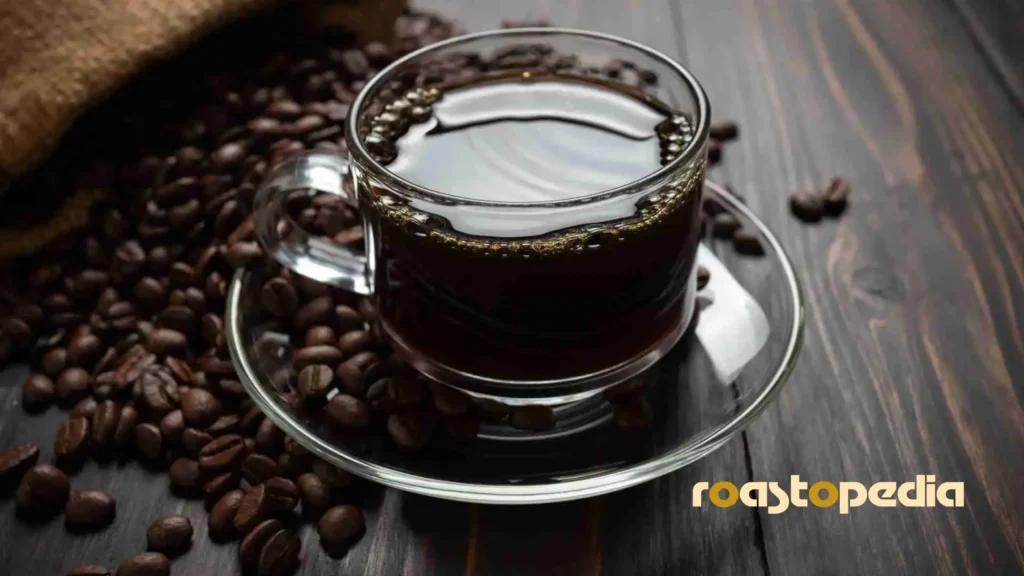
The name is also a visual reference to the appearance of the beverage: the addition of three dark espresso shots into a standard cup of drip coffee results in a liquid so opaque and dark that it absorbs almost all light, resembling the “dead,” non-reflective eye of a shark or a statue.
In certain regional dialects, particularly in the Southern United States, it is occasionally referred to as a “Purple Eye,” suggesting a level of bruising beyond a “Black Eye,” though “Dead Eye” remains the dominant industry term.
The Science of the Brew
The science of a Dead Eye is centered on the biological limits of caffeine consumption and the chemistry of multi-phasic extraction. A standard Dead Eye combines approximately 300 milliliters of drip coffee with 90 milliliters of espresso (three shots).
From a caffeine-stacking perspective, this creates a beverage containing between 350 and 420 milligrams of caffeine.
According to the United States Food and Drug Administration (FDA), 400 milligrams is the maximum recommended daily intake for a healthy adult; thus, a single Dead Eye constitutes an entire day’s caffeine allotment delivered in a 12-to-16-ounce serving.
Chemically, the Dead Eye is a “supersaturated” solution of coffee solutes.
The drip coffee base provides a high concentration of chlorogenic acids and soluble fibers, while the triple espresso add-on introduces a massive quantity of emulsified lipids (caweol and cafestol) and suspended micro-fines. This results in a Total Dissolved Solids (TDS) percentage that can exceed 4.0%, nearly three times the density of a standard cup of coffee.
The high concentration of alkaloids—specifically caffeine and theobromine—triggers a rapid “gastric emptying” response, leading to a faster-than-normal absorption of caffeine into the bloodstream, which accounts for the “shaking” or “jitter” effect frequently associated with this drink.
| Technical Variable | Dead Eye Specification | Comparative (Standard Drip) |
| Caffeine Concentration | ~1.1 mg/ml | ~0.4 mg/ml |
| Total Dissolved Solids (TDS) | 3.5% – 4.5% | 1.2% – 1.4% |
| Espresso-to-Drip Ratio | 1 : 3.3 | N/A |
| Lipid Density | Very High | Low |
| Viscosity | 1.8 – 2.1 cP | 1.1 cP |
| Alkaloid Profile | Maximum Saturation | Baseline |
Taste & Sensory Profile
The sensory profile of a Dead Eye is an assault on the palate, defined by an overwhelming and uncompromising bitterness. Dead Eye’s subtle aromatics of the coffee beans—the citrus, floral, or tea-like notes—are completely obliterated by the sheer mass of roasted compounds and phenolic acids.
The mouthfeel is exceptionally thick, almost “dusty,” due to the high concentration of micro-fines from the triple-shot extraction. There is a perceptible “chemical” taste to the finish, a result of the high caffeine concentration, which itself has a naturally bitter, medicinal flavor.
It is a beverage where the “tactile” experience—the heat, the weight on the tongue, and the immediate physiological “buzz”—overrides the “flavor” experience.
Variations
The primary variations of the Dead Eye are regional and nomenclature-based. In Starbucks culture, the drink is known as a “Green Eye.” In certain West Coast independent shops, it is called a “Triple Shot in the Dark.”
A cold variation, the “Iced Dead Eye,” is popular among students, though the cold temperature often causes the high concentration of oils to separate, creating a visible “sheen” on the surface of the drink.
A rare but notable variation is the “Turbo Dead Eye,” which uses a high-caffeine “robusta-blend” espresso, pushing the caffeine content to potentially dangerous levels exceeding 600 milligrams.
Notable Facts
A fascinating but obscure fact about the Dead Eye is its impact on “metabolic thermogenesis.” Because of the extreme caffeine dose, the Dead Eye can temporarily increase the body’s metabolic rate by 5% to 8%, causing a slight rise in core body temperature.
Historically, the Dead Eye gained a niche reputation in the “poker world,” where professional players used it to maintain high-level cognitive function during tournaments that lasted over 12 hours.
Additionally, from a chemical safety perspective, the Dead Eye is often cited in barista training as the limit of “safe service”; many specialty shops refuse to add a fourth shot (a “Quad Eye”) due to liability concerns regarding caffeine-induced heart palpitations.
Related Drinks
The Dead Eye is the final evolution of the Red Eye and Black Eye. It is functionally related to “Death Wish Coffee” (a high-caffeine brand) and “Cold Brew Concentrate,” both of which prioritize caffeine density. Structurally, it is a non-diluted version of an Americano, where coffee serves as the “water,” creating a “double-extraction” profile.