
Black Eye Coffee is the second tier in the American hierarchy of espresso-fortified drip coffees, representing a significant escalation in caffeine concentration and flavor intensity.
Like its counterpart, the Red Eye, the Black Eye lacks a single “inventor” and instead evolved as a vernacular beverage within the high-stress environments of the 1990s American workforce—specifically among emergency room staff, long-haul truckers, and Wall Street traders.
Black Eye was born from a need for a “maximum potency” beverage that could still be consumed quickly and without the additives of sugar or milk.
The transition of the Black Eye coffee from a customized request to a named menu item occurred as the “Second Wave” of coffee (led by Starbucks and Caribou Coffee) standardized the language of coffee customization.
By the late 1990s, the “Black Eye” was a recognized term across most North American coffeehouses. It represented a specific “machismo” in coffee culture; to order a Black Eye was to signal a level of exhaustion—or a level of caffeine tolerance—that a “regular” coffee could not satisfy.
In the modern era, the Black Eye has found a new audience in the “biohacking” and fitness communities as a pre-workout stimulant, valued for its high caffeine-to-volume ratio and lack of caloric content.
Etymology
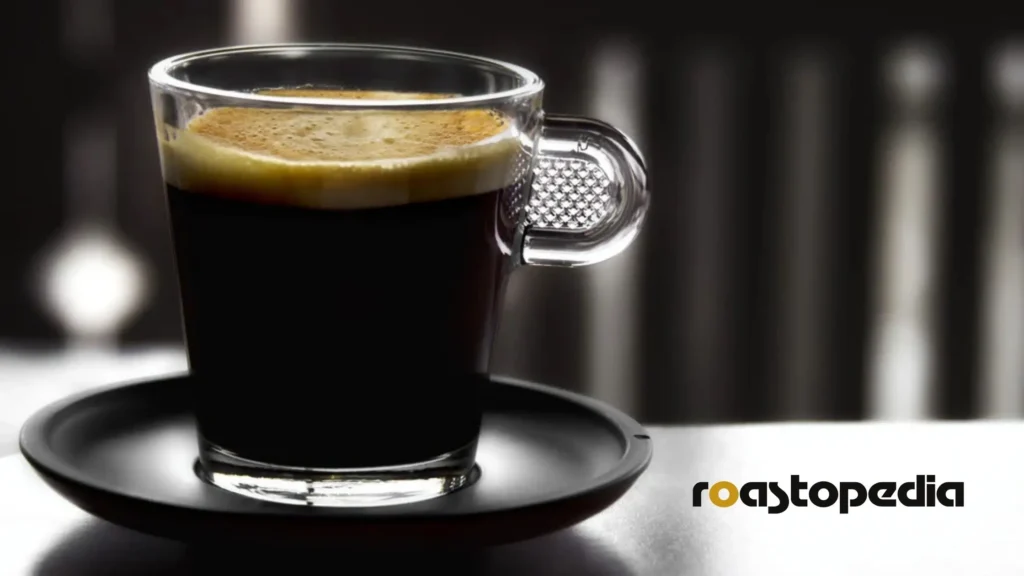
The etymology of “Black Eye” is both visual and metaphorical. Visually, when two shots of dark, oil-rich espresso are dropped into a lighter cup of drip coffee, they create a dark, circular ring that resembles a bruised “black eye” or a dark pupil.
Metaphorically, the name implies a drink that “hits you in the face,” referencing the immediate and intense physiological “jolt” provided by the double dose of espresso.
This naming convention follows the “Eye” taxonomy, where the “Black Eye” (two shots) is the middle ground between the “Red Eye” (one shot) and the “Dead Eye” (three shots).
The Science of the Brew
The science of a Black Eye revolves around the extreme concentration of alkaloids and polyphenols.
By adding 60ml of espresso (roughly 120 – 140 mg of caffeine) to 300ml of drip coffee (roughly 150mg of caffeine), the total caffeine content reaches approximately 270 – 290 mg.
This is roughly 75% of the FDA-recommended daily limit for adults in a single serving. The chemical interaction is also notable for the “emulsion stability”; the larger volume of drip coffee acts as a dispersing agent for the espresso’s oils.
From a molecular standpoint, the Black Eye has a significantly higher concentration of melanoidins—the brown polymers formed during roasting—than standard coffee. These compounds not only provide the dark color but are also potent antioxidants.
However, the high concentration of chlorogenic acid lactones and quinides (formed during the second extraction of espresso) makes the Black Eye significantly more bitter and potentially more taxing on the stomach lining than a single-extraction brew.
| Metric | Black Eye Value | Comparison (Red Eye) | Unit |
| Total Caffeine | 270 – 310 | 160 – 210 | Milligrams (mg) |
| Espresso Volume | 60 | 30 | Milliliters (ml) |
| Soluble Concentration | 2.5% – 3.0% | 1.8% – 2.0% | TDS (%) |
| Bitterness Index | High | Moderate | Perceptual Scale |
| Acidity (pH) | 4.9 | 5.0 | pH Scale |
| Oil Content | High | Moderate | Visual/Tactile |
Taste & Sensory Profile
The sensory profile of a Black Eye is defined by its overwhelming “darkness.” The acidity that might be present in a light-roast drip coffee is almost entirely masked by the deep, charred, and bitter notes of the double espresso shots. The mouthfeel is notably heavy and coating, a result of the high concentration of insoluble solids and coffee oils.
There is a distinct “savory” or “umami” quality to a well-made Black Eye, often with notes of tobacco, dark cocoa, and toasted grain. The finish is aggressive and persistent, with the bitterness lingering on the back of the palate for several minutes after consumption.
It is a drink designed for those who have a highly developed tolerance for bitter stimulants.
Variations
The most common variation is the “Iced Black Eye,” where the intense heat and bitterness are tempered by dilution with ice, though this often leads to “shaping,” where the oils congeal slightly.
In some specialty shops, a “Single-Origin Black Eye” is offered, where the drip and the espresso come from the same bean, allowing for a hyper-concentrated exploration of a specific terroir’s flavor.
In the Midwest, a variation known as a “Shot in the Dark” is often used interchangeably with the Black Eye, though some purists insist a Shot in the Dark must be made with a dark-roast drip base only.
Notable Facts
Research into “caffeine-induced cognitive enhancement” has often used dosages similar to a Black Eye (approx. 300mg) to study the limits of human focus.
Results suggest that while it significantly increases alertness, it can also impair “fine motor skills” due to the onset of caffeine tremors.
Another obscure fact is that the “Black Eye” was a favorite of several 20th-century American authors who used it to maintain focus during “marathon” writing sessions, leading to its niche reputation as the “Writer’s Fuel.”
Culturally, the drink is often served in a “for here” ceramic mug to prevent the plastic lid of a to-go cup from trapping the intense aromatic vapors, which are part of the “opening” experience of the drink.
Related Drinks
The Black Eye is the direct “big brother” to the Red Eye and the immediate predecessor to the Dead Eye. It is functionally related to the “Turkish Coffee,” which also delivers a high-concentration, unfiltered dose of caffeine and oils, though via a different extraction method. It is also structurally similar to the “Vienna Coffee” if the whipped cream were replaced by a second dose of espresso.