
SL34 is a coffee cultivar of the species Coffea arabica that has played a defining role in the global identity of East African specialty coffee. Within coffee taxonomy, SL34 is classified as a cultivar rather than a naturally occurring variety, as it was systematically isolated and selected through human intervention at Scott Agricultural Laboratories in Kenya during the 1930s. Despite this precise scientific classification, it is universally referred to as a variety within the commercial trade.
Grown predominantly at high altitudes, this plant is praised by coffee enthusiasts for producing an exceptional cup profile characterized by a complex, vinous acidity, heavy mouthfeel, and deep, dark fruit notes. Together with Ruiru 11 and SL28, SL34 constitutes the backbone of Kenya’s historic reputation as a premier producer of high-grade, premium coffees, commanding significant premiums from roasters worldwide due to its distinct, vibrant sensory attributes.
Origin
The historical development of SL34 is linked to early efforts by the British colonial administration to optimize coffee production in East Africa. In 1922, the Department of Agriculture in Kenya established Scott Agricultural Laboratories in Kabete to conduct agronomic research and address rampant plant diseases.
During the 1930s, an intensive individual tree selection program was conducted. The methodology involved surveying commercial plantations across Kenya to identify individual mother trees exhibiting exceptional drought tolerance, high yields, and outstanding liquor quality under local terroir conditions.
In 1935, a single outstanding tree was selected from the Loresho Estate in Kabete, a plantation originally established with seeds derived from the historic ‘French Mission’ coffee plots. This specific tree was cataloged as selection number 34, giving rise to the designation SL34.
For decades, industry consensus assumed that SL34 was a direct selection from the Bourbon genetic lineage, mirroring the trajectory of SL28. However, modern genetic testing conducted via DNA fingerprinting by organizations such as World Coffee Research has fundamentally rewritten this historical narrative.
Advanced genetic marker analysis has revealed that SL34 belongs to the Typica-related genetic group, specifically aligning with the ‘Ethiopian Legacy’ cluster. This discovery suggests that the original mother tree at Loresho Estate was a descendant of early Typica-like plants brought to East Africa, or a natural hybrid that preserved dominant Typica structures. This distinct genetic composition accounts for several of its unique physical and sensory differences from true Bourbon cultivars, establishing SL34 as a genetically distinct asset within the global distribution of Arabica varieties.
Botanical Characteristics
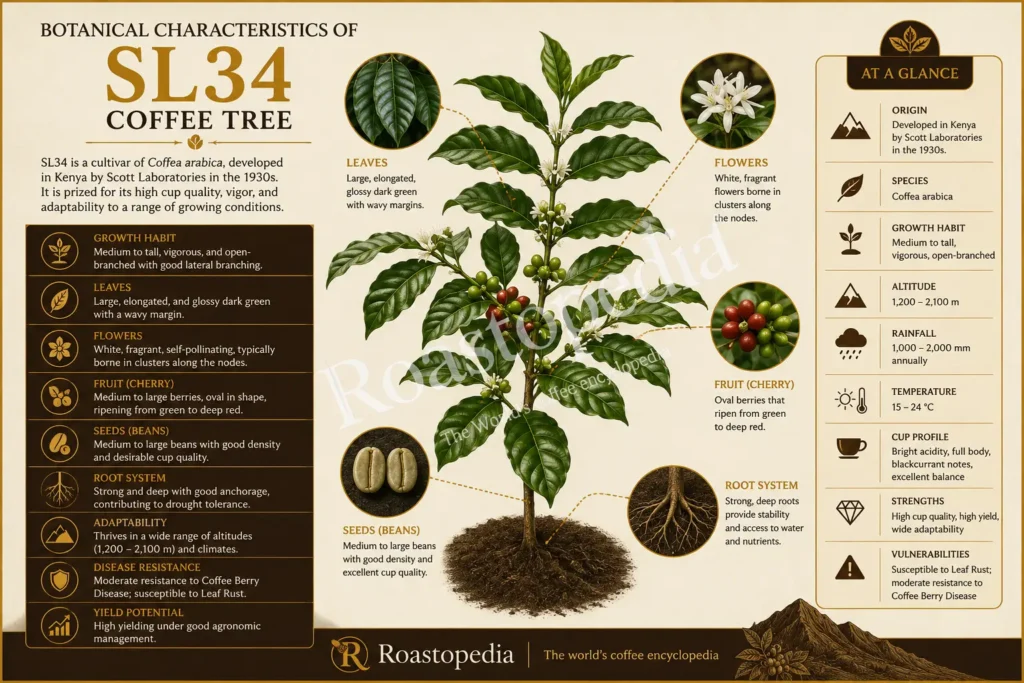
From a morphological perspective, SL34 is a tall, single-stemmed shrub characterized by an open, robust architecture. Its lateral branches exhibit a semi-erect growth pattern when young, which gradually tends to bend downward under the weight of mature fruit as the primary wood ages. The internodes along the lateral branches are relatively long, contributing to its expansive canopy.
One of the most striking botanical features of SL34 is the deep bronze coloration of its young, apical shoot tips. While occasional green-tipped variants can manifest due to localized environmental pressures, the dominant phenotype displays a rich, dark bronze hue that visually distinguishes it from completely green-tipped cultivars.
The leaves of the SL34 plant are large, broad, and oblong-elliptical with wavy margins, reflecting its strong Typica genetic heritage. The fruit, or coffee cherries, are large, oval-shaped drupes that undergo a uniform ripening process, transitioning from green to a rich, glossy crimson red at peak maturity. Within these cherries, the developed seeds—commonly referred to as coffee beans—are notably large, elongated, and dense. This superior bean size contributes heavily to the high percentage of ‘AA’ and ‘AB’ screen sizes obtained during mechanical grading in dry mills, making the cultivar lucrative for estate farmers aiming for top-tier commercial classifications.
Cultivation and Agronomy
SL34 is sensitive to its environmental conditions, demonstrating an optimal performance profile when cultivated in high-altitude zones, typically ranging from 1,500 to 2,100 meters above sea level. It requires a well-distributed annual rainfall pattern exceeding 1,200 millimeters and thrives in deep, well-drained, acidic volcanic soils rich in organic matter.
When established within these specific ecological parameters, the cultivar possesses an impressive yield potential, surpassing that of many traditional heritage varieties. Furthermore, SL34 exhibits remarkable adaptability to extreme weather conditions, including a documented resilience to prolonged periods of drought and an ability to withstand sudden, heavy rainfall events.
Despite its excellent productivity, SL34 presents significant agronomic challenges due to its total lack of genetic resistance to major fungal pathogens. The cultivar is exceptionally susceptible to Coffee Leaf Rust (caused by Hemileia vastatrix), which induces severe premature defoliation, as well as Coffee Berry Disease (caused by Colletotrichum kahawae), a devastating pathogen that directly attacks and destroys the developing green fruit.
Managing SL34 plantations requires intensive, costly agricultural inputs, including the rigorous application of copper-based fungicides, careful canopy pruning to maximize airflow, and precise fertilization regimes to prevent nutritional exhaustion. Due to these high operational expenses and risks, agricultural bodies have progressively encouraged the integration of disease-resistant composite cultivars like Ruiru 11 and Batian, though SL34 remains favored by purists seeking uncompromised quality.
Cup Profile and Sensory Characteristics
In the global arena of specialty coffee, SL34 is revered as a premier cultivar capable of achieving extraordinary scores during standardized sensory evaluation or cupping protocols. The sensory profile of a classic high-altitude SL34 lot is defined by its intense, vibrant, and multi-layered acidity, which frequently exhibits both bright citric (grapefruit, lemon) and crisp malic (green apple) attributes. This sparkling acidity is balanced by a remarkably heavy, syrupy, and full-bodied mouthfeel, a tactile combination that is relatively rare among highly acidic coffees.
Aromatic and flavor descriptors for SL34 are intensely fruity and sweet, characterized by a dominant note of blackcurrant, dark berries, and purple plum, accompanied by complex secondary undertones of dark brown sugar, molasses, and a refined, vinous finish reminiscent of a fine Cabernet Sauvignon.
When processed using the traditional Kenyan ‘double washing’ method—which involves extended fermentation, thorough washing, and meticulous soaking under clean water—the clean, expressive varietal characteristics of SL34 are amplified to their absolute peak. This uncompromising flavor complexity ensures that single-origin lots consisting entirely of SL34 remain highly sought after by specialty coffee roasters globally, consistently commanding premium auction prices and securing its legacy as an icon of sensory excellence.
See Also
- Green Coffee
- Organic Coffee
- Coffee Leaf
- Coffee Cherry
- Coffee Bean
- Coffee Flower
- Caturra
- Geisha Coffee
References
- World Coffee Research. (2018). Coffee Varieties Catalog: SL34. World Coffee Research.
- Gichimu, B. M., & Omondi, C. O. (2010). Morphological characterization of five newly developed lines of Arabica coffee in Kenya. Journal of Animal & Plant Sciences, 8(3), 1039-1046.
- Montagnon, C., Sheibani, F., Benti, T., Daniel, D., & Bote, A. D. (2022). Deciphering Early Movements and Domestication of Coffea arabica through a Comprehensive Genetic Diversity Study Covering Ethiopia and Yemen. Agronomy, 12(12), 3203.
- Pruvot-Woehl, S., Krishnan, S., Solano, W., Schilling, T., Toniutti, L., Bertrand, B., & Montagnon, C. (2020). Authentication of Coffea arabica Varieties through DNA Fingerprinting and its Significance for the Coffee Sector. Journal of AOAC International, 103(2), 325-334.
- Ngure, G. M., & Watanabe, K. N. (2024). Coffee sustainability: leveraging collaborative breeding for variety improvement. Frontiers in Sustainable Food Systems, 8, 1431849.
- Matovu, J. R., Musoli, P. C., Walyaro, D. J., & Olal, S. (2015). Resistance to coffee leaf rust (Hemileia vastatrix, Berk. and Broome) among arabica coffee genotypes in Uganda. Uganda Journal of Agricultural Sciences, 16(2), 145-155.
- Scalabrin, S., Magris, G., Liva, M., Vitulo, N., Vidotto, M., Scaglione, D., … & Morgante, M. (2024). A chromosome-scale assembly reveals chromosomal aberrations and exchanges generating genetic diversity in Coffea arabica germplasm. Nature Communications, 15, 1080.
- Van der Vossen, H. A. M., & Walyaro, D. J. (1981). An analysis of the components of yield in a cross-breeding programme with Arabica coffee (Coffea arabica L.). Euphytica, 30(2), 437-447.
- Walyaro, D. J. (1983). Considerations in breeding for improved yield and quality in Arabica coffee (Coffea arabica L.). PhD Thesis, Wageningen University.
- Melville, A. R. (1946). The selection of coffee varieties in Kenya. East African Agricultural Journal, 11(4), 223-228.
- Thorold, C. A. (1947). A study of Elgon dieback disease of coffee. Annals of Applied Biology, 34(2), 183-194.
- Mc’Donald, J. (1926). A preliminary account of a disease of green coffee berries in Kenya Colony. Transactions of the British Mycological Society, 11(1-2), 145-154.
- Hindorf, H. (1975). Colletotrichum species isolated from Coffea arabica in Kenya. Phytopathologische Zeitschrift, 82(2), 132-151.