
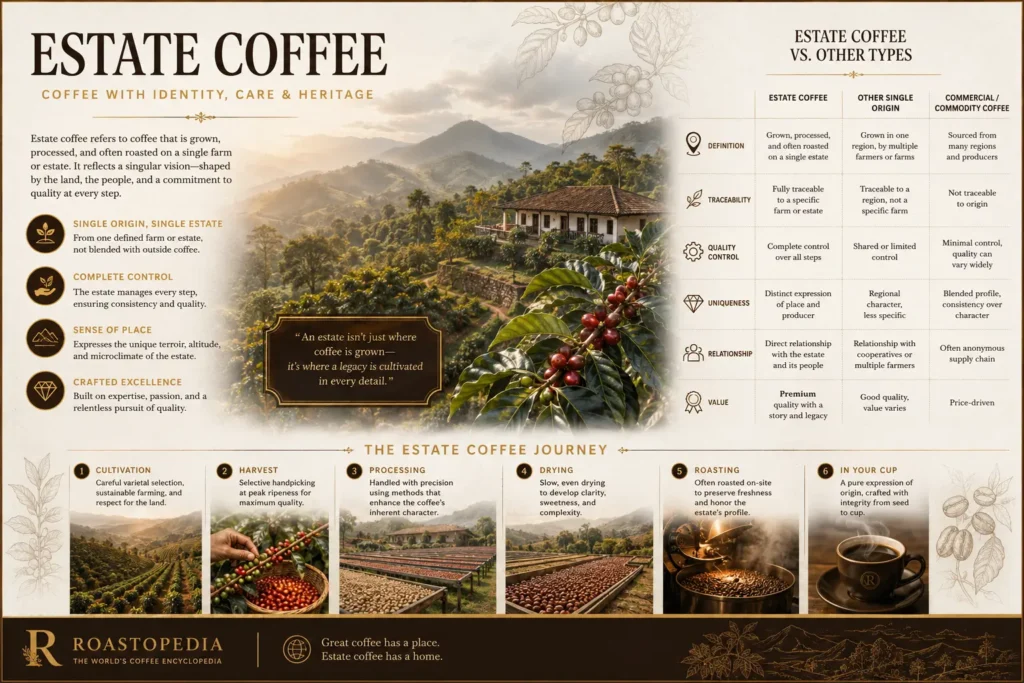
Estate coffee (also single-estate coffee or estate-grown coffee) refers to coffee that is cultivated, harvested, processed, and prepared for export from a single, clearly defined farm or plantation under unified ownership and management. The term encompasses the full arc of production occurring on one property — from the growing of the coffee tree to the milling of the green bean — with the estate name itself serving as a traceable identity, a quality marker, and a brand guarantee. An estate may range from a modest family plot of a few acres to a vast, vertically integrated plantation spanning hundreds or thousands of hectares; what unifies all estate coffees is the singularity of their origin and the chain of custody that preserves that identity from soil to sack.
In the strictest technical sense, a true coffee estate operates both a wet mill and a dry mill on or immediately adjacent to the farm, enabling it to take coffee from cherry on the tree all the way to export-ready green beans without relinquishing control to a third-party processor. In broader and more common contemporary usage, however, the term applies to any coffee whose identity as the product of a single, named property is maintained and verifiable throughout the supply chain.
Overview
Estate coffee occupies a distinctive position within the specialty coffee world. It is a subcategory of single-origin coffee, yet more precisely defined: while single-origin coffee may be sourced from a country, a region, or a cooperative blending beans from many smallholder farms, estate coffee is by definition the product of one identifiable property. The defining characteristic is complete traceability — a direct, unbroken link from the farmer and the land to the roaster and the consumer.
This traceability provides several structural advantages. Estate owners are able to invest in on-site infrastructure — wet mills, drying beds, raised tables, quality-control laboratories — that individual smallholder farmers typically cannot afford. They may implement consistent picking standards across the entire harvest, experiment with multiple processing methods on the same lot, and maintain year-to-year records that allow meaningful quality comparisons across seasons. Many progressive estates now further subdivide their production into micro-lots and nano-lots differentiated by variety, elevation, or processing method, allowing the diversity within a single property to be showcased at the highest level of granularity.
Estate coffees are not, by virtue of their origin designation alone, superior to all other forms of coffee. Their quality depends entirely on the care taken in cultivation, harvesting, and processing. The estate model, however, provides the conditions most conducive to consistent, documentable quality — which is why estate coffees appear with disproportionate frequency among the top-scoring lots in competitions such as the Cup of Excellence and Best of Panama.
Etymology and Terminology
The word estate derives from the Old French estat and the Latin status, denoting standing, condition, or a defined domain of property. Its application to agriculture — as in a landed estate — implies ownership, management, and defined territorial boundaries. In the coffee trade, estate has long been used in coffee-producing countries (see Coffee Belt) to signify a farm of some scale and permanence. In the Spanish-speaking world, the analogous terms are hacienda (a farm with its own full processing facility) and finca (farm or plantation, not necessarily with its own mill). In Brazil, the equivalent is fazenda; in Portuguese-speaking Africa, quinta; in Indonesia, large colonial-era farms were called ondernemingen.
The contemporary marketing application of estate — positioning a specific named farm as a guarantor of quality, much as a wine chateau or domaine guarantees the provenance of a bottle — is a modern specialty-trade usage that emerged in the 1980s and is addressed further in the History section below.
Origin and Historical Background
Colonial Antecedents
The structural origins of the coffee estate lie in the colonial plantation systems established by European powers across Latin America, Africa, and Asia from the seventeenth century onward. Following the spread of coffee cultivation from Yemen and Ethiopia through the Dutch, French, and British colonial networks, large-scale single-ownership farms became the dominant production model in many regions. Dutch-administered Java (present-day Indonesia), French Saint-Domingue (present-day Haiti), and British Ceylon (present-day Sri Lanka) were among the earliest territories where plantation-scale coffee cultivation took hold. In Latin America, Spanish and Portuguese colonial land-grant systems produced haciendas and fazendas that would, in some cases, endure for centuries.
These colonial estates were defined by their scale, their vertical control over production, and their reliance on forced or highly exploitative labor. While the social dynamics of modern estate coffee are radically different from those colonial-era origins, the physical infrastructure of large-scale, single-property coffee production — and the cultural prestige associated with named estates — descends directly from this history.
The Specialty Coffee Revolution and the Estate Concept (1970s–1990s)
The modern marketing of coffee by estate name — distinct from the mere existence of estate farms — emerged from the specialty coffee movement of the 1970s and 1980s in the United States. The pivotal figure in this development was William McAlpin of Hacienda La Minita, located in the Tarrazú region of Costa Rica.
McAlpin, who began growing coffee in Costa Rica in the early 1970s, drew an explicit analogy between coffee and fine wine. In the wine world, “estate-bottled” on a label guaranteed that every grape in the bottle was grown, vinified, and bottled on the same domaine — a mark of authenticity and quality control. McAlpin applied this logic to coffee: by controlling every step from cherry to export-ready bag on his own farm, and by rigorously rejecting any bean that did not meet his standard (ultimately only about 20–25% of La Minita’s harvested cherries bore the La Minita name), he could offer buyers a product of documented, repeatable excellence.
Beginning in the 1980s, McAlpin promoted La Minita through brochures, documentary material, and direct relationships with specialty roasters — pioneering a model of farm-as-brand that had no real precedent in the coffee trade. The success of La Minita inspired what one commentator described as “an avalanche” of other farms adopting the estate-marketing model, and by the 1990s, named estate coffees had become a recognized and valued category across the specialty trade.
Chronology
| Period | Development |
| 17th –18th century | European colonial powers establish large coffee plantations in Java, Haiti, Ceylon, and Latin America — the structural forerunners of the modern estate model. |
| 18th –19th century | Coffee fazendas expand dramatically in Brazil; haciendas and fincas become dominant production units across Central America and Colombia. Named regional coffees (e.g., Blue Mountain Jamaica, Kona Hawaii) begin to carry reputational weight. |
| Early 20th century | Estate model persists in producing countries; coffee is mostly traded by country grade and regional name rather than by specific farm identity. |
| 1974 | Importer Erna Knutsen coins the term specialty coffee in the Tea & Coffee Trade Journal, initiating the intellectual framework within which estate identity would later flourish. |
| 1980s | William McAlpin’s Hacienda La Minita (Costa Rica) pioneers the modern estate-branding model in specialty coffee, drawing on the analogy of estate-bottled wine. |
| Late 1980s–1990s | La Minita’s commercial success triggers widespread adoption of estate branding by farms in Costa Rica, Guatemala, Kenya, Indonesia, and beyond. The specialty press (notably Coffee Review) begins reviewing and scoring individual estate coffees. |
| 1999 | Alliance for Coffee Excellence (ACE) is founded; its Cup of Excellence competition, launched in the same period, becomes a key arena in which estate-grown micro-lots gain international recognition and auction prices. |
| 2000s | The Third Wave coffee movement accelerates consumer interest in provenance, traceability, and direct trade — all of which favor the estate model. Estates begin separating lots by variety, altitude, and processing method. |
| 2004 | Hacienda La Esmeralda (Panama) presents its Gesha variety at the Best of Panama competition, achieving a record auction price; the lot is from a single named estate and becomes one of the most celebrated estate coffees in history. |
| 2010s | Micro-lot and nano-lot production from individual estate blocks becomes standard in high-end specialty trade. Digital transparency tools and blockchain pilots extend traceability systems. |
| 2020s | Estate coffee continues to anchor the premium tier of the specialty market. Sustainability certifications (Rainforest Alliance, Organic, Fair Trade), climate resilience, and regenerative agriculture practices become increasingly prominent dimensions of estate identity and marketing. |
Characteristics and Quality Factors
Traceability
The most defining characteristic of estate coffee is complete, verifiable traceability. Unlike cooperative-sourced coffees — in which beans from dozens or hundreds of smallholder farms are combined at a central wet mill, making precise attribution impossible — estate coffee maintains an unbroken identity from the individual property to the end consumer. This traceability enables quality verification, ethical auditing (labor practices, environmental standards), and the year-over-year consistency that specialty roasters seek.
Terroir
Estate coffees are prized for expressing terroir — the French term (borrowed from viticulture) for the totality of environmental factors that shape a product’s character: soil composition and mineralogy, altitude, microclimate, rainfall patterns, sunlight exposure, and surrounding flora. Because all beans in an estate lot come from the same environmental context, terroir expresses itself more purely in estate coffee than in blended or cooperative lots. Estates at high altitude, on well-drained volcanic soils, or in regions with pronounced dry seasons tend to produce coffees of particular complexity and clarity.
Processing Control
A genuine estate’s ability to control processing — depulping, fermentation, washing, drying — from cherry to green bean is one of its most significant quality advantages. Consistent processing protocols eliminate the variability that often arises when cherries from many farms are pooled at a shared mill. Estates may employ washed (fully washed), natural (dry-processed), honey, or experimental fermentation methods depending on their infrastructure and the flavor profile they seek to develop.
Consistency and Seasonality
Estate coffees offer a level of consistency across seasons that cooperative or regional lots often cannot match, because the agronomic inputs, harvesting standards, and processing parameters remain under a single management decision. At the same time, because all beans share the same terroir and season, estate coffees are also subject to vintage variation — the year-to-year changes in climate that alter a crop’s character. This seasonality is often celebrated rather than concealed in the specialty trade, echoing the vintage culture of fine wine.
Size and Diversity
Estates range enormously in scale. At one end are tiny single-family farms of two to five hectares in regions such as Kona, Hawaii, or Antigua, Guatemala. At the other are vast, mechanized plantations in Brazil (fazendas) or Indonesia that stretch for thousands of hectares and produce millions of kilograms annually. The common thread is not scale but the singularity of ownership and management, and the preservation of the lot’s identity.
Notable Estate Coffees
Several named estates have attained iconic status in the global specialty coffee world:
Hacienda La Minita (Tarrazú, Costa Rica) — The estate that pioneered modern estate branding in the 1980s, renowned for rigorous quality control and full vertical integration.
Hacienda La Esmeralda (Boquete, Panama) — Home of the celebrated Gesha variety, whose Best of Panama auction results in 2004 and subsequent years reset global expectations for specialty coffee pricing.
Yirgacheffe / Kochere micro-estates (Ethiopia) — While Ethiopia’s coffee is often traceable only to cooperative or washing-station level, an increasing number of private estates in the Yirgacheffe and Kochere zones are establishing individual identities.
Kona estates (Hawaii, USA) — Hawaii’s Kona district is home to dozens of named estates, many tiny, whose coffees carry strict regional and quality designations.
Blue Mountain estates (Jamaica) — Jamaica Blue Mountain is a legally protected designation; only coffee grown in the defined Blue Mountain region and meeting strict grade standards may carry the name.
Distinction from Related Terms
| Term | Meaning |
| Single-Origin Coffee | Coffee from one country or defined region; does not require single-farm identity. |
| Estate Coffee | A subset of single-origin; specifically from one named farm under unified management. |
| Micro-Lot | A further subdivision of estate production — a specific block, altitude band, variety, or processing batch within a single estate. |
| Cooperative Coffee | Pooled production from multiple smallholder farms processed at a shared facility; traceability is to the cooperative, not the individual farm. |
| Hacienda | Spanish term for an estate with its own full wet-processing facility; roughly equivalent to estate in common use. |
| Finca | Spanish for farm; does not necessarily imply on-site milling. |
| Fazenda | Portuguese/Brazilian term for a farm or ranch; often used for large Brazilian coffee estates. |
| Plantation | A large-scale agricultural operation; broadly synonymous with estate in some producing regions (notably Papua New Guinea). |
Criticisms and Limitations
The estate model, while offering real advantages in traceability and quality control, is not without criticism. The term itself carries no universal legal protection in most countries, making it susceptible to misuse: a farm may style itself an estate without meeting the full standards of on-site processing and lot identity that the term implies. The estate concept also lends itself to marketing mythology — substituting narrative and prestige for demonstrated cup quality. Specialty buyers and importers are generally alert to this risk, and estates that inflate reputations beyond the quality of their actual product typically suffer commercial consequences.
A more structural critique concerns equity. The estate model historically concentrated land, capital, and the highest coffee prices in the hands of relatively few large landholders, while the majority of the world’s coffee — grown by smallholder farmers with fewer than ten hectares — entered the market at lower prices with less traceability. The emergence of cooperative models, direct trade, and smallholder-focused certification programs (Fair Trade, Relationship Coffee) represents in part a response to the income disparities that the estate-premium system can entrench.
See Also
- Single-Origin Coffee
- Specialty Coffee
- Coffee Processing Methods
- Selective Picking
- Geisha Coffee
- Coffee Brew Methods
- The Coffee Belt
- Coffee Waves
- Coffee Flavors
References
- Sweet Maria’s Coffee Library. “Estate.” Sweet Maria’s Coffee Library Glossary. https://library.sweetmarias.com/glossary/estate/ (accessed June 2026).
- Wikipedia. “Single-Origin Coffee.” Wikipedia: The Free Encyclopedia. https://en.wikipedia.org/wiki/Single-origin_coffee (accessed June 2026).
- Davids, Kenneth. “Coffee Language: Farm, Mill, and Estate Names.” Coffee Review. https://www.coffeereview.com/coffee-reference/coffee-basics/coffee-language/farm-mill-and-estate-names/ (originally published August 2014; accessed June 2026).
- My Coffee Explorer. “Estate Coffee.” Coffee Glossary. https://mycoffeeexplorer.com/glossary/estate-coffee (accessed June 2026).
- Tchibo. “Estate Coffee: An Introduction.” Tchibo Coffee Academy Blog. https://tchibo.us/blogs/academy/estate-coffee (September 14, 2023).
- Zenforest Coffee. “Single Origin Coffee vs. Single Estate: What’s Truly Better?” https://zenforestcoffee.com/single-origin-coffee-vs-single-estate-coffee/ (September 12, 2024).
- Perfect Daily Grind. “Everything You Need to Know About Single Origin Coffees.” https://perfectdailygrind.com/2015/09/everything-you-need-to-know-about-single-origin-coffee/ (October 9, 2020).
- Nordic Approach. “What Is a Single Coffee Origin, Estate, Producer and Variety in Specialty Coffee?” https://www.nordicapproach.no/glossary/single-coffee-origin-estate-producer-and-variety (accessed June 2026).
- Perfect Daily Grind. “What’s the Difference Between Coffee Estates and Coffee Co-Operatives?” https://perfectdailygrind.com/2023/02/coffee-estates-vs-coffee-co-operatives/ (February 20, 2023).
- Hacienda La Minita. “History.” https://www.laminita.com/history (accessed June 2026).
- Lux Cafe Club. “La Minita Coffee — A Taste of Costa Rica’s Finest Brews.” https://www.luxcafeclub.com/blogs/news/la-minita-coffee-a-taste-of-costa-ricas-finest-brews (February 12, 2024).
- Pendergrast, Mark. Uncommon Grounds: The History of Coffee and How It Transformed Our World. 2nd ed. Basic Books, 2010. [Excerpted at https://erenow.org/common/uncommon-grounds-the-history-of-coffee/21.php]
- Davids, Kenneth. “Coffees of the Millennium.” Coffee Review. https://www.coffeereview.com/coffees-of-the-millennium/ (November 5, 2017).
- Frontside Coffee Roasters. “Hacienda La Minita Coffee.” https://frontsidecoffee.com/pages/hacienda-la-minita (accessed June 2026).
- Volcanica Coffee. “Estate Coffee.” https://volcanicacoffee.com/collections/estate-coffee (accessed June 2026).
- Indian Coffee Beans. “Understanding Indian Coffee Estates (And Why They Matter).” https://www.indiancoffeebeans.com/learn/understanding-indian-coffee-estates (April 16, 2026).
- Specialty Coffee Association (SCA). SCA Green Coffee Grading Handbook. Specialty Coffee Association, 2015. [Referenced via https://agriculture.institute/post-harvest-mgt-value-addition/types-characteristics-specialty-coffees/]
- Estate House Coffee. “Specialty Coffee 101.” https://estatehousecoffee.com/pages/coffee-questions (accessed June 2026).
- Grokipedia. “Specialty Coffee.” https://grokipedia.com/page/Specialty_coffee (March 26, 2026).
- Coffee By Design. “Memories of La Minita.” https://coffeebydesign.com/blogs/blog/memories-of-la-minita (September 13, 2023).
- Dancing Goats Coffee. “Costa Rica La Minita Tarrazu.” https://www.dancinggoats.com/products/costa-rica-la-minita-del-sol (accessed June 2026).