
A portafilter basket is a removable metal filter cup that fits inside an espresso machine’s portafilter and holds the ground coffee during extraction. It is one of the most critical components in espresso preparation because it directly influences coffee dose, water flow, extraction uniformity, resistance, and ultimately the flavor and quality of the espresso.
Portafilter baskets are typically manufactured from stainless steel and contain a pattern of precisely engineered perforations through which brewed espresso exits during extraction. While often overlooked compared to grinders or espresso machines, the basket serves as the final chamber where water and coffee interact under pressure.
The design, size, hole geometry, depth, and capacity of a basket can significantly alter extraction characteristics. Modern specialty coffee professionals often view the basket as a precision brewing instrument rather than a simple filter.
Historical Development
The earliest espresso machines of the late nineteenth and early twentieth centuries employed rudimentary metal filter systems that lacked standardization. As espresso technology evolved throughout the twentieth century, manufacturers began developing interchangeable baskets capable of accommodating specific coffee doses and extraction styles.
The emergence of specialty coffee in the late twentieth and early twenty-first centuries accelerated innovation in basket design. Manufacturers introduced precision-engineered baskets with laser-cut holes, optimized hole patterns, and tighter manufacturing tolerances to improve extraction consistency.
Today, manufacturers of portafilter baskets such as IMS, VST, Pullman, Weber Workshops, and several espresso machine companies produce highly specialized baskets designed for professional and home use.
Anatomy of a Portafilter Basket
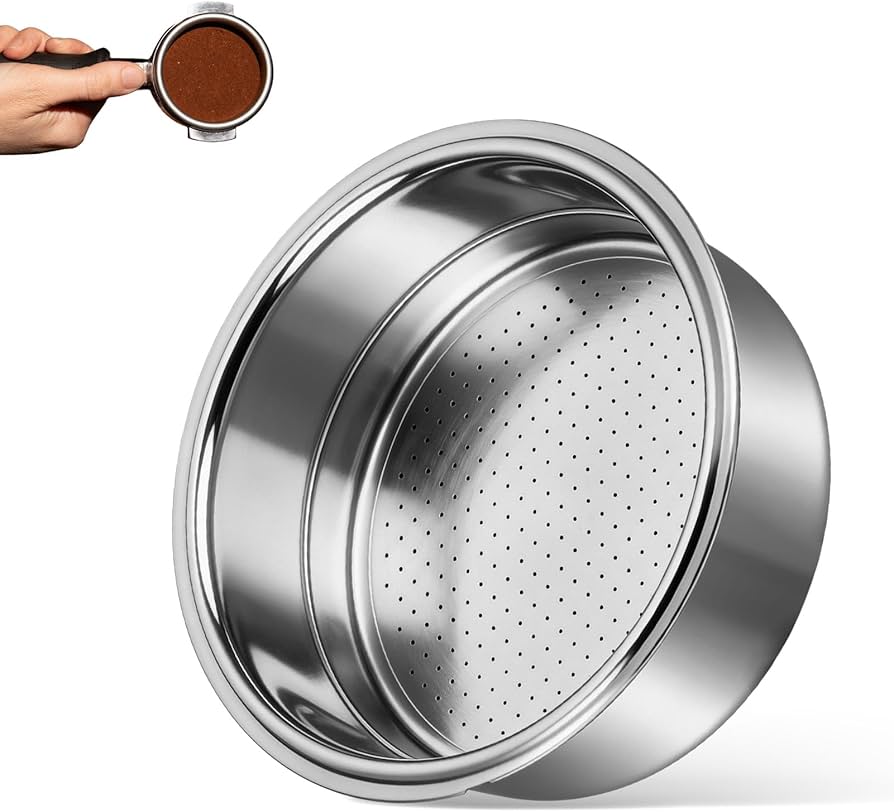
A typical best portafilter basket consists of:
Rim: The upper edge that locks into the portafilter body.
Sidewalls: The vertical walls that determine basket depth and coffee capacity.
Base: The lower section containing extraction holes.
Perforations: Hundreds of precisely sized holes that allow espresso to pass while retaining coffee grounds.
Internal Geometry: The shape of the basket’s interior influences water distribution and puck formation during extraction.
How a Portafilter Basket Works
When finely ground coffee is dosed and tamped into a basket, it forms a compressed coffee puck. Hot water is forced through the puck under pressure, typically around 9 bars in modern espresso machines.
The basket performs several functions simultaneously:
- Holds the coffee bed in place.
- Creates resistance necessary for espresso extraction.
- Supports even water distribution.
- Filters spent coffee grounds.
- Guides espresso toward the portafilter spouts or directly into the cup.
The basket’s dimensions influence the depth and density of the coffee puck, which in turn affects extraction dynamics.
Standard Portafilter Basket Sizes
Portafilter baskets are commonly classified according to the diameter of the portafilter they fit.
51mm Portafilter Basket
The 51 mm basket is common among entry-level and compact espresso machines.
Typical examples include certain machines manufactured by Delonghi, Geepas, Sonifer, Mebashi, and various consumer-oriented espresso brands.
Characteristics include:
- Smaller coffee bed surface area
- Deeper coffee puck
- Usually lower dosing capacities
- Common in beginner home espresso setups
Typical doses:
| Basket Type | Coffee Dose |
| Single | 7–10 g |
| Double | 12–16 g |
Typical shots:
- Single espresso
- Double espresso
- Milk-based drinks for home use
Because of the deeper puck geometry, extraction can be somewhat less forgiving than in larger commercial baskets.
53mm Portafilter Basket
Less common than 54 mm or 58 mm systems, 53mm portafilter baskets appear on certain proprietary espresso machines.
Typical doses:
| Basket Type | Coffee Dose |
| Single | 8–11 g |
| Double | 14–18 g |
These baskets occupy a middle ground between compact consumer and larger enthusiast systems.
54mm Portafilter Basket
The 54 mm basket has become particularly popular because of machines produced by Breville (Sage in some markets).
Examples include:
- Breville Bambino
- Breville Bambino Plus
- Breville Barista Express
- Breville Barista Pro
Characteristics:
- Wider puck than 51 mm baskets
- Improved extraction uniformity
- Good balance between home convenience and professional performance
Typical doses:
| Basket Type | Coffee Dose |
| Single | 8–12 g |
| Double | 16–20 g |
Common shot styles:
- Single espresso
- Double espresso
- Ristretto
- Lungo
Many specialty coffee enthusiasts consider 54 mm systems capable of producing café-quality espresso when paired with a suitable grinder.
57mm Portafilter Basket
The 57 mm format is relatively uncommon and is found on selected machines from manufacturers such as Lelit and Ascaso.
Typical doses:
| Basket Type | Coffee Dose |
| Single | 8–12 g |
| Double | 16–20 g |
These baskets provide extraction characteristics closer to commercial 58 mm systems.
58mm Portafilter Basket
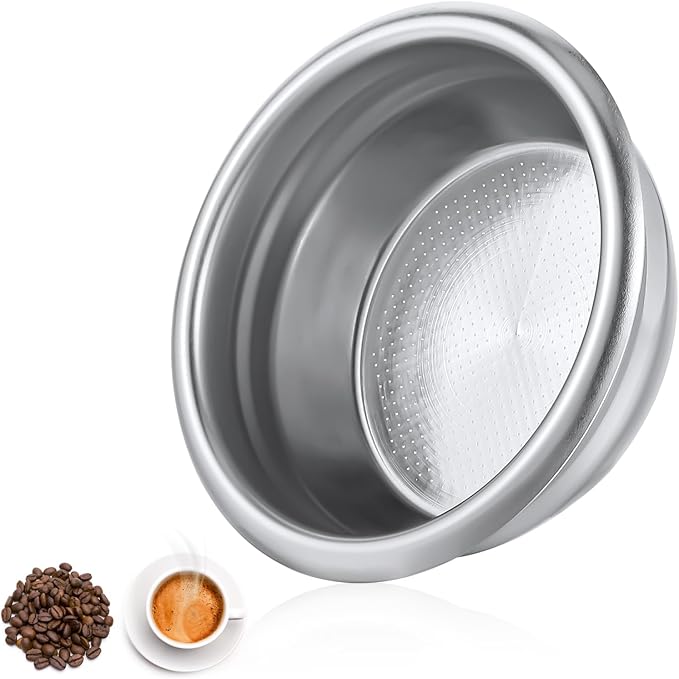
The 58mm portafilter basket is the global commercial espresso standard.
It is used by many professional espresso machine manufacturers, including:
- La Marzocco
- Nuova Simonelli
- Victoria Arduino
- Rocket Espresso
- ECM
- Profitec
- Synesso
- Slayer
Characteristics:
- Large surface area
- Shallower coffee puck
- Excellent extraction consistency
- Wide compatibility with accessories
Typical doses:
| Basket Type | Coffee Dose |
| Single | 7–12 g |
| Double | 16–22 g |
| Triple | 20–24 g |
| Quad or High-Capacity | 24–30 g |
Common shot styles include:
- Single espresso
- Double espresso
- Triple espresso
- Ristretto
- Lungo
- Specialty competition extractions
The 58 mm standard dominates professional coffee shops due to its flexibility and consistency.
Basket Types by Capacity
Single Basket
Designed for one espresso serving.
Typical dose:
7–12 g
Yield:
20–40 g espresso
Double Basket
The most widely used basket format.
Typical dose:
14–22 g
Yield:
30–50 g espresso
Triple Basket
Developed for larger espresso doses.
Typical dose:
18–24 g
Yield:
40–70 g espresso
Often used in specialty coffee environments.
High-Capacity Baskets
Designed for very large doses.
Typical dose:
24–30 g or more
Used for:
- Experimental extractions
- Competition routines
- Large milk beverages
Pressurized and Non-Pressurized Baskets
Pressurized Baskets
Pressurized baskets create artificial resistance through a secondary outlet mechanism.
Advantages:
- Easier for beginners
- More forgiving of inconsistent grinding
- Produces crema-like foam even with pre-ground coffee
Disadvantages:
- Reduced extraction precision
- Lower flavor clarity
Non-Pressurized Baskets
Also called traditional baskets.
Advantages:
- Greater control
- Higher extraction quality
- Preferred by specialty coffee professionals
Disadvantages:
- Requires a quality grinder
- Less forgiving of mistakes
Precision Baskets
Precision baskets are manufactured with extremely tight tolerances.
Features include:
- Uniform hole sizes
- Optimized perforation patterns
- Improved extraction consistency
- Reduced channeling
Popular precision basket manufacturers include:
- IMS
- VST
- Pullman
- Pesado
- Weber Workshops
These baskets are widely used in specialty coffee and competitive barista environments.
Basket Depth and Extraction
Basket depth affects the shape of the coffee puck.
Shallower baskets generally:
- Promote more even water distribution
- Improve extraction consistency
- Reduce channeling risk
Deeper baskets generally:
- Increase resistance
- Require more precise puck preparation
- Can be more sensitive to grind size adjustments
The interaction between basket diameter and basket depth is one of the most important variables in espresso extraction.
Common Problems Associated with Portafilter Baskets
Channeling: Water finds weak spots within the coffee puck, causing uneven extraction.
Basket Overfilling: Excessive coffee prevents proper headspace and may lead to uneven extraction.
Basket Underfilling: Insufficient coffee can cause poor puck integrity and weak espresso.
Damaged Perforations: Worn or clogged holes may alter water flow and extraction performance.
Uneven Distribution: Improperly distributed coffee can produce inconsistent results regardless of basket quality.
Maintenance and Care
Portafilter baskets should be cleaned regularly to remove coffee oils and residue.
Recommended maintenance includes:
- Rinsing after every use.
- Daily cleaning with espresso detergent.
- Inspecting perforations for blockage.
- Periodic soaking in cleaning solution.
- Replacing damaged baskets when necessary.
Proper maintenance preserves extraction consistency and prevents flavor contamination.
See Also
- Portafilter
- Espresso Machine
- Extraction
- Coffee Dose
- Tamp
- Distribution Tool
- Bottomless Portafilter
- Brew Ratio
- Channeling
- Flow Rate
- Contact Time
- Crema
References
- Illy, Andrea & Viani, Rinantonio. Espresso Coffee: The Science of Quality. Academic Press.
- Illy, Andrea. Coffee: The Chemistry of Quality.
- Rao, Scott. The Professional Barista’s Handbook.
- Rao, Scott. Coffee Roasting Best Practices.
- Specialty Coffee Association (SCA). Espresso Brewing Standards.
- Specialty Coffee Association. Coffee Skills Program Materials.
- VST Inc. Technical Basket Specifications.
- IMS Filtri Technical Documentation.
- Schomer, David. Espresso Coffee Professional Techniques.
- Pendergrast, Mark. Uncommon Grounds.
- Sivetz, Michael. Coffee Technology.
- Clarke, R.J. & Macrae, R. Coffee: Technology.
- Clarke, R.J. Coffee Volume 2: Technology.
- Navarini, Luciano. Studies on Espresso Extraction Dynamics.
- Petracco, Marino. Research on Espresso Preparation.
- European Coffee Brewing Centre Technical Publications.
- National Coffee Association Educational Resources.
- Coffee Quality Institute Educational Materials.
- Lingle, Ted. The Coffee Cupper’s Handbook.
- Gagné, Jonathan. The Physics of Filter Coffee.
- La Marzocco Technical Manuals.
- Nuova Simonelli Technical Documentation.
- Victoria Arduino Espresso Engineering Guides.
- Profitec Espresso Equipment Manuals.
- ECM Espresso Technical Resources.
- Slayer Espresso Technical Documentation.
- Pullman Precision Basket Specifications.
- Weber Workshops Engineering Notes.
- Pesado Precision Basket Documentation.
- ISO Standards Relating to Coffee and Espresso Equipment.