
Over-extraction is a brewing condition in which coffee grounds have yielded an excessive amount of their soluble compounds to the brewing water. It occurs when extraction continues beyond the point at which the most desirable flavors have been dissolved, causing less pleasant compounds to enter the cup. Over-extracted coffee is commonly associated with bitterness, harshness, dryness, and a lingering astringent finish.
In coffee brewing science, extraction is not inherently negative; in fact, extraction is the goal of brewing. The challenge lies in extracting the right compounds in the right proportions.
During the brewing process, water dissolves hundreds of chemical substances from roasted coffee. Fruity acids, sugars, and aromatic (see coffee aroma) compounds are generally extracted first, followed by compounds that contribute body and sweetness.
As extraction continues, increasingly bitter and drying compounds become more prominent. When too many of these later-stage compounds are extracted, the result is known as over-extraction.
Understanding Over-Extraction
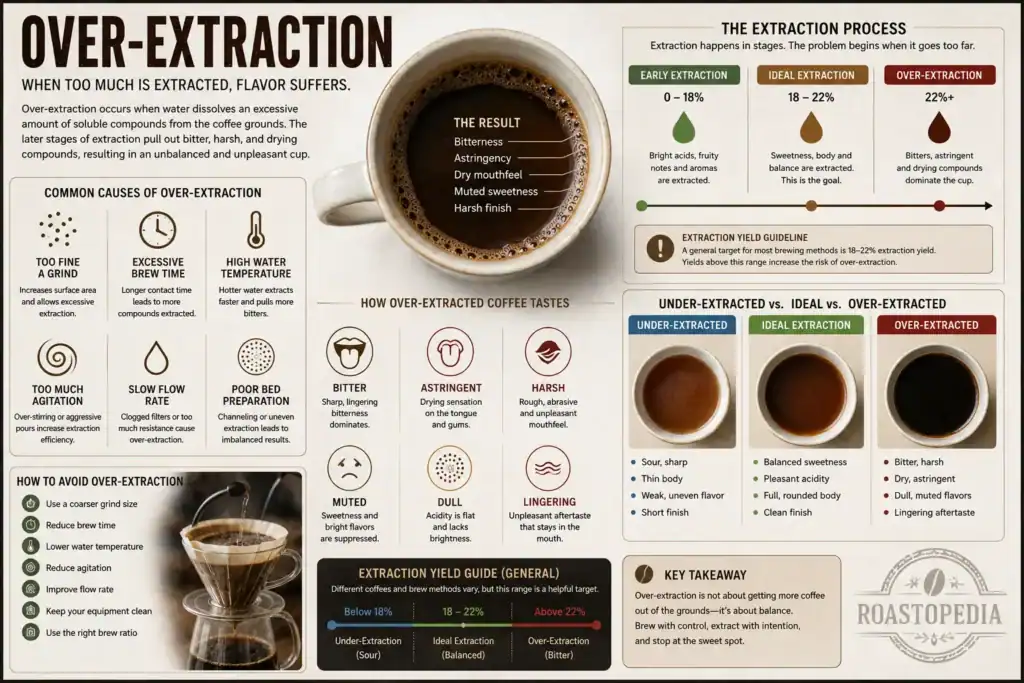
Coffee grounds contain both desirable and undesirable soluble materials. Brewing aims to capture a balanced combination of these substances. The earliest stages of extraction contribute brightness, acidity, and aromatic complexity, while the middle stages provide sweetness, body, and balance.
Toward the end of the extraction process, however, water begins dissolving compounds that can dominate the cup with bitterness and astringency.
For this reason, over-extraction is not simply a matter of extracting “too much coffee.” Rather, it refers to extracting an excessive proportion of less desirable compounds relative to those that contribute balance and sweetness.
In professional coffee analysis, over-extraction is often associated with extraction yields that exceed the generally accepted range of approximately 18–22%, although sensory evaluation remains the most important indicator.
Causes of Over-Extraction
Several brewing variables can increase the likelihood of over-extraction:
Grind Size
Grinding coffee too finely increases the total surface area exposed to water. This allows extraction to occur more rapidly and extensively. Fine grinds can therefore produce excessive extraction if brewing parameters are not adjusted accordingly.
Excessive Contact Time
The longer water remains in contact with coffee grounds, the greater the opportunity for extraction. Prolonged immersion or unusually slow drawdown times can result in over-extracted flavors.
High Water Temperature
Hotter water extracts coffee compounds more efficiently. Temperatures significantly above the commonly recommended brewing range of 90–96°C (194–205°F) may accelerate extraction and contribute to bitterness.
Excessive Agitation
Stirring, swirling, or aggressive pouring can increase extraction efficiency by continually bringing fresh water into contact with coffee particles. While controlled agitation is often beneficial, excessive agitation may push extraction beyond desirable levels.
Slow Flow Rates
In percolation methods such as pour-over brewing, slow drainage can extend contact time and increase extraction. Clogged filters, excessive fines, or poor grinder performance can contribute to this issue.
Sensory Characteristics
Over-extracted coffee is often identifiable through its flavor profile.
Common sensory attributes include:
- Pronounced bitterness
- Dry or astringent mouthfeel
- Harsh finish
- Muted sweetness
- Reduced clarity
- Dull or flattened acidity
- Lingering unpleasant aftertaste
These characteristics can vary depending on the coffee’s origin, roast level, and brewing method, but bitterness and dryness are among the most frequently reported indicators.
Over-Extraction in Different Brewing Methods
Pour-Over Brewing
Pour-over brewers may encounter over-extraction when using excessively fine grind sizes, prolonged drawdown times, or aggressive pouring techniques. The resulting cup often tastes bitter and lacks clarity.
Espresso
Espresso is particularly sensitive to extraction changes because brewing occurs under pressure. Over-extracted espresso may exhibit intense bitterness, harsh woody flavors, and a drying finish. Shots that run excessively long are often associated with over-extraction.
French Press
In immersion brewing methods such as the French Press, leaving coffee to steep for too long or using excessively fine grounds can produce over-extracted flavors and increased sediment.
Cold Brew
Although cold water extracts more slowly than hot water, extended steeping periods can still lead to over-extraction. Some cold brews become woody, bitter, or excessively heavy when steeped for too long.
Over-Extraction vs. Under-Extraction
Over-extraction and under-extraction represent opposite ends of the extraction spectrum.
| Characteristic | Under-Extraction | Over-Extraction |
| Primary Taste | Sour | Bitter |
| Sweetness | Low | Suppressed |
| Body | Thin | Heavy or drying |
| Acidity | Sharp and dominant | Dull or muted |
| Finish | Short and sour | Long and harsh |
| Cause | Insufficient extraction | Excessive extraction |
A well-extracted coffee generally falls between these extremes, balancing sweetness, acidity, body, and aroma.
Measuring Over-Extraction
Professional brewers often evaluate extraction using a combination of sensory analysis and brewing measurements.
Tools commonly used include:
- Refractometers
- Total Dissolved Solids (TDS) measurements
- Extraction Yield calculations
- Brew control charts
While numerical measurements can provide valuable guidance, experienced tasters emphasize that sensory quality remains the ultimate measure of successful extraction.
Preventing Over-Extraction
Brewers seeking to avoid over-extraction typically focus on maintaining balance among brewing variables.
Common corrective actions include:
- Using a coarser grind size
- Reducing brew time
- Lowering water temperature
- Reducing agitation
- Improving flow rate
- Optimizing brew ratios
- Minimizing filter clogging
Small adjustments are generally preferred, as changing multiple variables simultaneously can make diagnosis difficult.
Importance in Coffee Brewing
Over-extraction is one of the fundamental concepts in coffee preparation because it directly influences flavor quality. Understanding its causes allows brewers to diagnose brewing problems and make targeted adjustments to improve cup balance.
Whether preparing espresso, pour-over coffee, immersion brews, or cold brew, controlling extraction remains central to achieving desirable flavor characteristics.
Rather than maximizing extraction, modern brewing practices aim to achieve optimal extraction, where sweetness, acidity, body, and aroma exist in harmony without excessive bitterness or dryness.
See Also
- Agitation
- Brew Ratio
- Channeling
- Contact Time
- Extraction
- Extraction Yield
- Flow Rate
- Grind Size
- Immersion Brewing
- Percolation Brewing
- Refractometer
- Total Dissolved Solids (TDS)
- Turbulence
- Under-Extraction
- Water Temperature
References
- Rao, Scott. Coffee Brewing Best Practices. Scott Rao Publishing, 2019.
- Rao, Scott. Everything but Espresso. Scott Rao Publishing, 2010.
- Hoffmann, James. The World Atlas of Coffee. 2nd Edition. Octopus Publishing, 2018.
- Gagné, Jonathan. The Physics of Filter Coffee. BH Books, 2021.
- Hendon, Christopher. Water for Coffee. BH Books, 2015.
- Illy, Andrea & Viani, Rinantonio (Eds.). Espresso Coffee: The Science of Quality. Academic Press, 2005.
- Clarke, R. J. & Macrae, R. Coffee: Volume 2 – Technology. Elsevier Applied Science, 1987.
- Clarke, R. J. & Vitzthum, O. G. Coffee: Recent Developments. Blackwell Science, 2001.
- Navarini, Luciano et al. Coffee: Recent Developments. Wiley-Blackwell, 2021.
- Specialty Coffee Association (SCA). Brewing Handbook.
- Lockhart, Ernest E. The Coffee Brewing Handbook. Coffee Brewing Institute, 1957.
- Lingle, Ted R. The Coffee Cupper’s Handbook. Specialty Coffee Publications, 2011.
- Hendon, C. H., Colonna-Dashwood, M., & Colonna-Dashwood, C. Water for Coffee. BH Books, 2015.
- Frost, S. C., et al. “Systematically Improving Espresso: Insights from Mathematical Modeling and Experiment.” Matter, 2020.
- Moroney, K. M., Lee, W. T., O’Brien, S. B. G., Suijver, F., & Marra, J. “A Recipe for a Better Cup of Coffee.” Physics of Fluids, 2020.
- Specialty Coffee Association Coffee Standards Committee. Coffee Brewing Control Chart Guidelines.