
Caturra is a cultivar of the Arabica coffee plant, distinguished from a botanical variety by its origin: rather than representing a naturally occurring taxonomic rank below the species, Caturra originated as a single spontaneous mutation of the Bourbon cultivar and was subsequently propagated and selected through cultivation. Caturra belongs to Coffea arabica.
Origin and Classification
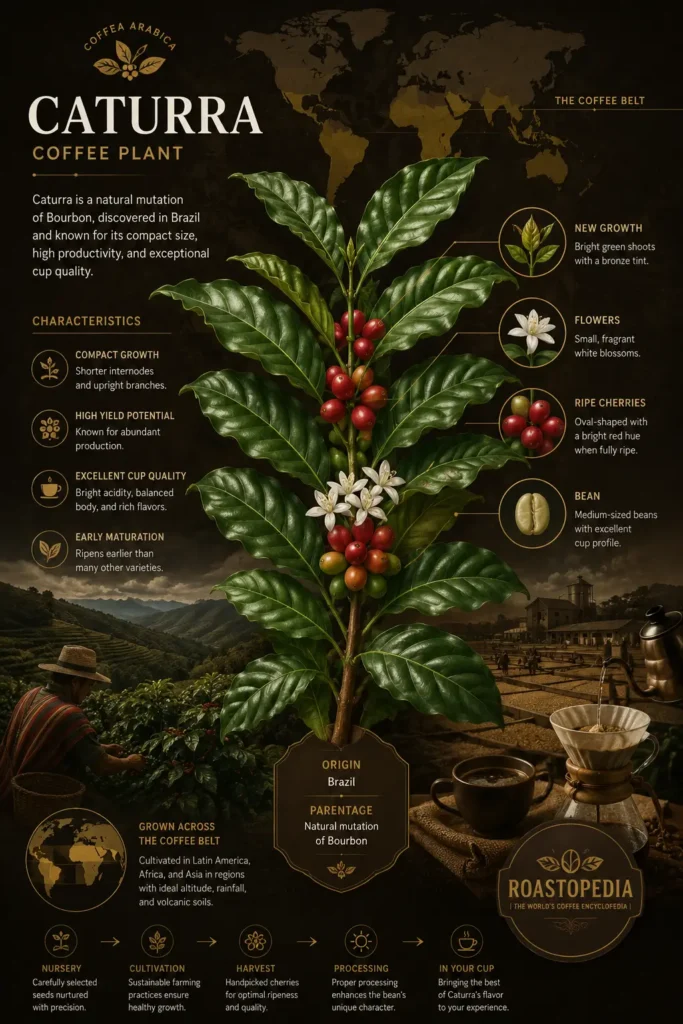
Caturra is a natural dwarf mutation of Bourbon, one of the oldest and most widely cultivated Arabica varieties. It was first identified on a plantation in the Brazilian state of Minas Gerais sometime between 1915 and 1918. The mutation affects a single gene governing internodal spacing, producing a compact, densely branched plant roughly two meters in height, compared to Bourbon’s three to four meters.
Because this trait first appeared as an isolated genetic event within Bourbon rather than through cross-breeding, Caturra is generally classified as a cultivar of Bourbon rather than a distinct variety in its own right, though the two terms are often used loosely and interchangeably in trade and farming contexts.
The name Caturra derives from the Guarani word for “small,” a direct reference to its dwarfed stature.
Development and Spread
Following its discovery, Brazil’s Instituto Agronômico de Campinas began a mass selection program in 1937, isolating high-performing individual plants and bulking their seed across successive generations. Caturra was never formally released for commercial cultivation in Brazil. It instead found its foothold in Central America, introduced to Guatemala in the 1940s before spreading to Costa Rica, Honduras, and Panama.
By the mid-20th century, it had become one of the economically dominant cultivars of the region, prized for allowing significantly higher planting densities than Bourbon and for producing more fruit within a smaller footprint. In Colombia, Caturra once accounted for close to half of national production before large-scale renovation with the rust-resistant Castillo cultivar, one of Caturra’s own descendants, began in 2008.
Caturra is also a parent of the Catimor group, formed by crossing it with the disease-resistant Timor Hybrid to combine Caturra’s compact growth with improved resistance to coffee leaf rust.
Cultivation and Cup Characteristics
Farmers hold that Caturra performs best at altitudes between roughly 1,200 and 2,000 meters, where slower cherry maturation supports deep green leaves and denser beans and more concentrated flavor development. As with Bourbon, it remains susceptible to coffee leaf rust and coffee berry disease, and its dense canopy structure can worsen airflow, compounding rust risk in humid conditions.
The terroir and the friendly environmental conditions within the Coffee Belt play a substantial role in its final cup profile, which is typically described as balanced and sweet, with bright acidity and citrus-forward notes. However, outcomes vary by growing region, processing method, and roasting approach. Because Caturra shares so much of Bourbon’s genetic and sensory character, cuppers frequently note difficulty distinguishing the two in blind tastings.
Two principal color variants exist: Red Caturra and Yellow Caturra, along with less common Purple and Chiroso types, each producing subtle differences in ripening behavior and flavor.
See Also
- Bourbon
- Cultivar
- Java Coffee
- Arabica
- Coffee Plant
- Coffee Cherry
- Terroir
- Altitude
- Coffee Acidity
- Estate Coffee
References
- World Coffee Research, “Caturra,” Coffee Varieties Catalog, varieties.worldcoffeeresearch.org
- Ozone Coffee Roasters, “Caturra Coffee: The Compact Bourbon Mutation,” ozonecoffee.co.uk
- MTPak Coffee, “Coffee Varieties: A Roaster’s Guide to Caturra,” mtpak.coffee
- Homegrounds, “Caturra Coffee Variety: Get to Know the Famous Varietal,” homegrounds.co
- Colipse Coffee, “Caturra Coffee Beans: Taste and Varietals,” colipsecoffee.com
- Bean Ground, “Discovering Caturra: A Dive into Bourbon Varietals,” beanground.com
- Coffeeness, “What Is Caturra Coffee? All About This Bourbon Varietal,” coffeeness.de
- Refuge Coffee Roasters, “What Is the Caturra Coffee Varietal?,” refugecoffeeroasters.com
- San Lázaro Coffee Company, “Specialty Grade Caturra,” sanlazarocoffee.com
- XLIII Coffee, “The ‘Dwarf Mutation’: Superior Caturra Coffee Varieties,” xliiicoffee.com
- International Coffee Organization, “Botany of the Coffee Plant,” icocoffee.org
- Davis, A.P., Govaerts, R., Bridson, D.M., & Stoffelen, P. (2006), “An Annotated Taxonomic Conspectus of the Genus Coffea (Rubiaceae),” Botanical Journal of the Linnean Society