
A coffee seedling is the young sporophyte of the genus Coffea, typically representing the developmental phase of the coffee plant between seed germination and the establishment of a sapling capable of field transplanting. The transition from coffee bean to a viable seedling is a sensitive physiological process influenced by terroir, altitude, and moisture availability. For organic coffee production, maintaining chemical-free nursery conditions during these early stages is critical for long-term plant health.
Germination and Growth Stages
The lifecycle of coffee plant seedlings begin with the germination of the coffee cherry seed. Germination typically occurs over 30 to 60 days. The process begins with the emergence of the radicle, which anchors the plant. As the hypocotyl elongates, it carries the seed—still encased in its parchment layer—above the soil surface. This specific developmental phase is frequently referred to as the “soldier stage” or “matchstick stage” due to its vertical, slender appearance.
Once the seed casing is shed, the first pair of leaves emerges. These are not true leaves but cotyledons, which are round and fleshy. This phase is known as the “butterfly stage.” These cotyledons provide the initial photosynthetic energy required for the coffee plant to develop its first true foliage. From this point, the plant enters a period of vegetative growth where the coffee leaf structure begins to mirror the elliptical, waxy characteristics of the mature shrub.
Anatomy
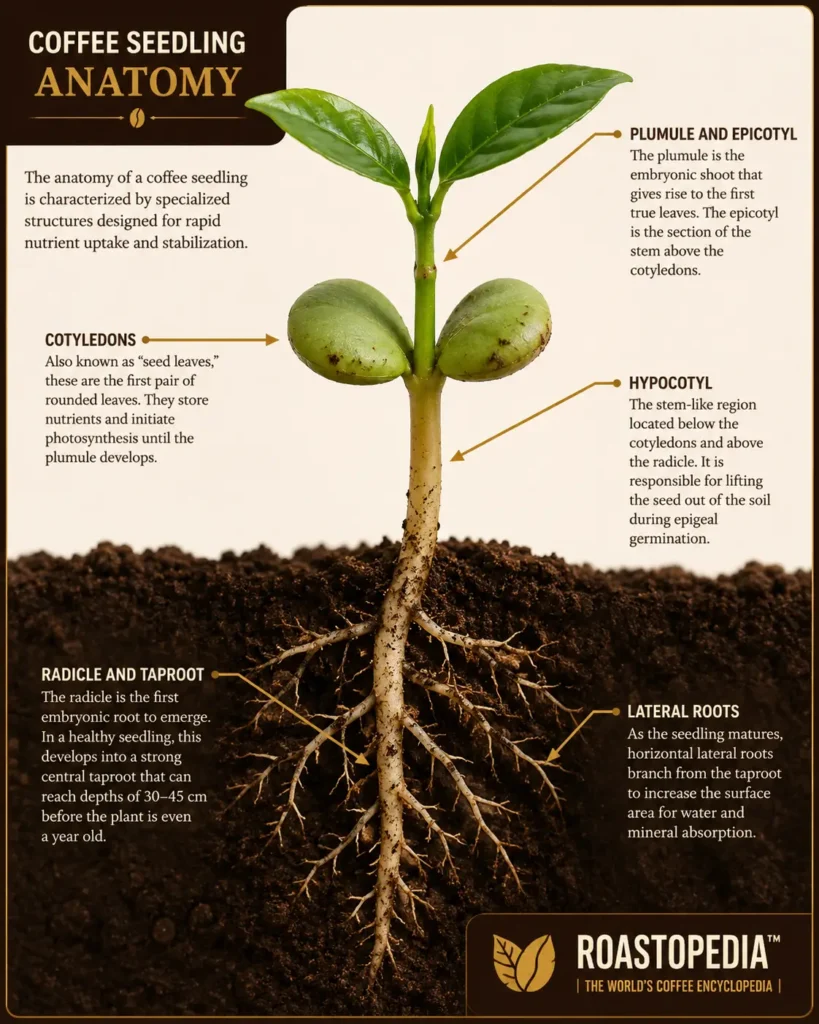
The anatomy of a coffee seedling is characterized by specialized structures designed for rapid nutrient uptake and stabilization.
Radicle and Taproot: The radicle is the first embryonic root to emerge. In a healthy seedling, this develops into a strong central taproot that can reach depths of 30–45 cm before the plant is even a year old.
Hypocotyl: The stem-like region located below the cotyledons and above the radicle. It is responsible for lifting the seed out of the soil during epigeal germination.
Cotyledons: Also known as “seed leaves,” these are the first pair of rounded leaves. They store nutrients and initiate photosynthesis until the plumule develops.
Plumule and Epicotyl: The plumule is the embryonic shoot that gives rise to the first true leaves. The epicotyl is the section of the stem above the cotyledons.
Lateral Roots: As the seedling matures, horizontal lateral roots branch from the taproot to increase the surface area for water and mineral absorption.
Environmental and Cultivation Factors
The success of a seedling nursery is often the determining factor in the productivity of a coffee estate. Seedlings are highly susceptible to environmental stressors. Variations in coffee acidity within the soil can inhibit root development, while excessive moisture may lead to fungal pathogens.
During the nursery phase, seedlings are often transitioned between shade levels to harden them for the intense sunlight of high-altitude plantations. Once the seedling reaches approximately 20–40 cm in height and possesses several pairs of true leaves, it is considered ready for permanent placement in the field.
See Also
- Coffee Plant
- Coffee Bean
- Estate Coffee
- Organic Coffee
- Coffee Cherry
- Single-Origin Coffee
- Coffee Leaf
- Coffee Flower
- Terroir
- Altitude
References
- Wintgens, J. N. (2004). Coffee: Growing, Processing, Sustainable Cultivation. Wiley-VCH.
- Clifford, M. N., & Willson, K. C. (1985). Coffee: Botany, Biochemistry and Production of Beans and Beverage. Croom Helm.
- Food and Agriculture Organization of the United Nations. (2010). Arabica Coffee Manual for Lao PDR.
- International Coffee Organization. (2023). Botanical Aspects of Coffee Development.
- World Coffee Research. (2022). Coffee Varieties Catalog and Nursery Management.
- Davis, A. P., et al. (2019). High extinction risk for wild coffee species and implications for a sustainable coffee sector. Science Advances.
- Lashermes, P., et al. (1999). Molecular characterisation and origin of the Coffea arabica L. genome. Molecular and General Genetics.
- Cannell, M. G. R. (1985). Physiology of the Coffee Crop. In Coffee: Botany, Biochemistry and Production.
- Rothfos, B. (1980). Coffee Production. GORDian-Max-Rieck GmbH.
- Wrigley, G. (1988). Coffee. Tropical Agriculture Series, Longman Scientific & Technical.
- Smith, A. W. (1985). Introduction to Coffee Botany and Genetics.
- Wellman, F. L. (1961). Coffee: Botany, Cultivation, and Utilization. Leonard Hill.