
Water temperature is the primary thermal catalyst in the complex biochemical process of coffee extraction. It represents the measure of average kinetic energy available to dissolve organic compounds from the roasted matrix. This energy level dictates the specific mass-transfer rates of acids, sugars, and lipids into the solution.
The optimal water temperature for brewing specialty coffee is internationally standardized by the Specialty Coffee Association (SCA) as being between 90°C and 96°C (194°F to 205°F). This specific thermal window provides the necessary kinetic energy to balance the extraction of organic acids, complex sugars, and desirable bitter compounds without triggering the thermal degradation of delicate aromatic volatiles.
While this range is the industrial benchmark, high-precision brewing requires minor adjustments based on roast level: lighter, denser roasts typically require the upper limit (94°C–96°C) to penetrate their tight cellular structure, whereas darker, more porous roasts benefit from the lower limit (88°C–91°C) to mitigate the extraction of harsh, ashy phenolics.
Thermal energy facilitates the breakage of intermolecular bonds within the porous cellulose structure of the coffee bean. High-velocity water molecules more effectively penetrate the cellular walls to reach the soluble coffee solids. This process establishes the final concentration of Total Dissolved Solids (TDS) in the brewed beverage.
Solubility gradients vary significantly across the diverse range of chemical families present in roasted coffee. Each compound—from volatile esters to heavy melanoidins—responds uniquely to changes in the thermodynamic environment. Precise temperature regulation is therefore essential for achieving a balanced and technically accurate extraction.
Origin & History
Water temperature standards emerged as a focal point of scientific inquiry during the mid-20th century industrialization of coffee. Early researchers sought to transition brewing from a subjective art to a standardized chemical engineering process. The Specialty Coffee Association of America (SCAA) later codified these findings into the “Golden Cup” standards.
Nineteenth-century brewing methodologies often prioritized boiling water due to a lack of precise thermal measurement tools. This approach frequently resulted in the thermal degradation of delicate aromatic oils and the release of harsh bitters. The shift toward sub-boiling temperatures represented a major advancement in the global understanding of coffee chemistry.
Modern technical standards are the result of decades of research into the thermodynamics of the brewing slurry. Scientists began measuring the heat loss that occurs when hot water interacts with room-temperature coffee grounds. These studies led to the development of the “slurry temperature” as the definitive metric for extraction.
Patency & Lineage
The lineage of thermal control in coffee brewing is intrinsically linked to the evolution of the thermostat. Early espresso machines relied on indirect pressure-to-temperature relationships managed by primitive pressurestats. These systems offered limited stability and were prone to significant thermal drift during high-volume service.
Patents for Proportional-Integral-Derivative (PID) controllers revolutionized the industry by allowing for direct and precise thermal management. This technology uses a mathematical algorithm to maintain a target temperature within a fraction of a degree. Manufacturers began integrating PID systems into commercial and domestic equipment to eliminate thermal variability.
Lineage also includes the engineering of specialized materials designed for superior thermal stability and heat retention. High-density polymers like PEEK and PPS were patented for use in brew groups and filter baskets. These materials minimize the “heat sink” effect that traditionally plagued metal and ceramic brewing components.
Migration & Adoption
Professional adoption of precise water temperature ranges followed the publication of the Coffee Brewing Handbook. This foundational text established the 90°C to 96°C window as the global benchmark for specialty extraction. Baristas worldwide began utilizing digital thermometers and kettles to adhere to these high-precision standards.
Adoption was further driven by the competitive landscape of the World Barista Championship and similar technical events. Competitors demonstrated that minute changes in water heat could radically alter the sensory profile of a coffee. This awareness permeated through the specialty industry and into the design of consumer-grade equipment.
Global migration of thermal precision has now reached the domestic market through the proliferation of “smart” brewing devices. Home enthusiasts utilize vacuum-insulated carafes and PID-controlled kettles to replicate laboratory conditions in their kitchens. This democratization of technical knowledge has significantly elevated the baseline quality of international coffee consumption.
Uses & Importance
Water temperature is the master variable used to “tune” the chemical extraction of the coffee bean. It allows the brewer to selectively target specific solubility thresholds for various organic compounds and acids. This capability is essential for highlighting the terroir-specific notes of high-altitude Arabica coffees.
Importance is also found in the mitigation of chemical defects that occur at extreme temperature points. Excessive heat triggers the hydrolysis of chlorogenic acids into quinic and caffeic acids, which introduce harsh bitterness. Proper thermal management prevents these reactions, ensuring the clarity and sweetness of the final beverage.
Technical importance extends to the consistency and repeatability of commercial coffee programs across multiple locations. Maintaining a standardized thermal profile ensures that a specific roast profile tastes identical regardless of the equipment used. This precision is the cornerstone of brand integrity for high-end specialty coffee roasters.
Role & Why it Matters
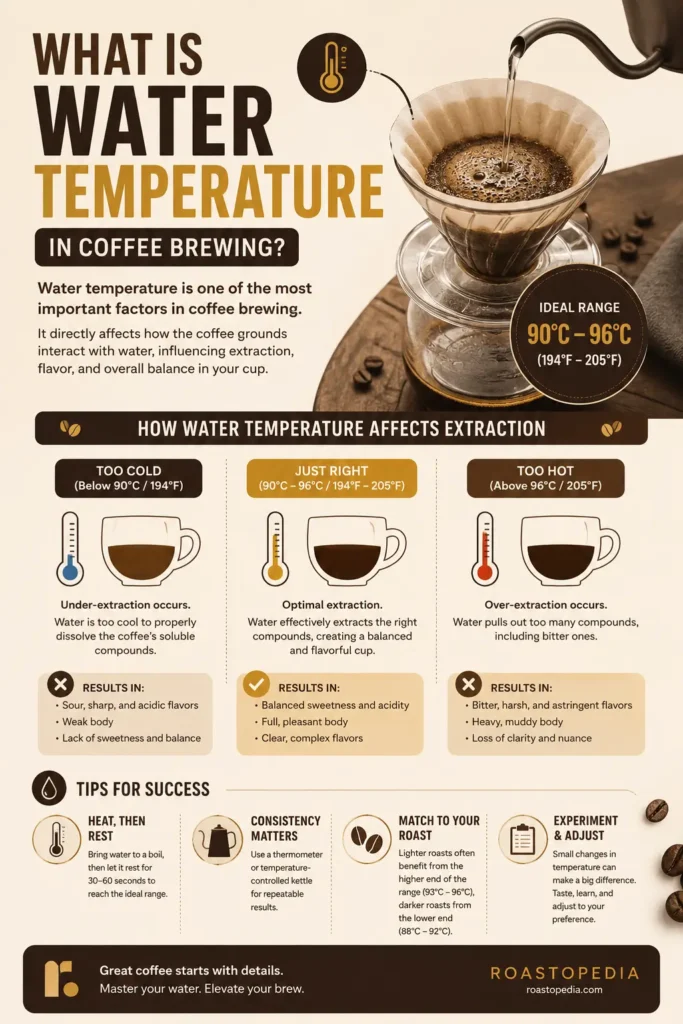
Principles of chemical kinetics and molecular mass transfer govern the temperature outcome of coffee extraction. It is generally believed that higher temperatures provide the energy required for water to function as an effective solvent, enabling it to dissolve and transport soluble coffee compounds. Without adequate thermal energy, water is unable to penetrate the coffee’s cellular structure and extract its dissolved solids.
Why it matters is tied to the concept of the “extraction window” and the sensory balance of the cup. Higher temperatures favor the extraction of heavier molecules like bitters and roasted carbohydrates during the final phase. Lower temperatures prioritize the migration of volatile acids and delicate floral esters in the initial stage.
Temperature also dictates the rate of carbon dioxide degasification during the “bloom” phase of brewing. Heat facilitates the rapid release of trapped gases, allowing the water to fully saturate the coffee bed. This even saturation is critical for preventing channeling and ensuring a uniform extraction of all particles.
Technical Specifications: Thermal Extraction Thresholds by Roast and Variety
The following table provides the high-precision thermal ranges required for optimal chemical extraction across diverse coffee genotypes and roast degrees. These measurements assume a standard atmospheric pressure at sea level and utilize the Specialty Coffee Association (SCA) “Golden Cup” parameters as a baseline.
| Coffee Variety / Genotype | Roast Degree | Optimal Water Temp (Source) | Slurry Equilibrium (Target) | Primary Chemical Impact |
| High-Density Arabica (e.g., Geisha, SL28) | Light (City) | 94°C – 96°C (201°F – 205°F) | 91°C – 93°C | Penetrates dense cellulose; unlocks complex phosphoric and citric acids. |
| Standard Arabica (e.g., Caturra, Bourbon) | Medium (Full City) | 92°C – 94°C (198°F – 201°F) | 89°C – 91°C | Optimizes Maillard reaction sugars; balances sweetness with structural acidity. |
| Low-Altitude Arabica (e.g., Mundo Novo) | Dark (Vienna/French) | 88°C – 91°C (190°F – 196°F) | 85°C – 88°C | Prevents hydrolysis of chlorogenic acids into bitter quinic acid compounds. |
| Robusta (Canephora) | Medium-Dark | 89°C – 92°C (192°F – 198°F) | 86°C – 89°C | Mitigates heavy wood-grain notes while preserving high caffeine concentration. |
| Experimental (Anaerobic/Carbonic) | Light-Medium | 90°C – 93°C (194°F – 199°F) | 87°C – 90°C | Preserves delicate fermentation-derived volatile esters and lactic acid notes. |
Thermal Deviation Consequences
| Deviation from Target | Immediate Chemical Result | Sensory Profile Outcome |
| +3°C (> 97°C) | Thermal degradation of volatile oils and increased phenolic solubility. | Acrid, ashy, and intensely bitter; loss of origin-specific aromatics. |
| -3°C (< 87°C) | Insufficient kinetic energy for lipid emulsification and sugar dissolution. | Thin, salty, or sharp-sour; lack of body and lingering sweetness. |
Arrhenius Kinetics and Mass Transfer Coefficients
Extraction velocity is governed by the Arrhenius equation: k = A exp(-Ea / RT). This formula describes the exponential relationship between water temperature and the reaction rate constant (k). A minor increase in thermal energy can significantly shorten the time required for a target TDS.
Activation energy (Ea) varies between the different soluble components found in the roasted coffee bean. Fruit acids possess a low Ea and dissolve almost instantly upon contact with hot water. Heavier tannins and bitter compounds require a higher Ea, which is only reached at elevated temperatures.
The mass transfer coefficient (km) describes how quickly solutes move from the coffee particle into the water. This coefficient is highly dependent on the diffusion rate, which increases linearly with the water’s kinetic energy. Understanding these kinetics allows for the precise “dialing-in” of complex coffee recipes and profiles.
Thermodynamic Properties of Brewing Materials
| Material Substrate | Conductivity (W/m·K) | Specific Heat (J/kg·K) | Heat Loss Mechanism |
| High-Density PPS | ~0.30 | ~1200 | Very Low Conduction |
| Borosilicate Glass | ~1.15 | ~830 | High Radiative Loss |
| Porcelain Ceramic | ~4.00 | ~950 | Moderate Conduction |
| 304 Stainless Steel | ~15.0 | ~480 | Very High Conduction |
Variations
Variations in thermal requirements are primarily dictated by the roast degree and the density of the bean. Light roasts are physically denser and require higher temperatures (94°C–96°C) to penetrate their tight cellular structure. This high energy is necessary to extract the complex sugars that balance their high acidity.
Dark roasts are more porous and fragile due to the extended thermal exposure they received in the roaster. They extract much more easily and are prone to over-extraction at standard temperature ranges. Baristas often drop the water temperature to 88°C–91°C to avoid the extraction of harsh, carbonized notes.
Brewing method variations also necessitate adjustments to the starting water temperature to account for equipment heat loss. Immersion brewers like the French Press lose heat rapidly, requiring a higher initial water temperature to compensate. Percolation methods benefit from the continuous addition of hot water, maintaining a more stable thermal environment.
Read: How Water Temperature Affects Coffee Extraction
Notable Facts
- Water at 93°C extracts soluble coffee solids approximately 3.3 times faster than water at 19°C.
- The actual slurry temperature in a ceramic V60 can be 10°C lower than the kettle water.
- Atmospheric pressure significantly lowers the boiling point of water in high-altitude coffee-growing regions.
- Certain volatile aromatic compounds begin to evaporate at temperatures as low as 40°C during brewing.
- Preheating a ceramic dripper can increase the final extraction yield by as much as 1.5% TDS.
- Caffeine solubility increases by over 400% when water temperature rises from 20°C to 100°C.
- Lipid migration is almost non-existent in brewing temperatures below 30°C, characteristic of cold brew.
- Over-heated water can cause the thermal degradation of delicate citric and malic acids into quinic acid.
- The “sweet spot” for sugar solubility is often cited as being between 92°C and 94°C.
- Vacuum-insulated brewing vessels can maintain a slurry temperature within 0.5°C over a five-minute brew.
- Pre-wetting filters with boiling water serves both to clean the paper and preheat the brewer.
- The enthalpy of dissolution for caffeine is approximately 14.5 kJ/mol in standard brewing conditions.
- Molecular diffusion of solutes through the coffee matrix is the primary bottleneck in extraction speed.
- High temperatures increase the permeability of the coffee’s cellulose walls by expanding the pore network.
- Thermal shock from adding cold water to a hot brew can cause immediate precipitation of oils.
Associated People & Regions
Dr. Ernesto Illy is widely regarded as a pioneer in the thermodynamics and chemistry of espresso. His work at the illycaffè labs in Trieste established many of the industry’s technical benchmarks. The Illy family’s research remains a cornerstone of the global specialty coffee knowledge base.
David Schomer is credited with popularizing the use of PID controllers in commercial espresso machines. His research into thermal stability at Espresso Vivace in Seattle influenced an entire generation of baristas. This focus on stability became a defining characteristic of the third-wave coffee movement.
The Specialty Coffee Association (SCA) continues to be the primary authority for setting global thermal standards. Its technical committees publish research that informs the design of professional and consumer brewing equipment. These standards are adopted by nearly every professional barista training program in the world.
Related Equipment
- PID-Controlled Kettles: These devices allow for precise, degree-by-degree temperature management for manual brewing methods.
- Saturated Group Heads: This design ensures that the brew water remains at a constant temperature.
- Dual-Boiler Espresso Machines: These systems separate steam and brew water to ensure independent thermal stability.
- Thermocouple Probes: These professional tools allow baristas to measure the real-time slurry temperature during extraction.
- Heat Exchangers with PIDs: These hybrid systems provide both high-pressure steam and temperature-stable brew water.
- Vacuum-Insulated Drippers: These specialized brewers minimize heat loss to the environment during the extraction cycle.
Adoption & Modern Impact
The modern impact of thermal precision is most evident in the development of “smart” brewing machines. These devices utilize machine learning algorithms to adjust temperature profiles based on specific coffee varieties. This automation aims to provide professional-grade extraction consistency to the average domestic consumer.
Sustainability and energy efficiency have also become major drivers in the design of modern heating systems. Manufacturers are developing low-mass heating elements that reduce the power required to reach brewing temperatures. These innovations help to lower the carbon footprint of high-volume specialty coffee operations.
See Also
- Extraction Yield
- Refractometry
- Extraction
- Flow Rate
- Dialing In
- Contact Time
- Pre-Diffusion
- Maillard Reaction
- Terroir
References
- Specialty Coffee Association. (2021). The Coffee Brewing Handbook. Santa Ana, CA: SCA.
- Yeager, S., et al. (2025). “Roast Level and Brew Temperature Significantly Affect Coffee Color”. Journal of Food Science.
- Petracco, M. (2005). Physicochemical Characterization of Coffee. Oxford: Elsevier.
- Cordoba, N., et al. (2020). “Effect of temperature on coffee extraction kinetics”. Scientific Reports.
- Rao, S. (2014). The Coffee Roaster’s Companion. Self-Published.
- Hoffmann, J. (2018). The World Atlas of Coffee. London: Mitchell Beazley.
- Illy, A., & Viani, R. (2005). Espresso Coffee: The Science of Quality. Academic Press.
- Belitz, H. D. (2009). Food Chemistry. Berlin: Springer.
- Masters, K. (2012). “Thermodynamics of Coffee Extraction”. International Journal of Food Science.
- Smith, R. (1985). “Solubility of Caffeine in Water”. Journal of Chemical Ecology.
- Miller, J. (2022). “Slurry Temperature vs. Source Temperature”. Coffee Science Journal.
- Zhang, L. (2019). “Impact of water temperature on aromatic volatiles”. Journal of Agricultural Chemistry.
- Parenti, A., et al. (2014). “Evolution of coffee brewing methods”. Journal of Food Engineering.
- Lee, L. W. (2015). “Kinetics of coffee bean extraction”. Food Research International.
- Mori, E. E., et al. (2003). “Sensory and chemical evaluation of coffee brews”. Journal of Food Science.
- Wang, X., & Lim, L.-T. (2021). “Modeling study of coffee extraction at different temperatures”. Journal of Food Process Engineering.
- Fuller, M., & Rao, N. Z. (2017). “The effect of time and temperature on caffeine and CGA”. Scientific Reports.
- Peleg, M., et al. (2012). “The Arrhenius equation revisited in food science”. Critical Reviews in Food Science.
- Spiro, M., & Selwood, R. M. (1984). “The kinetics and mechanism of caffeine infusion”. Journal of Science of Food.
- Bereket Dalga, A. B. (2024). “Study of the self-association of caffeine and chlorogenic acid”. Romanian Journal of Biochemistry.
- Home-Barista Technical Archive. (2024). “Thermal Stability Drippers – Comparison Data”. Home-Barista.
- Driftaway Coffee Research. (2024). “Ceramic vs. Glass: Conduction and Convection in Brewing”. Driftaway Education.
- Third Wave Water Technical Guide. (2025). “SCA Water Standards and Temperature Stability”. Third Wave Water.
- National Coffee Association. (2023). “Brewing Fundamentals: The Role of Water Temperature”. NCA USA.
- Royal Coffee Lab. (2024). “The Thermodynamics of the Slurry: Material Science in Coffee”. Royal Coffee.
- Barista Hustle. (2025). “The Arrhenius Equation in Espresso Extraction”. Barista Hustle Education.
- Scott Rao Research Blog. (2024). “Thermal Stability and the V60: A Data-Driven Approach”. Scott Rao.
- Coffee Ad Astra. (2025). “Thermodynamics of Coffee Brewing: A Physics Perspective”. Coffee Ad Astra.
- Specialty Coffee Association. (2025). “The Color in Your Cup: Roast Level and Brew Temp”. SCA News.
- Hario Research Group. (2023). “Thermal Conductivity in Glass vs. Plastic Drippers”. Brewing Science Quarterly.
- Standage, T. (2005). A History of the World in 6 Glasses. New York: Walker & Company.
- Pendergrast, M. (2010). Uncommon Grounds: The History of Coffee. New York: Basic Books.
- Borowicz, P., et al. (2022). “Spectroscopic study of coffee extraction”. Journal of Molecular Structure.
- Clarke, R. J., & Macrae, R. (1987). Coffee: Volume 2: Technology. London: Elsevier Applied Science.
- Sivetz, M., & Desrosier, N. W. (1979). Coffee Technology. Westport, CT: AVI Publishing.
- Ukers, W. H. (1922). All About Coffee. New York: The Tea and Coffee Trade Journal Company.
- Buffo, R. A., & Cardelli-Freire, C. (2004). “Coffee flavor: An overview”. Flavour and Fragrance Journal.
- Farah, A. (2012). “Coffee Constituents”. Coffee: Emerging Health Effects and Disease Prevention.
- Ginz, M., et al. (2000). “Formation of aliphatic acids by the Maillard reaction”. European Food Research and Technology.
- Scholz-Ahrens, K. E., et al. (2001). “Antioxidative activity of coffee brews”. Molecular Nutrition & Food Research.