
Kalita Wave is a flat-bottomed, pour-over coffee dripper produced by the Kalita Co., a family-owned Japanese equipment manufacturer.
Established in 1958 in Nihonbashi, Tokyo, the company later relocated its headquarters to Yokohama. The Wave series is distinguished by a patented geometry designed to promote extraction uniformity through controlled flow resistance.
Origin & History
Kalita Co. began as a paper filter manufacturer during the mid-20th-century Japanese coffee movement. Before this period, coffee consumption in Japan was largely restricted to professional coffee shops and restaurants. Kalita pioneered the “Made in Japan” movement for domestic brewing equipment to enable home preparation.
The Wave series represents the technical evolution of the company’s earlier trapezoidal (wedge-shaped) drippers. It was introduced to solve the common issues of bypass and uneven saturation found in conical brewers.
Patency & Lineage
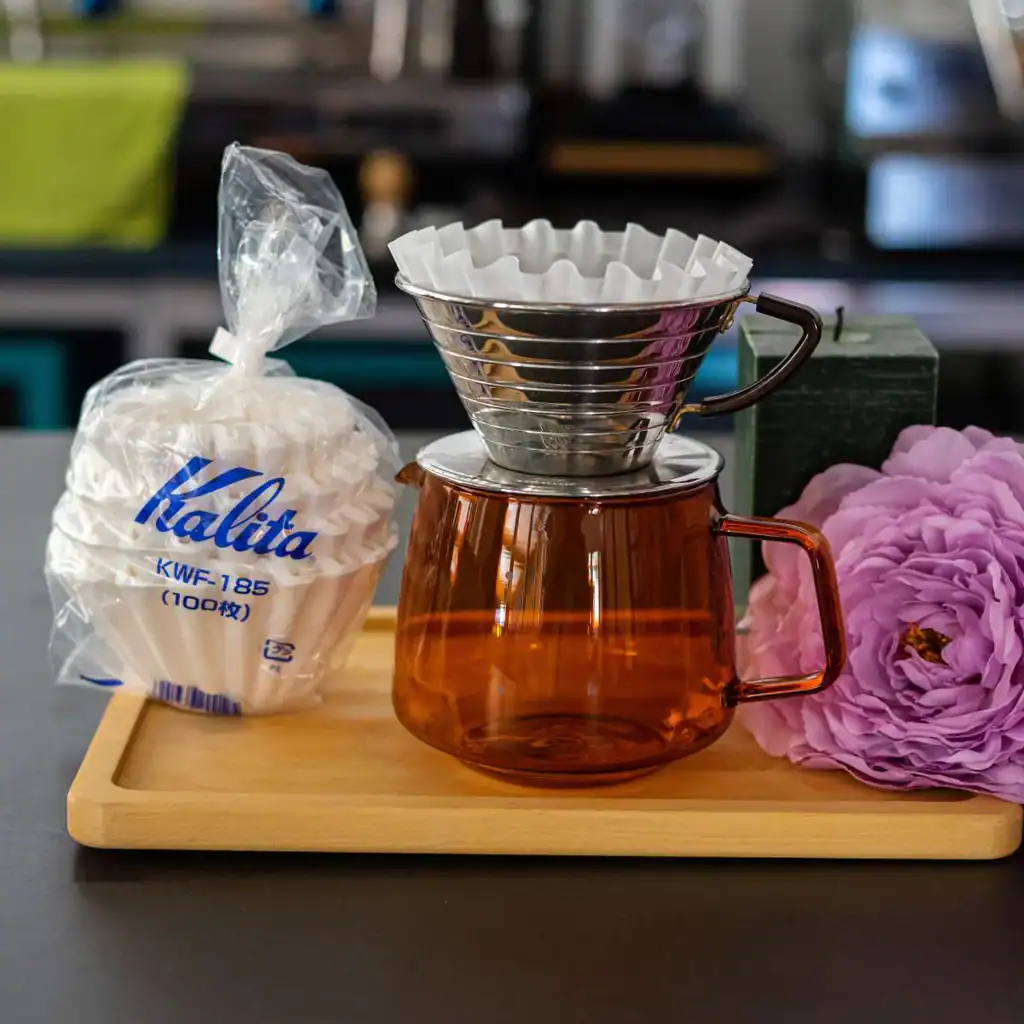
The Wave design is protected under multiple international patents, including US Design Patent D797,501. It descends from the traditional basket-style commercial brewers but scales the geometry for manual precision. The lineage incorporates the “Tsubame-Sanjo” manufacturing tradition in Niigata Prefecture. This region is famous for metalworking, where specialized craftsmen hand-forge the premium stainless steel versions.
Migration & Adoption
The method migrated from the Japanese specialty market to Western cafes in the late 2000s. It gained international prominence during the World Brewers Cup competitions between 2011 and 2015. Professional baristas adopted the Wave for its “forgiving” nature and high reproducibility. Today, it is a staple in Third Wave coffee establishments globally.
Uses & Importance
The Kalita Wave is primarily used for single-origin filter coffee preparation. It serves as a benchmark for “flat-bottom” extraction dynamics in coffee research and education. Its importance lies in its ability to produce a high Total Dissolved Solids (TDS) percentage without over-extraction.
Role & Why It Matters
The device plays a critical role in minimizing “channeling,” where water takes the path of least resistance through the coffee bed. The flat bottom ensures a consistent depth of the coffee grounds throughout the brewing process. This leads to a more balanced extraction compared to the varying depths of conical filters.
Technical Specifications
The following table details the physical dimensions and material properties of the two primary models.
| Specification | Model 155 (Small) | Model 185 (Large) |
| Ideal Brew Volume | 300–500 ml | 500–750 ml |
| Base Diameter | ~45 mm | ~60 mm |
| Top Diameter | ~100 mm | ~115 mm |
| Height | ~65 mm | ~80 mm |
| Drainage Holes | 3 (approx. 2.0 mm each) | 3 (approx. 2.0 mm each) |
| Standard Materials | Stainless Steel, Glass, Ceramic | Stainless Steel, Glass, Ceramic, Copper |
| Filter Type | 20-Pleat Wave Filter 155 | 20-Pleat Wave Filter 185 |
Key Design Features
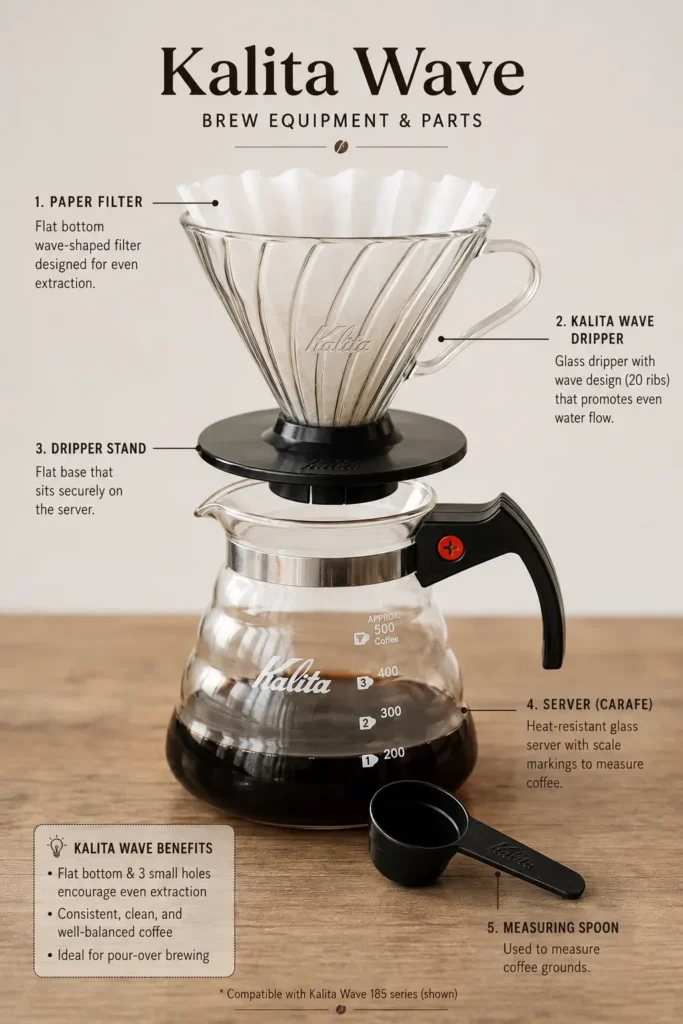
- Three-Hole Drainage: Three 2.0 mm holes are arranged in a triangular pattern at the base. This configuration prevents the “clogging” effect seen in single-hole drippers.
- The ‘Wave’ Filter: The proprietary paper filters feature exactly 20 vertical pleats. These pleats maintain a physical air gap between the paper and the dripper wall.
- Thermal Insulation: The “Wave Zone” air pockets act as thermal insulation. This preserves slurry temperature and prevents heat loss through the side walls.
- Surface Contact: The design minimizes surface contact between the filter and the dripper. This allows for horizontal airflow and consistent vertical water movement.
Variations
The Hasami Porcelain edition uses traditional Japanese pottery techniques for enhanced heat retention. The Tsubame Steel version features a mirror-polished finish and a distinct bottom gutter design.
The Glass Series utilizes a raised central ridge to prevent filter adhesion to the drainage holes.
Notable Facts
- The 20 pleats of the filter are engineered to withstand the weight of water without collapsing.
- Unlike the Hario V60, the Kalita Wave relies on flow restriction at the base rather than the grind size alone.
- The copper variant of the 185 model possesses the highest thermal conductivity among all materials.
Associated People & Regions
- Tsubame-Sanjo, Niigata: The Japanese city responsible for the precision metal manufacturing of the steel drippers.
- The Kalita Family: Founders and owners who have maintained the company’s focus on professional-grade home gear.
- Specialty Coffee Association (SCA): The organization that has featured the Wave in numerous technical brewing studies.
Related Equipment
- Hario V60: A conical brewer that uses a single large hole and internal ribs for rapid drainage.
- Chemex: A thick-paper conical brewer that emphasizes clarity via high-density filtration.
- Fellow Stagg [X]: A modern flat-bottom dripper influenced by the Wave’s extraction principles.
- Origami Dripper: A hybrid dripper that can accommodate both conical and Wave-style filters.
Adoption & Modern Impact
The Kalita Wave has standardized the “flat-bed” brewing profile in the coffee industry. It is the preferred method for roasters to evaluate the sweetness and body of medium-density coffees. Its design has influenced a new generation of “no-bypass” brewers seeking maximum extraction efficiency.
References
- Kalita Co., Ltd. Official Corporate History and Product Catalog. Yokohama, Japan.
- Hoffmann, J. (2018). The World Atlas of Coffee: From Beans to Brewing. Mitchell Beazley.
- Rao, S. (2010). Everything But Espresso: Professional Coffee Brewing Techniques.
- Gagné, J. (2020). The Physics of Filter Coffee. Scott Rao Publishing.
- US Patent Office. Design Patent D797,501: Filter for making beverages.
- Stephenson, T. (2015). The Curious Barista’s Guide to Coffee. Ryland Peters & Small.
- Moldvaer, A. (2014). Coffee Obsession. DK Publishing.
- SCA (Specialty Coffee Association). Brewing Best Practices and Standards.
- Abbott, S. (2020). The Science of Coffee Brewing: Flat-Bottom Dynamics.
- Japanese Coffee Co. Technical Analysis of the Kalita Wave Series.
- Hendon, C. H., et al. (2014). The Role of Dissolved Cations in Extraction. Journal of Agricultural and Food Chemistry.
- World Brewers Cup Archive. Winning Equipment Profiles 2011-2015.
- Tsubame-Sanjo Regional Industries Promotion Center. Metalworking Traditions and Modern Coffee Gear.
- Coffee Ad Astra. Comparative Study: Flat-Bottom vs. Conical Percolation.
- University of California, Davis Coffee Center. Brewing Geometry and Extraction Uniformity Reports.