
A percolator is a coffee brewing device that continuously cycles heated water through a bed of ground coffee until the desired extraction strength is achieved.
Unlike drip coffee makers, which pass water through the grounds only once, a percolator repeatedly recirculates brewed coffee through the coffee bed during the brewing process. This distinctive extraction mechanism produces a strong, robust beverage characterized by pronounced body and intense flavor.
Percolators were among the most widely used coffee brewing devices during the late nineteenth and much of the twentieth century. Before the widespread adoption of automatic drip coffee makers, they represented the dominant method of household coffee preparation in many parts of North America and Europe.
Although their popularity declined with the rise of drip brewing technology, percolators remain important historical brewing devices and continue to be used in domestic, commercial, and outdoor settings.
Origin
The principle underlying percolation brewing emerged during the nineteenth century as inventors sought more efficient methods of preparing coffee. Early percolating devices appeared in Europe during the first half of the century, with several patents describing systems that circulated boiling water through coffee grounds.
The modern percolator is generally associated with the work of American inventor Hanson Goodrich, who received a United States patent for an improved coffee percolator in 1889. His design established many of the features that would define subsequent percolators, including a vertical tube, a perforated distribution chamber, and a separate coffee basket.
Development and Evolution
Throughout the twentieth century, stovetop percolators became standard household equipment. Manufacturers produced models in aluminum, stainless steel, enamelware, and glass, making the brewing method accessible to a broad consumer market.
The introduction of electric percolators during the mid-twentieth century further increased their popularity. Automatic heating controls allowed users to maintain brewing temperatures without relying on stovetop heat sources.
By the 1970s, however, automatic drip coffee makers began replacing percolators in many households because they offered greater consistency and reduced risk of over-extraction.
Despite this decline in domestic use, percolators remain important brewing devices in the history of coffee preparation. Modern versions continue to be manufactured for home kitchens, outdoor recreation, institutional food service, and large-volume coffee production.
Extraction Mechanism
The percolator operates through a cyclical extraction process driven by heat and gravity. Water placed in the lower chamber is heated until it rises through a vertical tube. Upon reaching the top of the device, the water is dispersed over a basket containing ground coffee.
The liquid then passes through the coffee bed and returns to the lower chamber. This cycle repeats continuously throughout the brewing period, exposing the grounds to progressively stronger liquid rather than fresh water.
Filtration Method
Most traditional percolators employ a metal filter basket with numerous perforations. The filter separates the coffee grounds from the brewed beverage while permitting oils and microscopic particles to pass through.
Because metal filtration allows more soluble compounds and oils into the cup than paper filtration, percolated coffee typically exhibits a heavier body and more pronounced mouthfeel than many drip-brewed coffees.
Scientific Basis
Percolation brewing relies on repeated extraction. During each cycle, hot liquid dissolves organic acids, sugars, lipids, aromatic compounds, and other soluble substances from the coffee grounds.
The repeated recirculation of brewed coffee distinguishes the percolator from most other brewing systems. While this process can increase extraction efficiency, excessive brewing may extract larger quantities of bitter compounds and astringent substances, resulting in a harsher flavor profile.
Primary Brewing Device
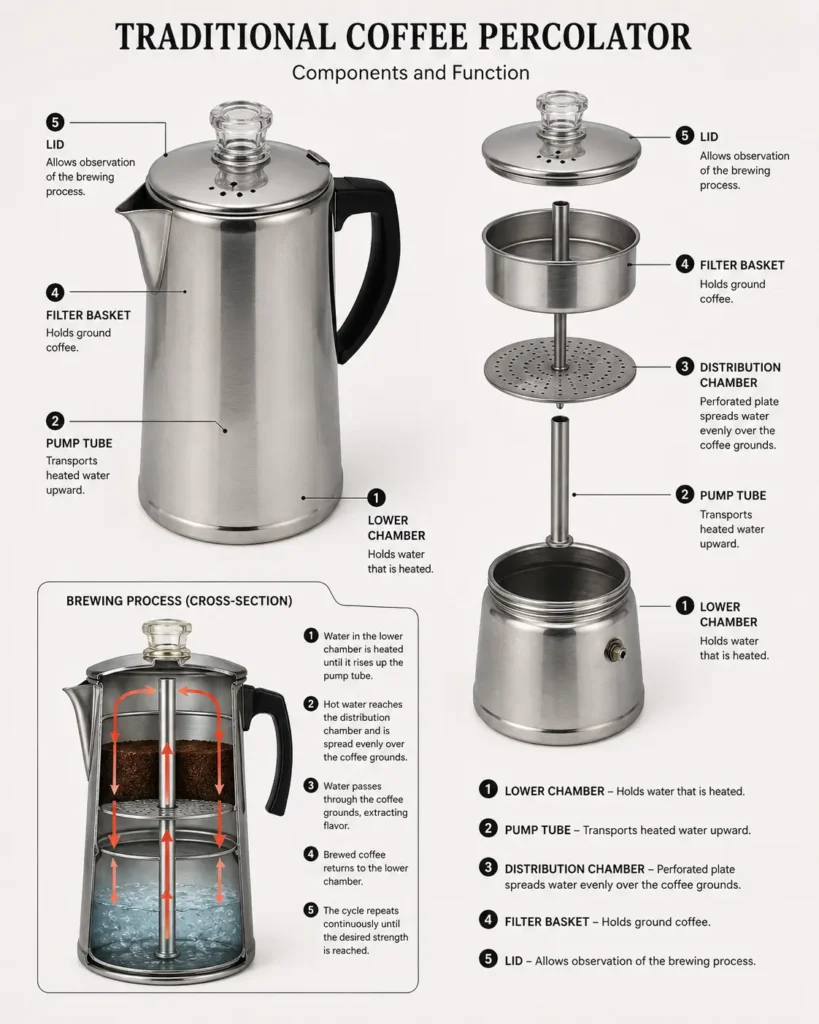
A traditional percolator consists of several components designed to facilitate the circulation of water and brewed coffee. These include a lower chamber for water, a vertical pump tube, a perforated distribution chamber, a filter basket for ground coffee, and a lid that allows observation of the brewing process.
Both stovetop and electric percolators operate according to the same fundamental principle, although electric models incorporate heating elements and automatic temperature controls.
Supporting Equipment
Preparation of percolator coffee commonly involves the use of a coffee grinder, measuring tools, a heat source for stovetop models, and fresh water suitable for brewing. Consistent grind size and accurate measurement contribute significantly to extraction quality.
Ingredients
To make coffee using a percolator, you need the following:
Coffee
Medium to coarse ground coffee is generally preferred for percolator brewing. A grind that is excessively fine may pass through the filter basket and contribute to sediment in the finished beverage.
Historically, percolators have often been associated with medium and dark roasted coffees (see coffee roast level) because these roast levels complement the method’s tendency toward bold extraction.
Water
Water constitutes the majority of the final beverage and therefore plays a significant role in quality. Clean, odor-free water with balanced mineral content supports effective extraction and flavor development.
Optional Additions
Percolator coffee is commonly consumed black but may also be served with milk, cream, sugar, or other flavoring agents according to regional and personal preferences.
Preparation Method
The preparation of coffee using a percolator generally follows a standardized procedure:
- Fill the lower chamber with the desired quantity of water.
- Insert the pump tube into the chamber.
- Place ground coffee into the filter basket.
- Assemble the brewing device securely.
- Apply heat until water begins circulating through the tube.
- Maintain brewing for the desired extraction period.
- Remove the percolator from the heat or deactivate the heating element.
- Allow grounds to settle briefly before serving.
Brewing times typically range from five to ten minutes depending on device size, coffee dose, and desired strength.
Flavor Profile
Percolator coffee is generally characterized by a bold and intense flavor. Repeated exposure of the coffee grounds to hot liquid often produces pronounced roast notes and elevated bitterness compared with single-pass brewing methods.
The resulting beverage frequently exhibits flavors associated with chocolate, roasted nuts, toasted grains, caramelization, and dark sugars, particularly when darker roast coffees are used.
Aroma
The brewing process generates a strong aroma because heated liquid repeatedly passes through the coffee bed. Roasted, smoky, nutty, and caramelized aromatic compounds are commonly present in the finished cup.
Body and Mouthfeel
Percolator coffee typically possesses a medium-to-heavy body. Metal filtration permits coffee oils and microscopic solids to remain in the beverage, contributing to a fuller mouthfeel than is commonly found in paper-filtered coffee.
Appearance
The beverage is generally dark in color with substantial opacity. Depending on grind size and filtration efficiency, small quantities of fine sediment may occasionally be present.
Variations
There are a few documented variations of percolator coffee, namely:
Stovetop Percolator
The stovetop percolator remains the traditional form of the brewing device. Heat supplied by a stove or open flame drives the circulation process and requires active monitoring by the user.
Electric Percolator
Electric percolators incorporate built-in heating elements that automate the brewing process. Many models regulate temperature and switch to warming mode after brewing is complete.
Camp Percolator
Designed for outdoor use, camp percolators are typically constructed from durable metal and intended for operation over campfires, portable stoves, or other field heat sources.
Large-Volume Commercial Percolator
Commercial and institutional percolators are engineered to produce substantial quantities of coffee for restaurants, events, offices, and catering operations. Some models are capable of brewing dozens of liters in a single cycle.
Cultural Significance
Like any other coffee brew method, the percolator brew has some cultural significance in certain regions.
Geographic Associations
Percolators achieved particular prominence in North America during the twentieth century, where they became closely associated with domestic coffee preparation. They also gained popularity in parts of Europe and other regions that embraced household coffee brewing.
Historical Importance
For much of the twentieth century, the percolator represented one of the most familiar methods of coffee preparation. Its widespread adoption helped establish coffee as a routine household beverage and contributed to the growth of consumer coffee culture.
Contemporary Role
Although automatic drip brewing systems now dominate many markets, percolators continue to occupy a niche position among enthusiasts, collectors, outdoor users, and institutions requiring large-batch preparation.
Advantages
Percolators offer several notable benefits. They are capable of producing large quantities of coffee, require relatively simple mechanical construction, and are often highly durable.
The method produces a strong, full-bodied beverage and can operate without electricity when stovetop models are used. Many designs also remain functional for decades with minimal maintenance.
Limitations
The primary limitation of percolator brewing is the potential for over-extraction. Because brewed coffee repeatedly passes through the grounds, bitterness and astringency may increase if brewing continues for excessive periods.
Temperature control can also be challenging in some models. In addition, the method generally offers less precision and consistency than many contemporary specialty coffee brewing systems.
Comparison with Other Brewing Methods
| Brewing Method | Extraction Type | Filter Type | Body | Typical Brew Time |
| Percolator | Recirculating Percolation | Metal | Medium-Heavy | 5–10 min |
| Drip Coffee Maker | Single-Pass Percolation | Paper | Light-Medium | 4–8 min |
| French Press | Immersion | Metal | Heavy | 4–6 min |
| Moka Pot | Pressure-Assisted Percolation | Metal | Heavy | 3–6 min |
| Pour Over | Gravity Percolation | Paper | Light | 2–4 min |
Influence on Coffee Culture
The percolator played a significant role in shaping twentieth-century coffee consumption. For generations of consumers, it defined the taste, aroma, and ritual of home-brewed coffee.
Influence on Brewing Technology
Many later brewing technologies emerged in response to limitations associated with percolation brewing. Automatic drip coffee makers, in particular, gained popularity because they reduced repeated extraction and offered greater consistency.
Industry Recognition
The percolator remains an important artifact in the technological history of coffee preparation. It is frequently discussed in studies of domestic appliances, coffee culture, and brewing innovation.
See Also
- Coffee Brewing
- Drip Coffee Maker
- Moka Pot
- French Press
- Pour Over Coffee
- Coffee Extraction
- Coffee Grinder
- Specialty Coffee
References
- Goodrich, Hanson. Coffee Percolator Patent No. 408,707 (1889).
- Ukers, William H. All About Coffee. Tea and Coffee Trade Journal Company.
- Pendergrast, Mark. Uncommon Grounds: The History of Coffee and How It Transformed Our World.
- Illy, Andrea; Viani, Rinantonio. Espresso Coffee: The Science of Quality.
- Rao, Scott. The Coffee Brewer’s Handbook.
- Davids, Kenneth. Coffee: A Guide to Buying, Brewing, and Enjoying.
- Morris, Jonathan. Coffee: A Global History.
- Wild, Antony. Coffee: A Dark History.
- Weinberg, Bennett Alan; Bealer, Bonnie K. The World of Caffeine.
- Specialty Coffee Association. Brewing Fundamentals.
- International Coffee Organization. Coffee Market and Technical Resources.
- National Coffee Association USA. Coffee Brewing Guidelines.
- Sivetz, Michael. Coffee Technology.
- Clarke, R.J.; Macrae, Ronald. Coffee: Volume 2, Technology.
- Folmer, Britta. The Craft and Science of Coffee.
- Institute of Food Technologists. Publications on coffee extraction and brewing science.
- Coffee Quality Institute. Educational brewing resources.
- European Coffee Brewing Centre. Technical standards and brewing research.
- Food and Agriculture Organization. Coffee production and utilization publications.
- International Society of Beverage Technologists. Coffee preparation and beverage science resources.
Further Reading
- Ukers, William H. All About Coffee.
- Morris, Jonathan. Coffee: A Global History.
- Folmer, Britta. The Craft and Science of Coffee.
- Clarke, R.J.; Macrae, Ronald. Coffee: Volume 2, Technology.
- Pendergrast, Mark. Uncommon Grounds.