
Hario V60 is a conical, single-hole pour-over dripper produced by the Japanese company Hario Co., Ltd., named for the 60-degree angle of its cone.
The V60 uses a paper or metal filter seated inside a ribbed cone, through which hot water is poured manually and drains by gravity through a single large aperture at the base. It produces a clean, bright, oil-reduced cup whose character is determined almost entirely by the brewer’s technique.
From Laboratory Glass to Coffee Icon
The name Hario translates directly from Japanese as King of Glass — hari meaning glass, o meaning king. That name wasn’t chosen for the coffee world.
When the company launched in 1921 under its original name, Hiromu Shibata Works, in the Kanda district of Tokyo, it was making heat-resistant glassware for scientific laboratories -chemistry flasks, medical equipment, the kind of precise, durable glass that couldn’t shatter when things got hot. The coffee world wasn’t on anyone’s radar.
That changed in 1948, when Hario released its first consumer product: a glass coffee siphon for household use. It was their first step into the kitchen, and the coffee industry noticed.
By 1964, Hario had established a dedicated coffee division — Hario Co., Ltd. — and was manufacturing siphons at scale, becoming one of Japan’s leading coffee equipment producers by 1967.
But the V60 was still decades away. Before it arrived, Japan’s coffee dripper market was dominated by trapezoid-shaped brewers — flat-bottomed, two-hole drippers that had been standard in Japanese kitchens since the mid-twentieth century. They worked fine. They were familiar. And Hario’s engineers spent years quietly wondering if there was a better shape.
The Parabola That Became a Pour-Over
The design process that eventually produced the V60 started with a mathematical idea rather than a culinary one. Hario’s designers were thinking about parabolas — the curve described by the equation y = x² — and whether a parabolic cone shape could produce a cleaner, more controlled flow of water through coffee grounds than the flat-bottomed drippers then in use.
The thinking was this: a conical shape, if the angle were right, would naturally funnel water toward the center of the coffee bed, lengthening the contact time between water and grounds and encouraging more even extraction. A flat-bottomed dripper has no such geometry working in its favour. The water finds the nearest hole and goes.
The angle they landed on was 60 degrees — steep enough to produce that central funnel effect, shallow enough to keep the coffee bed at a depth that allowed proper saturation without channelling. That 60-degree angle is what the V in V60 refers to: the V-shape of the cone, measured at 60 degrees. The name is essentially a geometric specification.
Working under serious time pressure — Hario’s engineers were tight on the development window — the team collaborated with resin makers and potters in Arita, a town in Saga Prefecture on Japan’s Kyushu island with over 400 years of porcelain-making history.
The goal was to replicate the cup clarity associated with cloth-filtered coffee using a conical paper filter. The key was airflow. And the solution was the ribs.
The Apparatus — Three Details That Do Everything
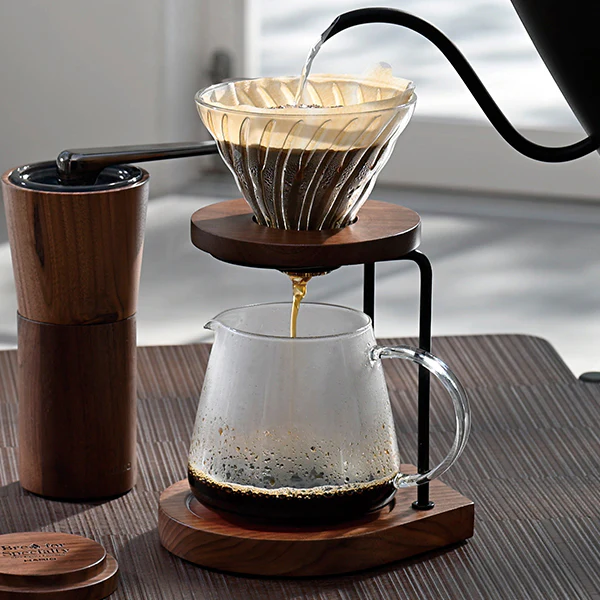
The V60 is not a complicated object. It is a cone with a handle, a hole at the bottom, and ribs on the inside walls. Those three features — the cone, the hole, and the ribs — are the entire engineering story.
The cone, at 60 degrees, encourages water to spiral inward and downward as it passes through the coffee bed. This creates a longer, more uniform extraction path than a flat bottom allows. The coffee grounds pile thicker at the centre, where water dwells longest, and thinner at the edges, where it exits faster — a gradient that, when controlled through careful pouring, produces balanced extraction across the entire bed.
The single large hole at the base is, counterintuitively, what gives the brewer its precision. Multiple small holes restrict flow. A mesh base controls it.
But one large, open hole places the entire responsibility for flow rate on the brewer’s pour — how fast you pour is how fast it drains. Slow down; the bed gets wetter. Speed up; it drains faster. The V60 doesn’t regulate you. You regulate yourself.
The ribs are the detail most people notice last and understand least. In earlier conical drippers with straight or diagonal ribs, the paper filter would press flush against the interior wall of the cone, blocking the air that needs to escape as hot water enters. Trapped air means slowed drainage and uneven saturation.
Hario’s engineers gave the V60 spiral ribs that twist from the bottom hole up to the rim of the cone. These ribs lift the filter fractionally away from the wall, creating a continuous air channel that allows gas to escape freely and water to flow without interruption. The spiral also helps distribute incoming water across the filter surface rather than concentrating it at the pour point.
The original V60, released commercially in October 2005, was ceramic — specifically Arita-yaki porcelain, produced in that same historic town the engineers had worked with during development.
Arita-yaki uses fine white clay that yields an extremely smooth, non-porous surface with good heat retention. The original white ceramic version is still in production today, largely unchanged from the 2004 design.
How the Extraction Actually Works
Brewing with a V60 begins before any water is poured. The paper filter — which comes in natural (unbleached) and white (oxygen-bleached) versions, both in a proprietary tabbed design that folds and seats into the cone — is rinsed with hot water first.
This serves two purposes: it bonds the filter to the cone so it doesn’t shift during brewing, and it removes the papery taste that would otherwise bleed into the cup. The rinse water is discarded.
Ground coffee goes in next, medium-fine in texture — finer than a French Press grind, coarser than that of espresso coffee, somewhere in the range of coarse table salt. The bed is levelled so water meets it evenly. Then the bloom pour: a small amount of hot water — roughly twice the weight of the coffee — is poured slowly over the grounds and left to sit for 30 to 45 seconds.
Fresh coffee releases trapped carbon dioxide (CO2) when it meets hot water. If you pour everything at once without letting this gas escape first, it creates a barrier between the water and the coffee solids and produces uneven, under-extracted results.
The bloom pour — sometimes called the pre-infusion — lets the gas vent. The coffee bed swells, sometimes dramatically in very fresh roasts, then settles. That swelling is the gas leaving.
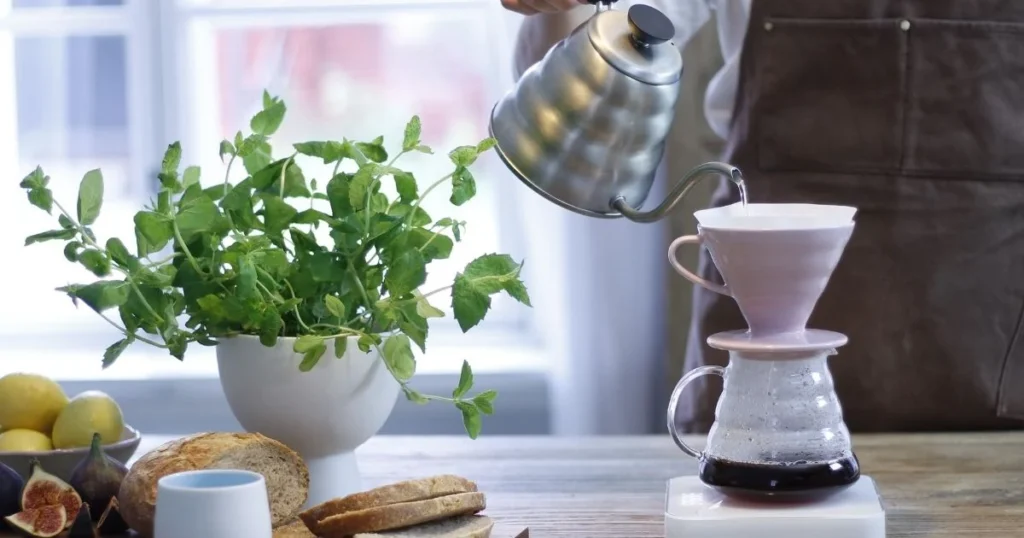
After the pour over bloom, the remaining water goes in next, typically in two to four pours, each one added as the previous pour drains to just above the bed level. A gooseneck kettle is the standard tool because its narrow spout gives the brewer control over pour speed and placement — both of which directly affect the final cup.
Total brew time for a single serving runs between 2:30 and 3:30 minutes, depending on grind size, pour speed, and desired strength.
Because the paper filter catches all the coffee’s oils and fine particles, what ends up in the cup is clear, sediment-free, and structurally different from an unfiltered brew. The lipid compounds cafestol and kahweol — present in abundance in a French Press cup — are absorbed by the paper and never reach the drinker.
What the Cup Tastes Like
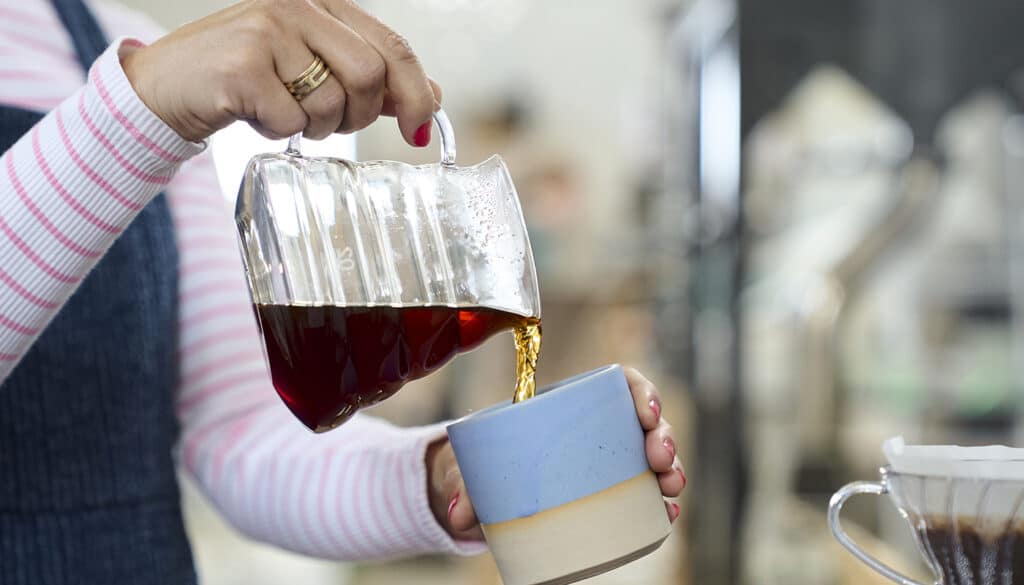
Bloom pour over coffee, made using the Hario V60, is clean, bright, and expressive. Because the paper filter removes the oils that contribute heaviness and mouthfeel, the resulting coffee is lighter in body than a French Press or Moka Pot brew, but dramatically more transparent in flavour. Notes that would be blunted by oil — floral top notes, fruit acidity, delicate sweetness — come through clearly.
This is precisely why the V60 became the brewer of choice in the specialty coffee world. Single-origin coffees with complex, origin-specific flavour profiles — an Ethiopian Yirgacheffe with its bergamot and jasmine notes, a Kenyan AA with its blackcurrant acidity, a Colombian with its caramel and red fruit — express those characteristics most legibly through a V60. It doesn’t flatten the coffee. It frames it.
Acidity is the most prominent sensory variable. The V60 tends to amplify brightness, which is a virtue when the coffee has something worth amplifying and a problem when it doesn’t. Heavy, low-grown commodity coffees don’t flatter this brewer. The method exposes everything, including flaws.
The Competition That Changed Everything
For its first five years, the V60 was largely a Japanese phenomenon. It had found its audience among specialty cafés and home brewers in Japan, but hadn’t made significant inroads elsewhere.
That changed in 2010 at the inaugural World Brewers Cup in London, where American barista Michael Phillips brewed with a V60 and won the competition. The exposure was immediate and global.
What followed was a run of World Brewers Cup victories that made the V60 the most decorated brewer in the competition’s history. Champions used it to win in 2012, 2014, 2015, 2016, 2017, and 2021.
In 2016, Tetsu Kasuya became the first Asian competitor to win the World Brewers Cup — using a V60 and a distinctive two-phase pouring technique he developed specifically for the device, which Hario subsequently collaborated with him to formalize.
The competition wins did something important: they moved the V60 from a specialty niche to a global standard.
By the mid-2010s, the brewer was present in artisan cafés across Europe, North America, Australia, and Southeast Asia. It became the brewer that third-wave coffee used to signal seriousness — the device behind the counter that told you the café cared about what it was doing.
Materials, Sizes, and Variations
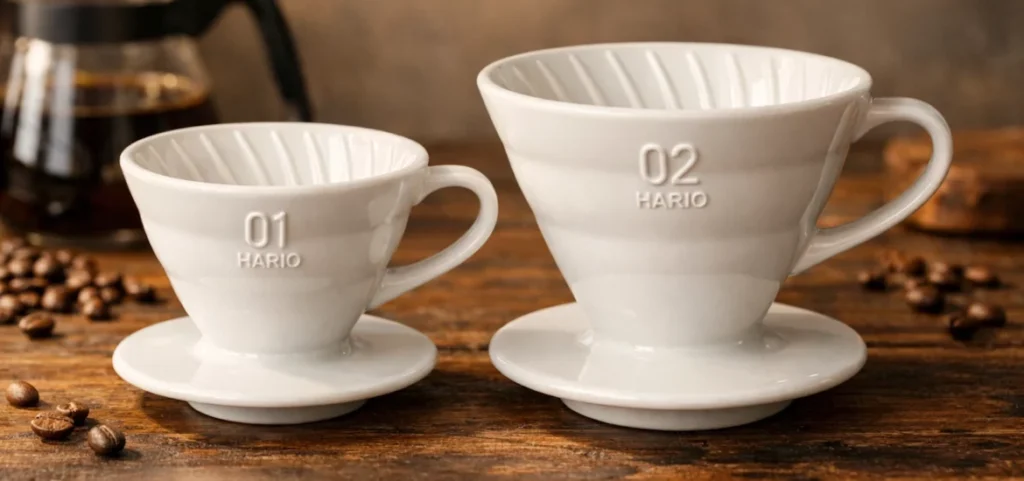
Hario has released the V60 in ceramic, glass, plastic, copper, and stainless steel. The ceramic version remains the most widely used in café settings because of its thermal stability — ceramic holds heat well and doesn’t interfere with flavour.
The glass version allows the brewer to watch the extraction in progress, which has made it popular with home brewers who want visual feedback. The plastic version is the lightest and most travel-friendly, and despite the material, it performs identically to ceramic from a flavour standpoint — plastic doesn’t impart taste at the temperatures involved.
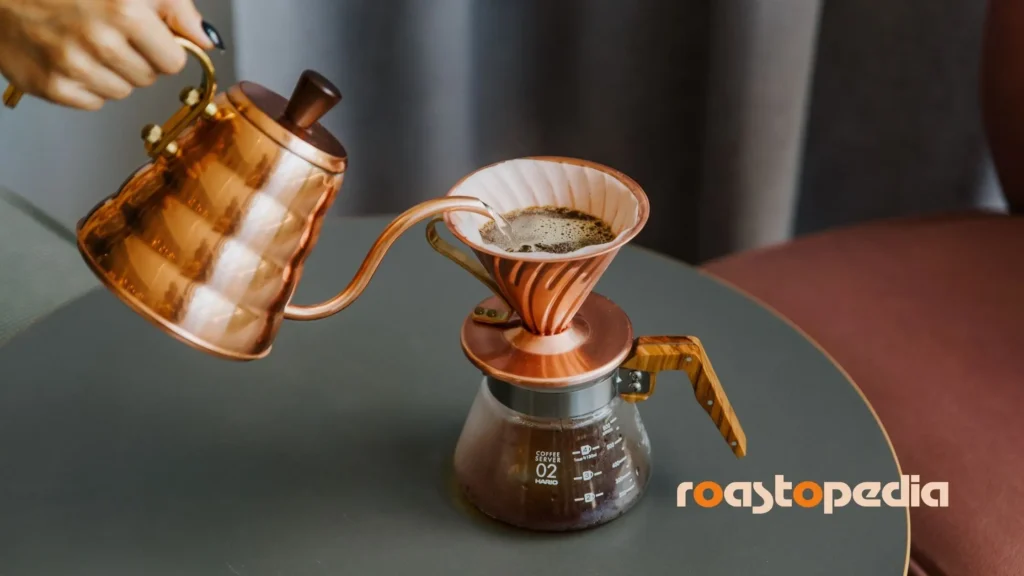
The copper and stainless versions are premium objects — thermally superior to ceramic, visually striking, and considerably more expensive. They are as much design objects as brewing tools.
Hario V60 brewer comes in three sizes: 01 for one to two cups, 02 for one to four cups — the most common size — and 03 for one to six cups. Size affects more than capacity. As the dripper scales up, the spiral ribs extend further, and the drainage hole grows proportionally, which subtly changes flow dynamics. Most competition brewing and recipe development is done on a size 02.
The filter papers are proprietary — Hario’s tabbed design is specific to the V60’s cone geometry, and third-party alternatives exist but vary in thickness and porosity. Thicker filters slow drainage and produce a heavier cup; thinner filters speed drainage and emphasise brightness.
Some brewers use metal mesh filters, which eliminate the paper and allow oils through, producing a hybrid cup somewhere between a V60 and a French Press.
Hario has also released the Mugen — a V60 variant developed in collaboration with Tetsu Kasuya that removes the spiral ribs entirely and replaces them with a single central rib running down the inside of the cone.
This design channels all airflow through one path, producing a slower, more even drain and a fuller body than the standard V60. It is, in effect, a different brewer wearing a V60’s shape.
A Few Things Worth Knowing
The V60 is used in over 75 countries and regions. Its filters are produced in both Japan and overseas, and are available in oxygen-bleached white and unbleached natural versions.
The bleached filters are chemically treated with oxygen rather than chlorine, so there is no chemical residue concern, though the natural filters are sometimes preferred for environmental reasons.
Because the paper filter removes cafestol and kahweol — the diterpene compounds associated with elevated LDL cholesterol in regular unfiltered coffee drinkers — the V60 cup is considered one of the more cardiovascular-neutral brewing methods. This distinction, shared with other paper-filtered methods like the Chemex and drip coffee, separates it from the French Press and Moka Pot in nutritional research.
The design of the V60 has remained almost entirely unchanged since 2004. Hario made a device that worked the first time and has largely left it alone. The material options and size range expanded; the core geometry did not. That is unusual in consumer products and says something about how precisely the original engineering solved the problem it was trying to solve.
The V60 has also become something of a barista benchmark. In training environments, it is commonly used to evaluate a barista’s pour control, consistency, and understanding of extraction — precisely because it punishes imprecision more visibly than most other brew methods. A skilled brewer and a careless one will produce dramatically different cups from the same coffee and the same device.