
Decotation is the oldest surviving method of coffee preparation, in which ground or whole coffee is added directly to water and brought to a boil, with no filtration between the grounds and the drinker.
The word decoction refers to the extraction of soluble compounds through sustained or repeated boiling — a technique that predates every other form of coffee brewing and remains in daily use across East Africa, the Middle East, and parts of Scandinavia.
The method does not have a single inventor and no patent. It is simply what people did with coffee before anything else existed.
Before Brewing: The Oldest Relationship Between Coffee and Heat
The story of boiled coffee is inseparable from the story of coffee itself. Before there were filters, before there were pots designed for the purpose, before there was even a settled understanding of what roasting did to coffee beans, people were boiling coffee.
The practice likely began in Ethiopia, where the coffee plant originates, and spread outward through Yemen and across the Ottoman Empire as coffee culture expanded during the fifteenth and sixteenth centuries.
In Ethiopia, the earliest uses of coffee involved not the bean but the whole plant — leaves were brewed as tea, coffee cherries were eaten whole or crushed with animal fat for travel provisions, and the green or lightly roasted bean was added to hot water in clay vessels over fire. This was not brewing in any considered sense.
It was the straightforward application of the only extraction logic available: add plant material to water, apply heat, drink what results.
By the 15th century, Sufi monks in Yemen were roasting and grinding coffee beans and boiling them in water during night prayer vigils. The stimulating effect was the point — the brew kept monks awake for extended devotional practice.
From these early Yemeni uses, the boiled coffee method spread into the Ottoman Empire, where it encountered the copper and brass vessel that would formalize it: the cezve.
The Cezve and the Ottoman Formalization
When coffee reached Istanbul and the broader Ottoman world in the 16th century, the method became codified for the first time. Ground coffee, water, and often sugar were combined in a small, long-handled metal pot — the cezve, also called an ibrik in the broader region — and heated slowly, sometimes in hot sand, sometimes over an open flame.
The mixture was brought to the point of boiling, producing a thick foam at the surface, then pulled back from the heat before it could boil over. This process was repeated two or three times.
The resulting drink was poured directly into small cups, grounds and all. Drinkers would wait for the grounds to settle before drinking and left the last portion of the cup — heavy with sediment — untouched. No filtration, no separation. The grounds were part of the experience, and the thick, heavy liquid above them was the drink.
Ottoman coffeehouses, called qahveh khaneh, spread this method from Istanbul to Cairo to Vienna and beyond. When coffee reached Europe in the 17th century, the preparation method that arrived with it was the boiled pot.
Europeans adapted it to whatever vessel they had on hand — a common cooking pot, a jug, a kettle — and the boiled method remained the dominant European coffee preparation until the French biggin drip pot appeared in the late eighteenth century and began the slow shift toward filtered brewing.
Ethiopia’s Living Decoction Tradition
In Ethiopia, the jebena ceremony is considered the most elaborate and culturally significant form of boiled coffee still practiced anywhere in the world. The jebena is a clay pot with a round base, a narrow neck, and a spout — used exclusively for making and serving coffee.
The ceremony built around it is not casual. It is a formal social ritual that can last several hours and involves three successive rounds of brewing from the same grounds.
The first round, called Abol, produces the strongest cup — the initial decoction from fresh grounds. The second, Tona, is weaker. The third, Baraka — meaning blessing — is the weakest of all, sometimes little more than lightly flavored water.
Guests are expected to drink all three rounds. Leaving before the third cup is considered impolite. The full ceremony, from roasting the green beans in a flat pan over charcoal through the three rounds of brewing, can take two hours or more.
Coffee brewed in the jebena is typically served with salt, butter, or the herb tenadam — rue — rather than sugar, depending on the region and the household. Cardamom and other spices are sometimes added to the brewing water.
The resulting cup is thick, intense, and deeply aromatic in ways that paper-filtered coffee cannot replicate — the oils are fully present, the sediment settles in the cup, and the flavor of the clay vessel itself contributes a subtle earthiness to the brew.
Cowboy Coffee and the Scandinavian Tradition
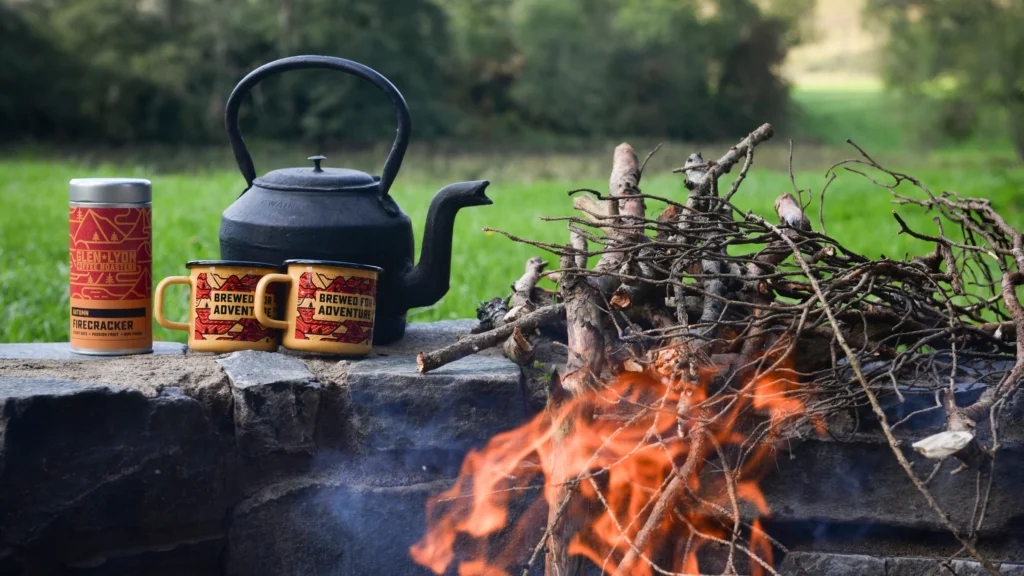
The decoction method crossed into American frontier culture as cowboy coffee — ground coffee added directly to a pot of water, boiled over an open fire, and allowed to settle before pouring.
There was no cezve, no ceremony, no cultural framework. There was a tin pot, fire, and ground coffee. The resulting brew was strong, often bitter, and entirely functional. A cold splash of water was sometimes added after boiling to help the grounds sink to the bottom faster.
In Scandinavia, an equivalent tradition survived well into the twentieth century as kokekaffe — directly translated as boiled coffee. Coarsely ground coffee was added to boiling water, stirred, and left to settle.
Eggshell — sometimes a whole beaten egg — was occasionally mixed with the grounds before boiling, a practice that has a clear technical logic: the egg white proteins bond with the fine coffee particles and sink with them, producing a surprisingly clear cup without any filter.
Scandinavian boiled coffee, particularly in rural and outdoor contexts, persisted as a practical preference long after filtered methods were widely available.
The Science of What Boiling Does to Coffee
Boiling extracts differently from hot water just below the boil. At one hundred degrees Celsius, extraction becomes aggressive and rapid — compounds that dissolve at lower temperatures are joined by others that require sustained high heat to become soluble.
The result tends toward higher bitterness, higher intensity, and a heavier body than filtered methods.
The repeated-boil technique used in Turkish and Ethiopian preparation complicates this further. Each time the coffee approaches the boil and is pulled back, a different extraction profile builds in the cup.
Experienced practitioners read the foam closely — the thick mousse that rises at the surface indicates both temperature and the state of the grounds — and manage the heat accordingly.
The foam itself is a suspension of coffee oils, fine particles, and CO2 bubbles, and its texture is a reliable real-time indicator of the brew.
Because no paper filter is used, all of the coffee’s oils — including cafestol and kahweol, the diterpene compounds associated with elevated LDL cholesterol in regular consumption — pass freely into the cup.
Boiled coffee is, from a lipid standpoint, equivalent to the French Press and significantly different from any paper-filtered method. Long-term, daily consumption of unfiltered coffee has been consistently associated in nutritional research with elevated cholesterol levels, a finding that applies to decoction methods as much as to any other unfiltered brew.
Variations Across the World
Across the cultures that still practice boiled coffee, variation appears primarily in three dimensions: the vessel, the additives, and the number of boils.
In Turkey, the cezve is copper or brass, the grind is ultra-fine — finer than espresso — and the brew is often sweetened before serving, with the level of sweetness specified by the guest before brewing begins (sade means plain, az şekerli means a little sweet, orta means medium, çok şekerli means very sweet).
The foam is a point of pride, and pouring in a way that distributes it evenly across multiple cups is a considered skill.
In Saudi Arabia and Yemen, qishr — a brew made from coffee husks rather than ground beans, spiced with ginger — represents a related but distinct decoction tradition using the byproduct of coffee processing rather than the roasted bean itself.
In India, kaapi preparations in some regional traditions involve multiple decoctions from the same grounds. In Morocco and other North African countries, coffee is sometimes boiled with spices including cinnamon, cardamom, and cloves.
The Mirra style of boiled coffee, associated with parts of the Arab Gulf and Ethiopia, involves reducing the brew to a thick, near-syrup concentration through prolonged boiling — a method designed to produce a very small serving of extraordinarily intense coffee, consumed in shots rather than cups, often flavored with cardamom and served unsweetened.
Why It Has Never Disappeared
Every filtered brewing method invented over the last two centuries was, in some sense, invented as an improvement on boiled coffee. The French biggin filtered out the grounds. Melitta Bentz’s paper filter produced a cleaner cup.
The espresso machine applied pressure for speed. The pour-over drippers gave the brewer control over flow. And yet boiled coffee — the original, the method that predates all of these — continues to be practiced daily by hundreds of millions of people across the world.
It survives not because it has been forgotten or because better options haven’t reached the people who use it.
Boiled coffee survives because it is woven into social and cultural rituals that no brewing equipment can replicate, because it requires nothing more than fire and a vessel, and because the cup it produces — heavy, oily, sediment-laden, intensely aromatic — is something that no filtered method can precisely reproduce. It is the oldest cup of coffee. And it is still being made.