
The Second Wave Coffee movement represents the transformative era that transitioned coffee from a generic commodity to a specialized craft experience. It emerged in the late 1960s as a reaction to the perceived quality decline of First Wave coffee. This period introduced the concept of Specialty Coffee and established the coffeehouse as a primary social destination.
The wave was characterized by an increased emphasis on lifestyle, coffee quality, the broader adoption of espresso preparation methods, and the emergence of specialty coffee culture. During this period, coffeehouse chains expanded significantly, while beverages such as the latte and cappuccino became widely recognized and consumed.
It was also defined by a focus on Origin and Roast Profile. It bridged the gap between the industrial mass production of the mid-twentieth century and the extreme transparency of the current era. This era established the foundational standards for the modern specialty coffee industry.
The Progenitor: Alfred Peet and the Berkeley Revolution
Alfred Peet is widely recognized as the grandfather of the Second Wave. He moved to the United States from the Netherlands in 1955 and was critical of American coffee quality. Peet opened Peet’s Coffee & Tea in Berkeley, California, in 1966.
He specialized in high-quality Arabica beans and a specific Dark Roast profile. Peet prioritized the shortest possible distance between the Drum Roaster and the consumer. His influence was direct and foundational to the entire specialty movement.
Peet trained the original founders of Starbucks and supplied their initial bean supply. He introduced European roasting standards to an American audience accustomed to stale, canned coffee. His dedication to freshness and flavor established the early benchmark for Gourmet Coffee.
The Founding of Starbucks and the Seattle Hub
Jerry Baldwin, Zev Siegl, and Gordon Bowker founded Starbucks in 1971. They opened their first location at Seattle’s Pike Place Market as a retail bean store. The founders sought to bring Peet’s high-quality standards to the Pacific Northwest.
The company initially operated exclusively as a retailer of whole Green Coffee and equipment. They eventually expanded operations to include their own Roasting Plant in 1973. This move allowed for greater control over their signature dark roast profiles.
The early Starbucks era focused on education and connoisseurship for a niche audience. It established Seattle as the global epicenter of the American coffee movement. This local success provided the blueprint for the company’s eventual international expansion.
Howard Schultz and the Italian Influence
Howard Schultz joined Starbucks as the director of retail operations in 1982. He took a transformative trip to Milan, Italy, in 1983. Schultz was captivated by the communal atmosphere of Italian Espresso Bars.
He observed that coffee in Italy was a social ritual rather than a beverage. Schultz proposed integrating brewed coffee and Espresso drinks into the Starbucks retail model. The founders initially resisted this shift away from their bean-focused plan.
Schultz left to found his own coffee company, Il Giornale, in 1985. He eventually returned to purchase Starbucks in 1987 with the help of local investors. This acquisition marked the beginning of the company’s transition into a global beverage icon.
Erna Knutsen and the Specialty Coffee Label
Erna Knutsen provided the Second Wave with its defining commercial and linguistic framework. She worked as a secretary for the coffee brokerage firm B.C. Ireland in San Francisco. Knutsen fought for the right to Cup coffee alongside her male colleagues.
In 1974, she coined the term Specialty Coffee in the Tea & Coffee Trade Journal. This term referred to beans produced in unique geographic microclimates. She argued that these coffees deserved to be traded outside the standard C-Market.
Knutsen founded her own firm, Knutsen Coffee Ltd., in 1985 to serve small roasters. She became a mentor to countless Small-Batch Roasters across the country. Her advocacy established the precedent for evaluating coffee based on sensory excellence.
Roasting Science: Pyrolysis and the Second Crack
Second Wave roasting is technically defined by the pursuit of the Second Crack. Roasters utilize advanced Drum Roasters to achieve high internal bean temperatures. This process involves complex chemical reactions such as the Maillard Reaction and Pyrolysis.
As temperatures reach approximately 225°C, the bean’s cellular structure begins to fracture. This stage forces internal Lipids and oils to migrate to the surface. The result is a shiny, oily appearance and a heavy Body.
The flavor profile of a Second Wave roast is characterized by bittersweet intensity. It emphasizes toasted nuts, dark chocolate, and heavy Caramelization. This style effectively masked the inherent Acidity of the beans for a uniform taste.
The Chemistry of Dark Roasting
Dark roasting triggers the formation of specific volatile compounds that define the Second Wave. These include Pyrroles, Furans, and Pyridines created during intense thermal degradation. These compounds contribute to the toasted, earthy, and smoky characteristics of the cup.
The process of Carbonization becomes dominant as the roast progresses past the second crack. This reduces the concentration of chlorogenic acids and organic salts. The resulting beverage has lower perceived acidity but higher levels of bitterness.
Melanoidins are also formed in high concentrations during this stage of the roast. These brown polymers contribute to the syrupy mouthfeel and color of the coffee. They are essential for the visual and sensory identity of a dark-roasted espresso.
Technical Evolution: The Faema E61 Group Head
The Faema E61 is the technical cornerstone of the Second Wave espresso movement. Ernesto Valente introduced this revolutionary machine in Italy in 1961. It replaced the traditional manual Lever with a motorized volumetric pump.
The machine ensures a consistent Extraction Pressure of 9 bars (130 psi). It features a unique Thermo-syphon system that maintains thermal stability in the group. This system cycles hot water through the Group Head using natural convection.
The E61 introduced the concept of Pre-infusion through a mechanical expansion chamber. This allows the coffee puck to swell before full pressure is applied. This technical innovation improved extraction consistency and reduced the risk of Channeling.
George Howell and the Coffee Connection
George Howell founded The Coffee Connection in Boston in 1974. He is credited with bringing a higher level of Quality Control to the movement. Howell treated coffee with the same reverence usually reserved for fine wine.
He implemented rigorous Cupping protocols to ensure bean consistency across his stores. Howell was an early advocate for Direct Trade relationships with coffee farmers. He sought to highlight the specific Flavor Profiles of different growing regions.
His commitment to quality eventually led to the creation of the Cup of Excellence. This program established the world’s first international internet auction for specialty coffee. It helped break the cycle of Commodity Pricing for high-end producers.
The Development of the Frappuccino
The Frappuccino is seen as one of the most commercially successful innovations of the era. Originally developed by Andrew Frank at The Coffee Connection in 1992, the drink was created to maintain sales during the warm summer months.
Frank used a soft-serve frozen yogurt machine to achieve a smooth consistency. The name is a portmanteau of Frappé and Cappuccino. Starbucks acquired the trademark and recipe when they purchased Howell’s company in 1994.
The drink was launched nationally under the Starbucks brand in 1995. It utilized a specific Coffee Base and various flavored syrups. This product significantly expanded the coffee industry’s reach to non-traditional consumers.
The Coffee Bean & Tea Leaf and Frozen Innovation
Herbert Hyman founded The Coffee Bean & Tea Leaf in 1963. The company was an early pioneer of the gourmet coffee movement in California. In 1987, a store manager accidentally invented the Ice Blended drink.
This innovation preceded the Frappuccino and catalyzed a global trend for frozen coffee. The Ice Blended utilized a proprietary powder base to ensure Emulsion stability. It allowed the company to maintain high sales volumes throughout the entire year.
The brand focused on a mix of Single-Origin coffees and blended dessert-like beverages. Its success highlighted the growing consumer demand for customized coffee treats. This variety became a hallmark of the Second Wave retail experience.
Milk Texturing: From Sea Foam to Microfoam
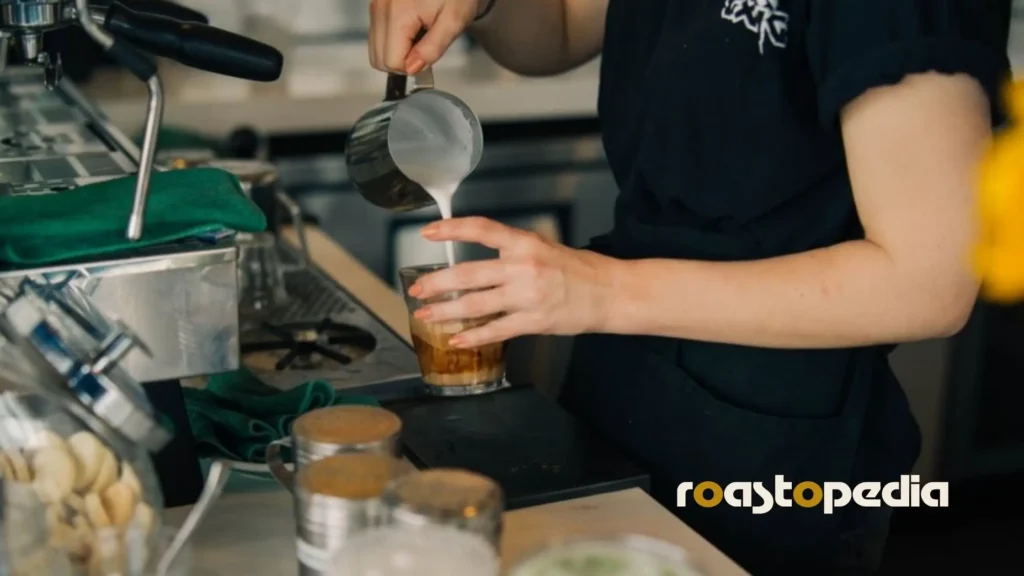
The Second Wave introduced the technical art of Milk Steaming to the masses. Early baristas utilized high-pressure Steam Wands to create dense, large-bubbled foam. This was often referred to as Sea Foam due to its stiff consistency.
Technique evolved as baristas sought a silkier texture for Latte Art. This led to the development of Microfoam through precise air incorporation. Baristas learned to “stretch” and “roll” the milk to create a uniform emulsion.
David Schomer of Espresso Vivace was a pioneer of this technical mastery. In the late 1980s, he popularized the heart and Rosetta designs in Seattle. This required precise control over Milk Temperature and pour velocity.
The “Third Place” Sociological Theory
The Third Place is a sociological theory that defined the Second Wave aesthetic. Ray Oldenburg defined it as a social environment separate from home and work. Howard Schultz integrated this theory into the Starbucks business model.
Second Wave coffee shops were designed to encourage customers to linger. They featured comfortable Armchairs, ambient lighting, and curated jazz music. This atmosphere transformed coffee consumption into a communal and social ritual.
The availability of free Wi-Fi in later years solidified this social role. It became a primary destination for remote work and informal meetings. This function allowed shops to justify higher prices for Espresso-Based Drinks.
Gloria Jean’s and Mall Coffee Culture
Gloria Jean Kvetko founded Gloria Jean’s Coffees in 1979 in Illinois. She played a critical role in bringing specialty coffee to American suburbs. Her company focused on opening locations within regional Shopping Malls.
Gloria Jean’s introduced a wide variety of Flavored Coffees to the mass market. These products appealed to consumers who find traditional espresso too intense. The brand’s success demonstrated the viability of a national Franchise Model.
The company eventually expanded internationally with a massive presence in Australia. This expansion established the template for modern global coffee franchising. It ensured that the Second Wave aesthetic was accessible to a broad demographic.
Regional Expansion: Second Cup and Caribou Coffee
Second Cup was founded in Canada in 1975 as a mall kiosk. It played a similar role to Gloria Jean’s by popularizing specialty beans. The brand became a dominant force in the Canadian coffee landscape.
Caribou Coffee was founded by John and Kim Puckett in 1992. It utilized a “mountain lodge” aesthetic to differentiate itself from urban competitors. The company grew rapidly to become the second-largest coffee chain in America.
These regional players ensured that specialty coffee was not limited to coastal cities. They established robust Supply Chains and training programs for thousands of baristas. Their growth solidified the commercial infrastructure of the Second Wave.
Economic Impact and Quality Premiums
The Second Wave fundamentally altered the Global Coffee Trade infrastructure. It moved the industry away from a purely volume-based commodity model. Specialty roasters began paying Quality Premiums above the standard C-market price.
This provided a direct financial incentive for Coffee Producers to focus on quality. The Specialty Coffee Association of America was founded in 1982. It established standardized Grading Scales and cupping protocols for the industry.
These standards allowed the industry to quantify quality and facilitate fair trade. The economic shift ensured a sustainable supply of High-Altitude Arabica. This infrastructure was essential for the movement’s long-term commercial success.
The Sociology of the “Starbucks Effect”
The Starbucks Effect is a recognized marker of urban Gentrification and economic shift. The arrival of a specialty coffee shop often signaled rising property values. It served as a visual indicator of a neighborhood’s transition to middle-class status.
Urban planners studied how coffee shops functioned as anchors for local commerce. They provided a “soft” security presence through increased foot traffic and activity. This phenomenon helped revitalize many neglected urban corridors in the 1990s.
The presence of a national coffee brand established a baseline of local services. It encouraged further investment from other retailers and service providers. This socioeconomic impact was a defining byproduct of the Second Wave’s growth.
The Transition to the Third Wave
The Second Wave reached its peak in the early 2000s. Its massive success created the conditions for the Third Wave movement. This newer era sought to strip away the “selly” aspects of the Second Wave.
Third Wave roasters moved away from dark roasting and flavored syrups. They prioritized Transparency and lighter roasting profiles to highlight Terroir. They sought to treat coffee as an artisanal agricultural product.
Despite these differences, the Second Wave provided the necessary foundation. It established the technical equipment and Supply Chains used today. To date, coffee enthusiasts regard the Second Wave as the most influential era in global coffee history.