
Liberica, known scientifically as Coffea liberica W. Bull ex Hiern, is a significant commercial coffee species belonging to the Rubiaceae family. While it constitutes less than 2% of the current global coffee trade, it represents a critical biological and historical pillar of the coffee industry. It is distinguished from other species by its massive tree stature, large Fruit size, and resilience to environmental stressors.
Origin and Historical Production
The species is indigenous to the lowland tropical forests of West and Central Africa, specifically Liberia and Côte d’Ivoire. Its global significance surged in the late 19th century following the Coffee Leaf Rust (Hemileia vastatrix) epidemic that decimated Arabica plantations in Asia. During the 1890s, the Philippines and Indonesia shifted production to Liberica due to its inherent immunity to the pathogen.
In the mid-20th century, a separate epidemic of Tracheomycosis (fungal wilt) significantly reduced Liberica yields. Today, production is primarily concentrated in Southeast Asia and parts of West Africa. The Philippines remains a notable producer, where the species is celebrated as Barako coffee.
Botanical Characteristics and Morphology
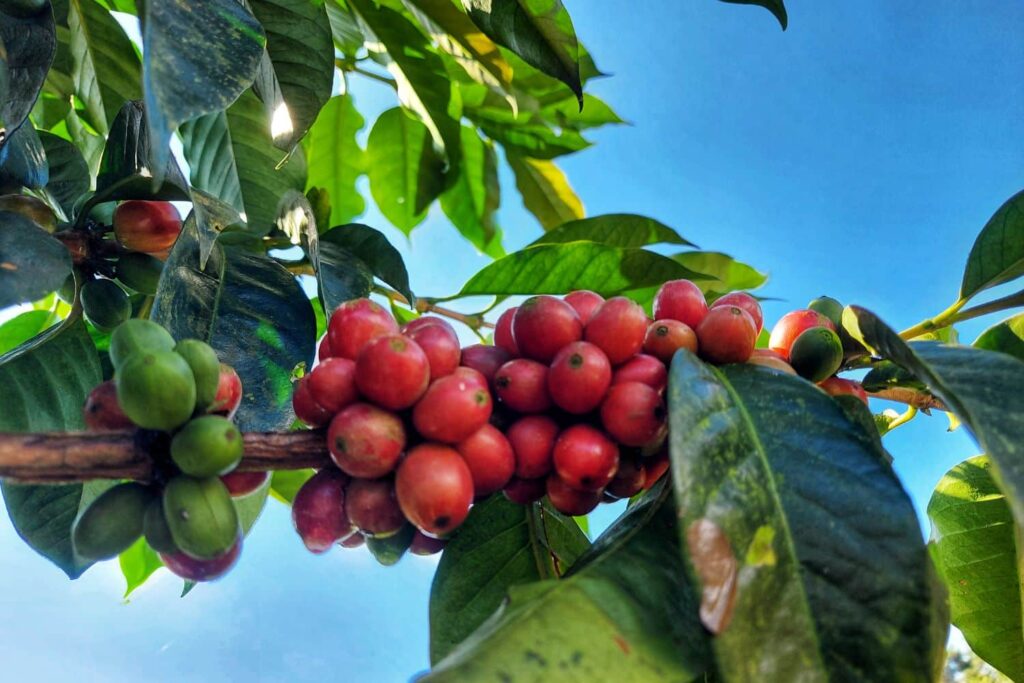
Coffea liberica is a Diploid species (2n = 22) characterized by a robust arborescent growth habit. In wild states, trees can reach heights of 18 to 20 meters, necessitating specialized Harvesting techniques. The root system is notably deep and vigorous, allowing the plant to thrive in poor soils and withstand prolonged drought.
The leaves are the largest in the genus, possessing a thick, leathery (coriaceous) texture and measuring up to 30 cm in length. The Fruit, or cherry, is significantly larger and firmer than that of Arabica or Robusta. These cherries contain a higher pulp-to-bean ratio and require extended Processing times to remove the dense mucilage.
Sensory and Chemical Analysis
The chemical composition of Liberica is distinct, with Caffeine concentrations typically ranging from 1.4% to 1.6%. This is lower than Robusta but higher than the average Arabica specimen. The Bean is noted for its asymmetrical, almond-like shape, often featuring a “hook” at one end.
Sensory profiles of Liberica are frequently described as “smoky,” “woody,” or “floral.” It possesses a heavy body and low acidity, making it a functional component for high-viscosity Blends. In traditional Southeast Asian markets, it is often roasted with sugar or butter to accentuate its naturally pungent aroma.
Technical Specifications Table
| Feature | C. liberica Specification |
| Ploidy Level | Diploid (2n = 22) |
| Max Tree Height | 18–20 Meters |
| Ideal Altitude | 0–800 Meters |
| Bean Shape | Large, Asymmetrical, Almond-shaped |
| Caffeine Content | 1.4% – 1.6% |
| Annual Rainfall | 1,500 – 2,500 mm |
Relationship to Excelsa
Taxonomically, Liberica is the parent species of the Excelsa variety (Coffea liberica var. dewevrei). While they share a Genetic lineage, they are differentiated by their sensory outputs and minor morphological variations. Excelsa is often treated as a separate commercial category due to its tart acidity and smaller tree size compared to the liberica variety.
See Also:
- Arabica: Genetics and Cultivation
- Robusta: Resiliency and Production
- Excelsa: The Tart Variety
- Coffee Types: Taxonomy and Diversity
References
- Ukers, W. H. All About Coffee. Tea and Coffee Trade Journal Company, 1922. https://archive.org/details/allaboutcoffee00ukeruoft
- ScienceDirect. “Coffea Liberica – an overview.” Agricultural and Biological Sciences. https://www.sciencedirect.com/topics/agricultural-and-biological-sciences/coffea-liberica
- Royal Botanic Gardens, Kew. “Genus Coffea L.” Plants of the World Online. https://powo.science.kew.org/taxon/urn:lsid:ipni.org:names:37340-1
- Specialty Coffee Association. “A Botanist’s Guide to Specialty Coffee.” https://sca.coffee/research/botany
- Davis, A. P., et al. “The coffee leaf rust pandemic: An ever-present danger.” Plant Pathology. https://bsppjournals.onlinelibrary.wiley.com/doi/10.1111/ppa.13846
- World Coffee Research. “Minor Coffee Species: Liberica.” https://varieties.worldcoffeeresearch.org/
- Philippine Coffee Board. “Barako: The Philippine Liberica.” https://philcoffeeboard.com/
- MTPak Coffee. “Excelsa Coffee Company: Introducing a climate-resistant species.” https://mtpak.coffee/2025/05/excelsa-coffee-company/
- Talhinhas, P., et al. “The Coffee Leaf Rust Pathogen Hemileia vastatrix.” Molecular Plant Pathology. https://onlinelibrary.wiley.com/doi/10.1111/mpp.12512
- International Coffee Organization. “Historical Production Trends of Minor Species.” https://www.ico.org/