
Machine harvesting, also known as mechanical harvesting, is a coffee harvesting technique that uses mechanical equipment to detach and collect coffee cherries from coffee plants. It is one of the three principal methods of coffee harvesting, alongside selective picking and strip picking.
Machine harvesting is primarily employed in regions where coffee is cultivated on large-scale plantations with relatively flat terrain and uniform planting arrangements.
The technique was developed to reduce dependence on manual labor, increase harvesting efficiency, and lower production costs. Machine harvesting became increasingly important during the late twentieth century as labor shortages, rising wages, and agricultural mechanization transformed coffee production systems in several coffee-producing countries, particularly Brazil.
Machine harvesting is most commonly associated with Coffea arabica cultivation in mechanized agricultural regions, although adaptations have also been developed for other coffee-growing environments. The suitability of machine harvesting depends on factors including topography, plantation design, cultivar characteristics, and desired coffee quality standards.
Historical Development
The mechanization of coffee harvesting emerged as part of broader agricultural modernization efforts during the twentieth century. Early experiments focused on adapting harvesting technologies used in other perennial crops. Significant advancements occurred in Brazil during the 1960s and 1970s, when researchers and agricultural equipment manufacturers developed machines specifically designed for coffee plantations.
The expansion of mechanized coffee harvesting coincided with the establishment of high-density planting systems and the adoption of cultivars suitable for mechanical operations. By the early twenty-first century, machine harvesting had become a standard practice in many large-scale coffee-producing regions of Brazil and was increasingly adopted in other countries where environmental and economic conditions permitted mechanization.
Principles of Operation
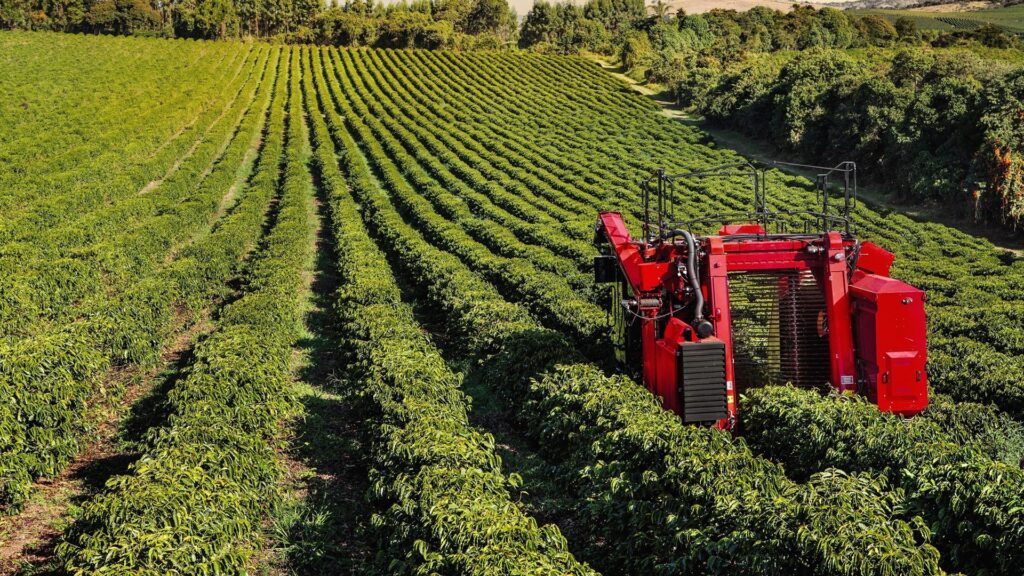
Machine harvesters remove coffee cherries through controlled mechanical vibration or contact with harvesting components. The objective is to detach ripe cherries from branches while minimizing damage to the coffee plant and reducing the collection of unwanted material.
Most commercial coffee harvesters operate by:
- Straddling coffee rows.
- Using vibrating rods, fingers, or beaters to shake branches.
- Detaching cherries through inertial forces.
- Collecting detached cherries using conveyor systems.
- Transporting harvested material into storage bins or trailers.
The efficiency of the process depends on the force applied, cherry maturity, branch flexibility, and machine settings.
Types of Machine Harvesting Systems
Over-the-Row Harvesters
Over-the-row harvesters are self-propelled machines that travel directly over coffee rows. Vibrating mechanisms positioned on both sides of the machine detach cherries while collection systems gather the fruit.
These harvesters are widely used in Brazil and are considered the dominant form of mechanical coffee harvesting.
Side-Mounted Harvesters
Side-mounted harvesters operate alongside coffee rows and remove cherries through mechanical contact or vibration. They are often attached to tractors and may be used in plantations where full over-the-row operation is impractical.
Portable Mechanical Harvesters
Portable harvesters are handheld or backpack-mounted devices that generate vibration to assist workers in detaching cherries. Although partially mechanized, they still require manual collection and are generally classified as intermediate technologies between manual and fully mechanized harvesting.
Harvesting Approaches
Machine harvesting may be conducted using different operational strategies depending on production objectives.
Single-Pass Harvesting
A single-pass harvest removes the majority of cherries during one operation. This approach maximizes efficiency but often collects cherries at multiple stages of maturity.
Multiple-Pass Harvesting
In multiple-pass systems, machines make repeated passes through the plantation over several weeks. Earlier passes target predominantly ripe cherries, while later passes collect remaining fruit. This approach can improve harvested cherry uniformity but increases operational costs.
Selective Mechanical Harvesting
Modern harvesting systems may be adjusted to reduce vibration intensity and improve the selective removal of ripe cherries. Such systems attempt to combine the efficiency of mechanization with improved quality outcomes.
Agronomic Requirements
Successful machine harvesting generally requires specific plantation characteristics.
Terrain
Mechanized harvesting is most effective on relatively flat or gently sloping land. Steep mountainous terrain can limit machine access and increase operational risks.
Row Configuration
Coffee rows are typically designed to accommodate machinery movement. Uniform row spacing and consistent plant architecture facilitate harvesting efficiency.
Plant Structure
Cultivars intended for mechanized harvesting often exhibit:
- Uniform growth habits.
- Strong branch architecture.
- Suitable plant height.
- Concentrated fruit maturation patterns.
Field Accessibility
Adequate road infrastructure and maneuvering space are necessary for transporting machinery and harvested coffee.
Advantages of Machine Harvesting
Machine harvesting offers several advantages in commercial coffee production.
Increased Harvesting Speed
Mechanical systems can harvest large areas in significantly less time than manual labor.
Reduced Labor Dependence
Mechanization decreases reliance on seasonal labor forces, which may be scarce or costly in some producing regions.
Lower Long-Term Costs
Although machinery requires substantial capital investment, operational costs per unit of harvested coffee may decline over time in large-scale production systems.
Timely Harvest Completion
Rapid harvesting allows producers to collect coffee within optimal harvest windows and reduce losses associated with delayed picking.
Scalability
Machine harvesting enables efficient management of extensive coffee plantations that would otherwise require large labor forces.
Disadvantages of Machine Harvesting
Despite its benefits, machine harvesting has several limitations.
Reduced Selectivity
Machines often harvest ripe, underripe, and overripe cherries simultaneously, potentially affecting coffee quality.
High Initial Investment
The acquisition and maintenance of harvesting equipment require significant capital expenditure.
Terrain Restrictions
Many coffee-growing regions characterized by steep slopes and fragmented farms are unsuitable for large harvesting machinery.
Plant Damage
Improper machine settings or repeated harvesting operations may cause branch breakage, leaf loss, or stress to coffee plants.
Post-Harvest Sorting Requirements
Mixed-maturity harvests frequently necessitate additional sorting and processing to separate cherries according to quality standards.
Effects on Coffee Quality
The influence of machine harvesting on coffee quality depends on harvest management, cultivar characteristics, and post-harvest processing practices.
Historically, machine harvesting was associated with lower selectivity and greater variability in cherry maturity. However, advances in harvesting technology, precision agriculture, and post-harvest sorting systems have improved quality outcomes.
In many large-scale coffee-producing regions, machine-harvested coffees are capable of achieving specialty-grade quality when accompanied by:
- Appropriate harvest timing.
- Multiple harvesting passes.
- Density sorting.
- Optical sorting technologies.
- Careful post-harvest processing.
Quality differences are therefore influenced not only by the harvesting method itself but also by the broader production and processing system.
Geographic Distribution
Machine harvesting is most prevalent in coffee-producing regions characterized by large farms, suitable topography, and advanced agricultural infrastructure.
Major areas of adoption include:
- Brazil
- Australia
- United States (limited use)
- Selected regions of Colombia
- Selected regions of Costa Rica
Adoption remains comparatively limited in many mountainous coffee-producing nations where terrain favors manual harvesting methods.
Comparison with Other Harvesting Methods
| Characteristic | Machine Harvesting | Strip Picking | Selective Picking |
| Labor Requirement | Low | Moderate | High |
| Harvest Speed | High | Moderate | Low |
| Selectivity | Low to Moderate | Low | High |
| Equipment Cost | High | Low | Low |
| Suitability for Steep Terrain | Poor | Good | Excellent |
| Potential Quality Control | Moderate | Moderate | High |
| Scalability | High | Moderate | Limited by labor availability |
Significance
Machine harvesting represents one of the most important technological developments in modern coffee agriculture. It has enabled large-scale producers to increase efficiency, address labor constraints, and improve harvest logistics while supporting the expansion of industrialized coffee production systems.
Although manual harvesting remains essential in many coffee-growing regions, particularly those characterized by mountainous terrain and specialty coffee production, machine harvesting continues to play a central role in the global coffee industry and is expected to remain a key component of coffee production where environmental and economic conditions support mechanization.
References
- Wintgens, J. N. (Ed.). Coffee: Growing, Processing, Sustainable Production. Wiley-VCH.
- International Coffee Organization (ICO). Coffee Production and Processing Resources.
- DaMatta, F. M., Ronchi, C. P., Maestri, M., & Barros, R. S. “Ecophysiology of Coffee Growth and Production.” Brazilian Journal of Plant Physiology.
- Matiello, J. B., Santinato, R., Garcia, A. W. R., Almeida, S. R., & Fernandes, D. R. Cultura de Café no Brasil: Novo Manual de Recomendações.
- Food and Agriculture Organization of the United Nations (FAO). Mechanization of Agricultural Production Systems.
- Empresa Brasileira de Pesquisa Agropecuária (EMBRAPA). Publications on Coffee Mechanization and Harvesting Systems.
- International Trade Centre (ITC). The Coffee Guide.
- Illy, A., & Viani, R. Espresso Coffee: The Science of Quality.
- Clarke, R. J., & Vitzthum, O. G. Coffee: Recent Developments.
- Brazilian Agricultural Research Corporation (EMBRAPA Café). Research reports on mechanical coffee harvesting technologies.